US and Allies Sign AI Supply Chain Pact to Counter China
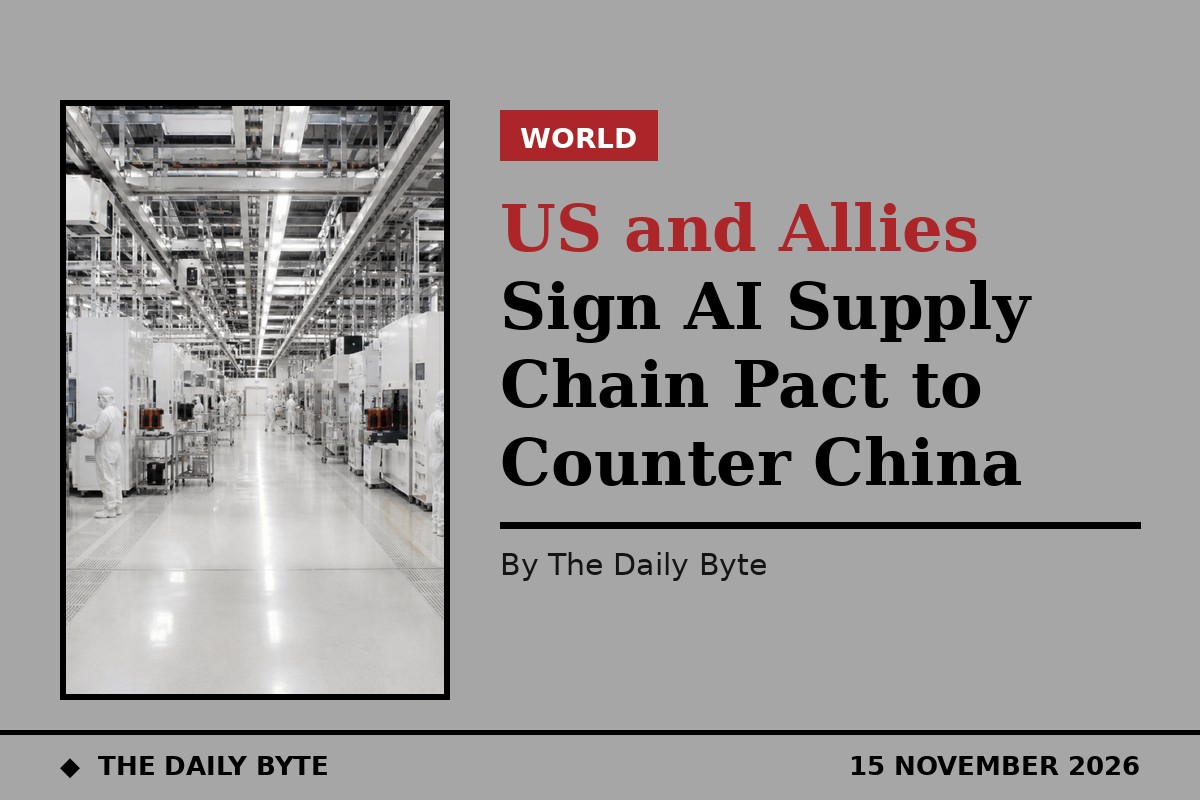
The United States and eight partner countries have signed a declaration aimed at securing the technologies, materials and infrastructure needed to develop artificial intelligence, in a move designed to reduce strategic dependence on China.
The agreement, the San Francisco Declaration on the Secure Foundations of Enduring Prosperity, was signed in San Francisco on Sunday, 15 November. The signatories are the United States, Japan, Australia, Israel, the United Kingdom, South Korea, India, Qatar and the United Arab Emirates.
The declaration expands Pax Silica, the US-led initiative launched in 2025 to strengthen supply chains for the semiconductors and critical minerals that underpin AI. It commits the nine countries to identify the sensitive technologies and critical infrastructure that need particular protection, and to coordinate measures to improve supply security.
A joint list of technologies to protect
At the heart of the declaration is an agreement to build a joint list of AI technologies and supply chains that require greater protection. The work covers semiconductor manufacturing and supply, critical minerals, energy and industrial capacity, with the signatories also aiming to develop new industrial and investment hubs linked to artificial intelligence.
Jacob Helberg, the US under-secretary of state for economic affairs, presented the declaration as the next stage of Pax Silica and negotiated the pact, according to the Financial Times, which first reported the signing.
The narrower nine-country group brings together the members whose cooperation matters most to making a protected-technologies list work in practice: countries with chipmaking capacity, frontier AI laboratories, or the Gulf capital to fund new industrial projects.
More signatories expected next week
Germany, Sweden, the Netherlands and the European Commission are expected to join the declaration in the week after 15 November, according to the Financial Times. They were not among the nine signatories announced on Sunday.
That distinction matters. The original Pax Silica declaration already lists 25 signatories, 24 countries plus the European Union, with Taiwan participating without signing. The San Francisco declaration is a smaller, more focused agreement among the nine, rather than a replacement for the wider initiative.
The European Commission was authorised by EU member states on 11 November to negotiate the joint declaration on economic security with the United States, as an addendum to the Pax Silica declaration approved in June.
Timing ahead of Trump-Xi meeting
The signing comes just days before US President Donald Trump is due to meet Chinese President Xi Jinping at the Asia-Pacific Economic Cooperation summit in Shenzhen, which opens on 18 November.
Washington has framed the initiative as a way to protect the procurement of silicon, critical minerals, energy and other key inputs for the semiconductor and AI industries from coercive dependencies and single points of failure.
The declaration itself is a statement of intent rather than a finished rulebook. Its real test will be whether the nine countries can agree on the joint list of protected technologies and turn it into coordinated investment, export and industrial policy in the months ahead.


