US and Allies Sign Pact to Protect AI Supply Chains
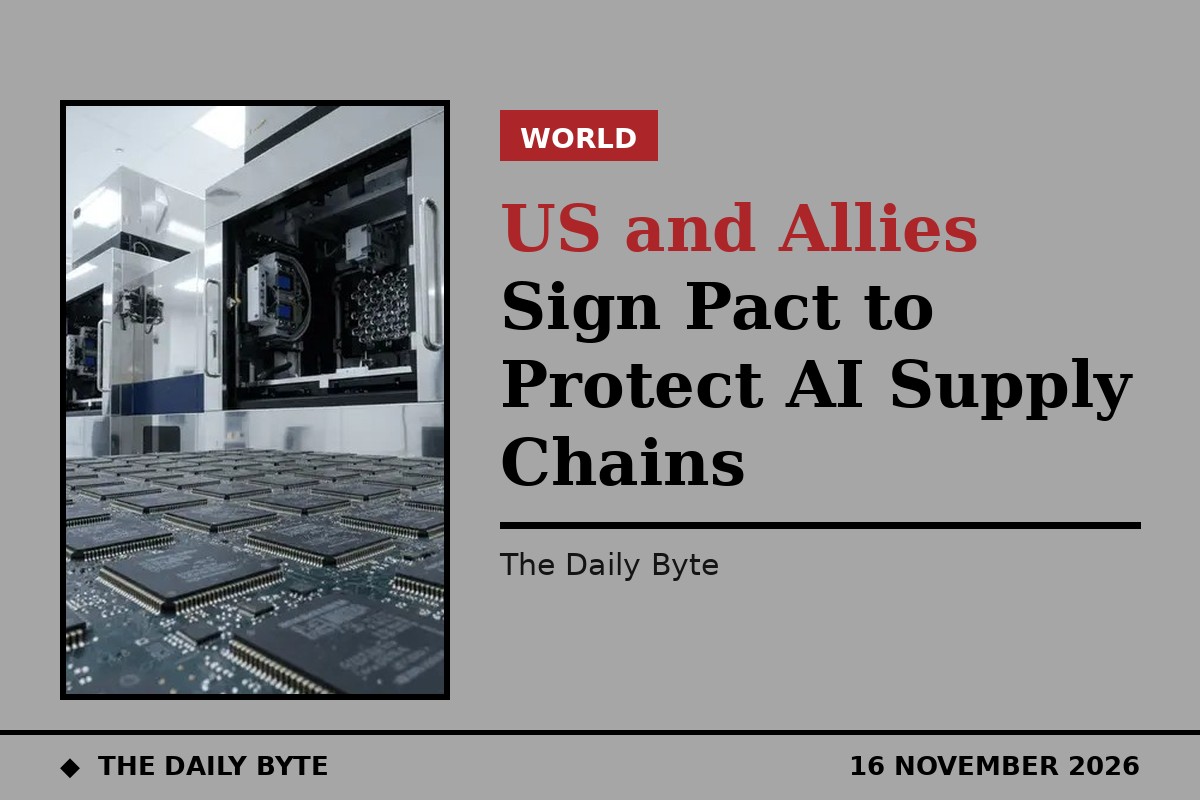
The United States and eight allies have signed a declaration to draw up a joint list of artificial intelligence technologies and supply chains that need protection, in the latest step of the US-led Pax Silica initiative.
The San Francisco Declaration on the Secure Foundations of Enduring Prosperity was signed on Sunday, according to the Financial Times. The signatories are the United States, Japan, Australia, Israel, the United Kingdom, South Korea, India, Qatar and the United Arab Emirates.
What the declaration covers
The agreement commits the partners to identify sensitive technologies and critical infrastructure needed to build advanced AI, and to coordinate measures to improve the security of those supply chains. It covers semiconductors, critical minerals, energy and industrial capacity, as Washington and its partners seek to reduce vulnerabilities and deepen cooperation amid growing competition with China.
US Under Secretary of State for Economic Affairs Jacob Helberg, who negotiated the pact, told the Financial Times: "What makes the San Francisco Declaration historic is that Pax Silica partners have agreed to treat the security of those technologies and the infrastructure behind them as a shared responsibility."
Germany, Sweden, the Netherlands and the European Commission are expected to sign the declaration next week, according to the Financial Times reporting.
Part of the wider Pax Silica effort
The declaration expands Pax Silica, the US State Department's flagship initiative on AI and supply-chain security, which was launched in December 2025. The original Pax Silica declaration has 25 signatories, comprising 24 countries plus the European Union, with Taiwan participating without signing.
The new declaration states that economic security is fundamental to national security, and calls for stronger protections against the theft or unauthorised transfer of technologies that could provide military or intelligence advantages to hostile actors.
Text not yet published
One caution is in order. As of Sunday evening, the State Department had not published the declaration's text, so the details reported so far rest on Helberg's briefing to the Financial Times and the outlets carrying it. The text, when it appears, will show whether the joint list carries enforcement measures such as export controls and investment screening, or remains a statement of intent.
Why the list matters
The promise of a joint list is the most concrete element of the declaration. Rather than each country deciding on its own which technologies deserve protection, the nine signatories aim to agree together on the items that matter most, from the semiconductors at the heart of AI systems to the critical minerals, energy supplies and industrial capacity needed to build them.
The approach reflects a shared concern that the supply chains behind AI are concentrated in a small number of places, and that theft or unauthorised transfer of sensitive technology could hand military or intelligence advantages to hostile actors. The declaration frames economic security as fundamental to national security, a line Helberg has used to describe the initiative since its launch.
Timing ahead of the Trump-Xi meeting
The agreement comes ahead of President Donald Trump's planned meeting with Chinese President Xi Jinping at the Asia-Pacific Economic Cooperation summit in Shenzhen this week. The timing is unlikely to be a coincidence: the declaration signals to Beijing that Washington and its partners intend to coordinate their approach to AI supply chains, even as the two leaders prepare to meet.
Whether the declaration has lasting effect will depend on what follows. Germany, Sweden, the Netherlands and the European Commission are expected to join next week, which would widen the group further. The real test, however, will be whether the joint list is followed by coordinated action, and whether the partners can agree on measures strong enough to change how AI technology and its supply chains are protected.
Sources: Newsmax, reporting the Financial Times and TradingView.


