US Approved 879,000 AI Chips for China Firms
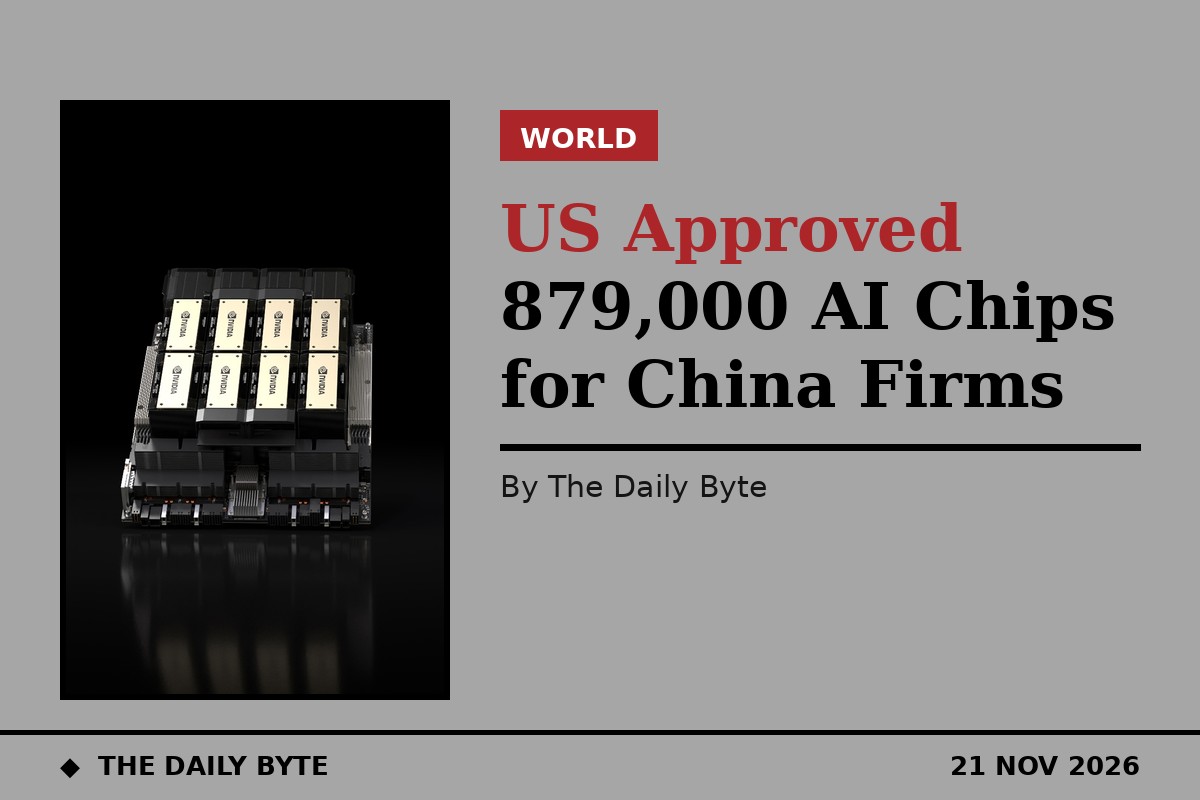
The United States approved licences for 879,000 advanced artificial intelligence chips for Chinese companies over a six-month period, according to licensing records released by the House Foreign Affairs Committee on Thursday. The approvals covered Nvidia's H200 and AMD's MI325X processors, two of the most powerful AI chips on the market, and went to firms the Pentagon lists as alleged Chinese military-backed companies.
The records, released by the committee's chairman, Brian Mast, show that the Commerce Department's Bureau of Industry and Security approved the sales from December 2025 through May 2026, out of applications covering more than 3.4 million chips. Export licensing records are normally confidential, but Mast used his authority under the Export Control Reform Act to make them public. The approvals included 150,000 chips for Tencent, 75,000 for Alibaba, 43,000 for Baidu and 4,000 for the carmaker BYD.
Who received the chips
All four of the named recipients appear on the US Department of Defense's list of alleged Chinese military-backed companies. Tencent has been on the list since January 2025, while Alibaba, Baidu and BYD were added in June 2026. The H200 and MI325X are used to train and run large AI models, and their export has been restricted as part of Washington's effort to slow China's development of advanced AI.
The approvals have raised questions about how closely the licences were examined. Chris McGuire, a senior fellow at the Council on Foreign Relations who previously worked on technology and national security at the White House, said the approvals raise doubts about "whether Commerce conducted any serious national security review before approving these licenses".
Not every request was granted. The Bureau of Industry and Security refused to authorise some of Nvidia's largest proposed deals, including applications to sell 610,000 chips to Alibaba and 508,000 to ByteDance, the owner of TikTok. Mast also claimed that some of Nvidia's applications were attempts to sell chips through suspected smuggling fronts, and the New York Times reported that some of the entities named are linked to Megaspeed, a company US officials accuse of diverting chips to China. According to documents shared by Mast, every Nvidia and AMD application stated that the proposed transfer posed a "low" risk of diversion.
Tighter rules follow the disclosure
The Commerce Department announced new export control rules on Monday, and they took effect on Thursday. The rules require a US export licence when Chinese companies contract foreign semiconductor manufacturers, such as South Korea's Samsung Electronics and Taiwan's TSMC, to produce advanced chips for them. They also restrict Chinese companies from remotely accessing advanced AI chips housed in data centres overseas, closing a route some firms had used after direct imports were blocked.
The tighter rules are already being felt. Tencent said on Wednesday that the new ban will reduce the quantity of advanced computing capacity available to the company and slow its efforts to train AI models. Alibaba's chief executive, Eddie Wu, said on the company's earnings call on Thursday that the policy "will definitely have some impact on the long-term construction of Alibaba Cloud's data centres both domestically and globally", adding that its long-term target of 20 gigawatts of capacity may be lowered, along with its capital spending plan.
Chinese AI company Moonshot AI has cancelled a 150 million dollar contract to lease Nvidia Blackwell Ultra B300 chips installed at a data centre in Indonesia, according to The Information, and has suspended talks on other new deals. Both Tencent and Alibaba have said they expect Chinese chipmakers to be producing advanced AI hardware at scale in 2027 or 2028, which would reduce their dependence on imported chips.
One important caveat remains: it is unclear how many of the 879,000 approved chips were actually shipped. The Register reported that many of the approved orders never resulted in shipments, probably because Beijing must also approve imports and chose not to do so while its own chipmakers develop improved products.


