US approved 879,000 Nvidia AI chips for China sale
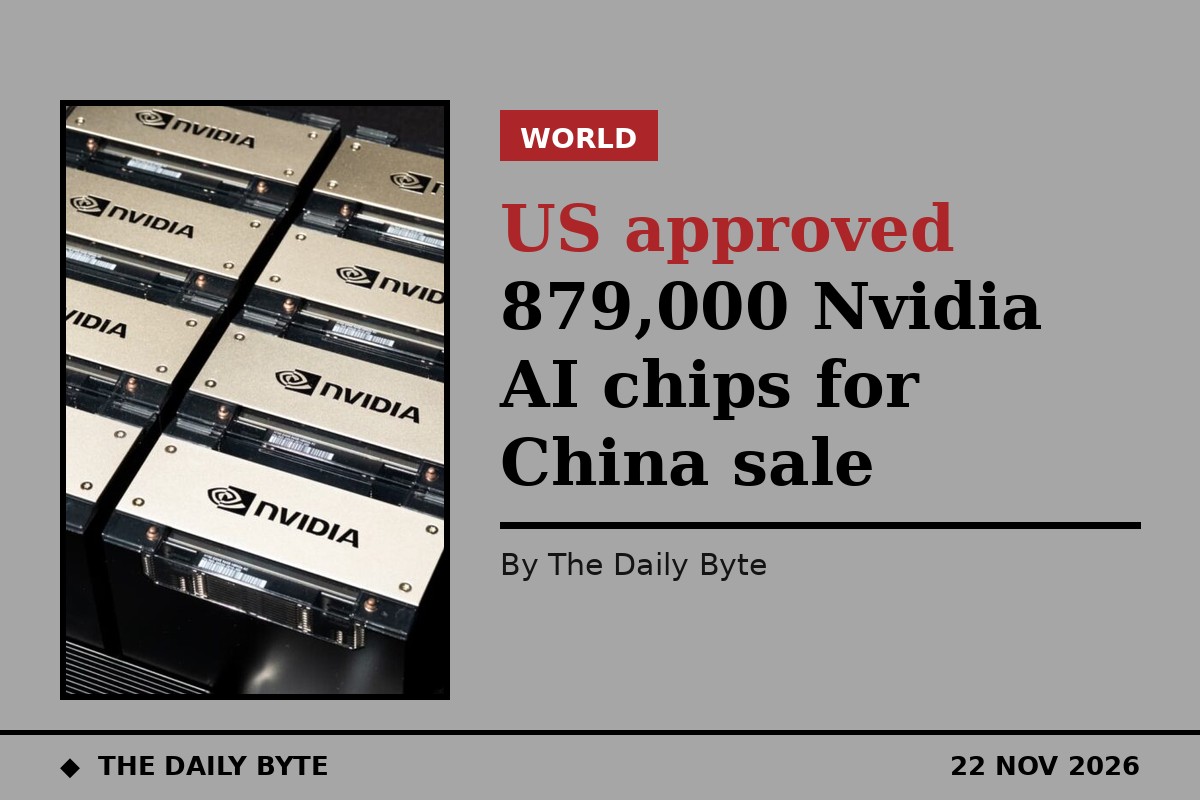
The United States approved the sale of 879,000 advanced artificial intelligence chips to Chinese companies between December 2025 and May 2026, according to documents released by the House Foreign Affairs Committee on 19 November 2026. The approvals covered chips made by Nvidia and AMD, and included companies on the Pentagon's list of alleged Chinese military-backed companies.
Committee chair Brian Mast, a Republican from Florida, released the licensing data under the Export Control Reform Act. He described it as the most detailed public disclosure in the history of the act. Companies had sought permission to ship about 3.4 million chips over the same period, so the approvals covered roughly a quarter of the requests.
Who received the approvals
The approvals included 150,000 chips for Tencent, 75,000 for Alibaba, 43,000 for Baidu and 4,000 for the electric vehicle maker BYD, according to the committee. All four are on the Pentagon's list of alleged Chinese military companies. The chips included Nvidia's H200 and AMD's MI325X, both high-performance processors used to train and run AI systems.
The Commerce Department's Bureau of Industry and Security handled the licences. The Commerce Department said its approach to H200 licensing was based on a rule published in the Federal Register in January 2026, which imposed significant additional national security requirements on applicants seeking case-by-case consideration rather than a presumption of denial.
Approval does not mean delivery
The documents list approvals, not shipments, and it is not yet clear how many of the approved chips were actually sent to China. Some licence rows were marked approved but not shipped. Nvidia said its approvals were subject to strict conditions and limited volumes, and added that it had since stopped shipping H200 chips to China. Both Nvidia and AMD said they complied with United States export control regulations.
The disclosure has renewed debate in Washington about whether export controls on advanced semiconductors are working as intended. Supporters of the controls argue that cutting off access to the most powerful chips slows China's military AI development. Critics of the current approach say the approvals show the system is too permissive, while industry groups warn that overly broad restrictions can push Chinese buyers towards domestic suppliers.
What happens next
The committee's release came ahead of planned congressional questioning of former Nvidia chief executive Jensen Huang, with further scrutiny expected in the coming weeks. Lawmakers are also examining related questions, including whether chips reached China through intermediaries and whether the licensing process gave enough weight to national security concerns.
For now, the figures give the clearest public picture yet of the scale of approved AI chip sales to China in the first half of 2026. The central question for policymakers is no longer only how many chips were requested, but how many were actually delivered, how they were used, and whether the licensing rules need to change.


