US backs Colombia return to aerial coca spraying
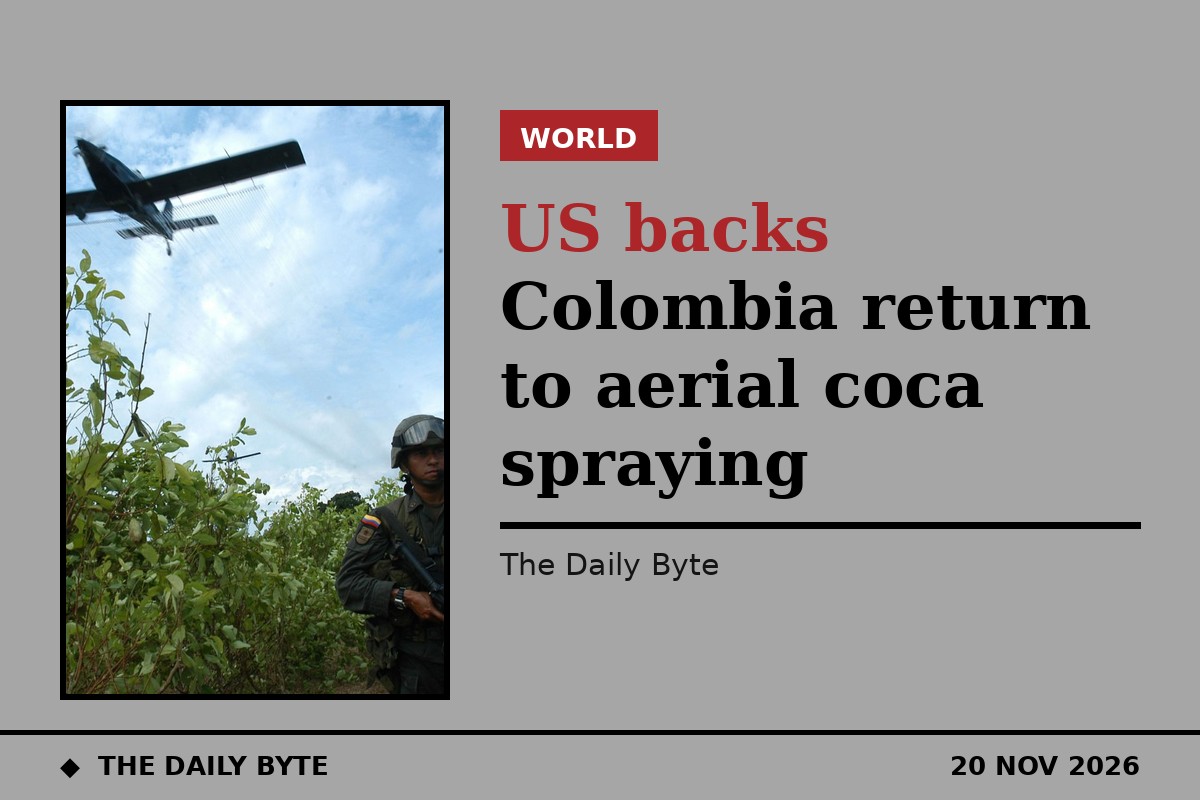
The United States has expressed support for Colombia’s plans to resume aerial spraying of coca crops, defending the controversial strategy despite warnings from American lawmakers about the risks to human health and the Amazon rainforest.
In a letter to lawmakers seen by The Associated Press, the State Department said it supported Colombia’s renewed efforts to combat drug trafficking, including the proposed return to aerial eradication after an 11-year hiatus. The department was responding to a letter sent on 29 October to Secretary of State Marco Rubio by 19 Democratic lawmakers led by U.S. Rep. Mark Pocan of Wisconsin.
The Associated Press confirmed on Thursday that two of the signatories had received the department’s response, dated 18 November. The other signatories included Reps. Alexandria Ocasio-Cortez of New York, Rashida Tlaib of Michigan, Jim McGovern of Massachusetts and Pramila Jayapal of Washington.
A strategy suspended since 2015
The decades-old U.S.-backed strategy was suspended in 2015 after concerns about the health effects of glyphosate, the herbicide previously used to destroy coca crops, the raw material for cocaine. The World Health Organization’s cancer research agency had classified glyphosate as probably carcinogenic to humans.
President Abelardo de la Espriella’s government now plans to test aerial spraying on up to 1,000 hectares (2,471 acres) of coca crops in Putumayo, an Amazonian department bordering Ecuador and Peru. The pilot would use glufosinate ammonium instead of glyphosate. That herbicide has also faced scrutiny over potential health risks and is no longer approved for use in the European Union.
Colombia is preparing a short-term pilot programme to assess the viability of aerial eradication, the State Department’s letter said. Colombia would provide the personnel, aircraft fuel and herbicide needed for the operations, and would be responsible for selecting the herbicide in accordance with its own laws and regulatory procedures. Pocan said the response also indicated that Washington planned to provide technical assistance and aircraft for the pilot.
Courts and conditions still to clear
The pilot cannot start yet. A court in Putumayo temporarily halted it in September, finding that the government had not demonstrated compliance with the strict conditions set by Colombia’s Constitutional Court, including safeguards for human health and the environment and consultation with affected communities. A regional court kept the pilot on hold on 3 November, citing unresolved questions about the herbicide’s effects on health and the environment, and gave the plaintiffs four months to file a separate lawsuit.
Colombia’s environmental regulator opened a review of an environmental impact study by police on 4 November. The pilot still requires the regulator’s approval of an environmental management plan and a formal opinion on the potential health risks from Colombia’s National Institute of Health.
Supporters argue that aerial spraying offers a faster and safer alternative to sending security forces into remote areas controlled by armed groups, where coca fields can be protected by land mines and other threats. Critics say spraying can damage legal crops, threaten rural communities and push farmers deeper into the rainforest, accelerating deforestation.
The argument on both sides
The State Department said aerial spraying, alongside manual eradication and drug interdiction, offered significant potential to reduce coca cultivation and cocaine production. It said the Trump administration welcomed Colombia’s increased efforts to reduce cocaine production, which it said had reached record levels following the previous government’s failed counternarcotics policies.
“We expect Colombia to lead these efforts and demonstrate results, with the United States prepared to support its chosen approach,” the department said in response to questions from the AP.
Colombia remains the world’s largest cocaine producer, with coca cultivation reaching a record 261,000 hectares in 2024, according to the latest available United Nations figures.
Pocan criticised the response. “Aerial fumigation was not effective in the past at reducing coca cultivation over the long-term, and the hazards to human health and the environment are too significant to justify restarting the program,” he told AP. “I will continue to oppose this harmful program.”
Andrew Miller, advocacy director at Amazon Watch, an environmental organisation that works with Indigenous communities, warned that the programme could undermine cooperation with local people. “This obsolete fumigation program is likely to alienate the very Amazonian communities the Colombian government should be coordinating with,” he said.
The State Department’s response comes as Colombia and the United States discuss expanding security cooperation against drug trafficking. Colombian Foreign Minister Omar Bula said on Wednesday that the government would seek congressional approval for potential joint military operations with Washington, following talks with U.S. Defense Secretary Pete Hegseth in Bogota. Colombia’s presidency and Environment Ministry did not reply to requests to comment.
Sources: Associated Press; Associated Press, 29 October 2026.


