US, China, Russia Agree to Boost Fuel Supply
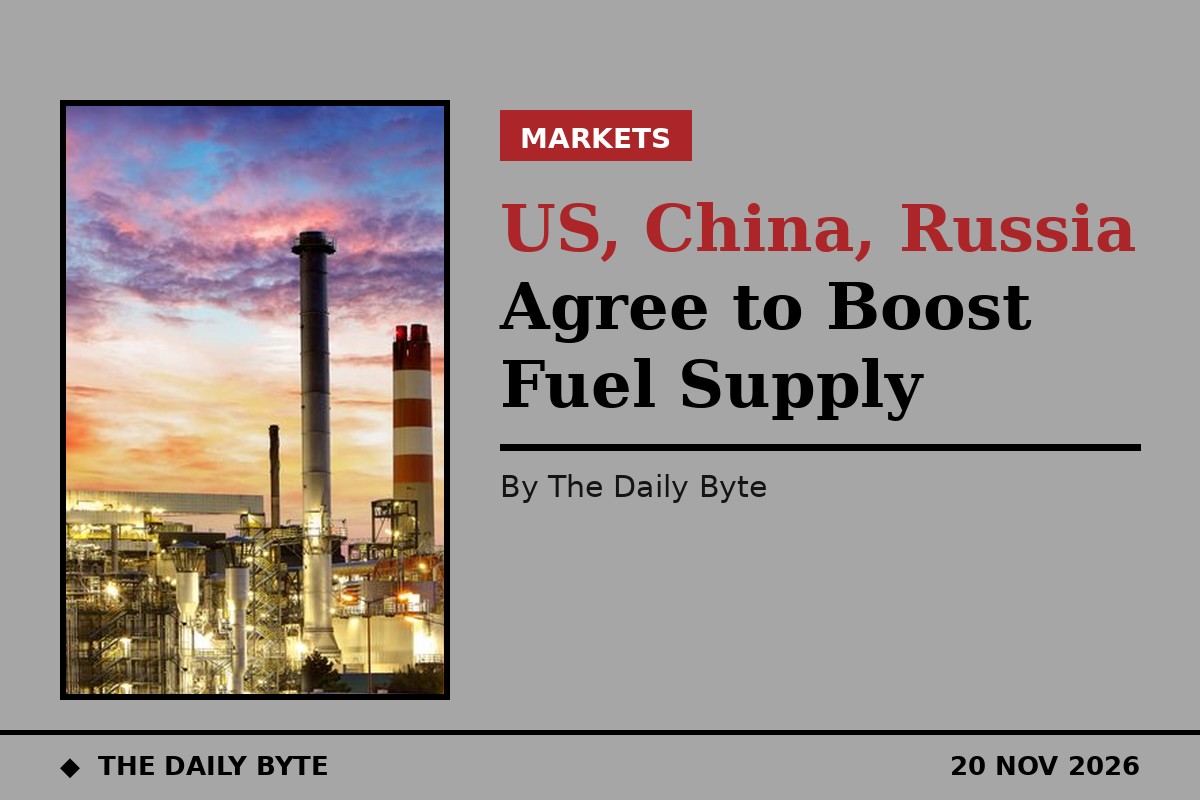
The leaders of the United States, China and Russia have agreed to try to increase the world’s supply of refined fuels, in a joint pledge issued after an unprecedented three-way meeting in Shenzhen on Thursday 19 November 2026. President Xi Jinping hosted Presidents Donald Trump and Vladimir Putin for talks lasting about an hour and a half on the sidelines of the Asia-Pacific Economic Cooperation summit, and the three issued a joint statement saying they “plan to increase the production and supply of refined petroleum products for the benefit of all nations” and reaffirmed the importance of stable energy flows.
Fuel markets have been under strain for months: supplies of products such as diesel have tightened and prices have surged as the wars in Ukraine and Iran disrupted refining and shipping. The three countries are among the world’s refining giants: the United States and Russia are two of the largest oil producers, while China is the world’s biggest crude importer. But the statement gave no volumes, no timetable and no detail on how any increase would be delivered, and traders reacted with a shrug.
What the three leaders actually agreed
The joint statement covered far more than fuel. The three leaders also agreed to reform the United Nations, curtail the International Criminal Court and avoid nuclear war, and said a nuclear war “cannot be won and must never be fought”. Xi called the gathering of “groundbreaking” significance, while Trump said at the start of the meeting: “We are really making history.” Putin said the group should discuss food and energy security, noting costs had soared because of trade disruption from the Ukraine war and Trump’s February 2026 attacks on Iran, according to Rigzone.
On fuel, the wording was short: no volumes, no timetable, no detail on who would do what.
Markets barely moved
Oil traders took the pledge in their stride. Brent crude traded at about $92.62 a barrel in London on Thursday, little changed from where it closed on Wednesday, and slipped to as low as $91.21 during the session. The premium diesel commands over crude, a key measure of market strength, fell as much as $2.84 a barrel and stood at $58.55 at 12:35 p.m., according to data from ICE Futures Europe. By 06:09 UTC on Friday 20 November, Brent’s front-month contract was $92.15 a barrel, down 0.55%, and West Texas Intermediate was $83.48, down 0.29%.
European gasoil prices fell 1.5% on the news, while crude prices barely moved, Rystad Energy said in an update sent to Rigzone late on Thursday. “The market reaction to the news from the trilateral summit in Shenzhen, China, was modest,” said Jorge Leon, Rystad’s head of geopolitical analysis.
Why analysts doubt quick relief
The scepticism comes down to capacity. In the United States, crude processing rates are already the highest for the time of year in three decades. “We’re at 96% right now,” Joe DeLaura, senior energy strategist at Rabobank, told Marketplace. “We have no spare capacity. That’s why we can’t run any harder.” US Energy Information Administration figures, released on 18 November, showed American refineries processed 16.9 million barrels a day in the week ending 13 November, down 129,000 barrels a day, at 95.7% capacity utilisation.
Russia faces a different problem. Rystad estimates its refinery runs have slumped to around 3.5 million barrels a day in November, from 4.3 million in October and 5.0 million a year ago, as Ukrainian drone strikes forced operators to cut throughput. Abhi Rajendran, director of oil markets research at Energy Intelligence, said raising Russian fuel exports would require the attacks on its refining system to stop and damaged plants to be repaired and brought back on line, a process that takes time.
China has the most room to act. Erica Downs of Columbia University told Marketplace that China is the only country in the world with substantial spare refining capacity. But Beijing’s refining system is geared towards the domestic market, and Rystad expects China to keep product exports around September-October levels. China’s crude imports fell from 12.4 million barrels a day in February to 7 million in June, and by September its stocks stood at about 1.14 billion barrels, roughly 180 million barrels below their March peak.
“The declaration gives no volume target or timetable, leaving each government to decide how much it can deliver,” Leon said. DeLaura was blunter: at a time of high prices, words of cooperation sound good, but “there’s no ‘there,’ there”.
What happens next depends on whether the three governments publish volumes or timing, whether China raises imports and exports, and whether strikes on Russian refineries ease. Until then, the pledge remains a statement of intent, not extra fuel.