US chip curbs hit Southeast Asia data centres
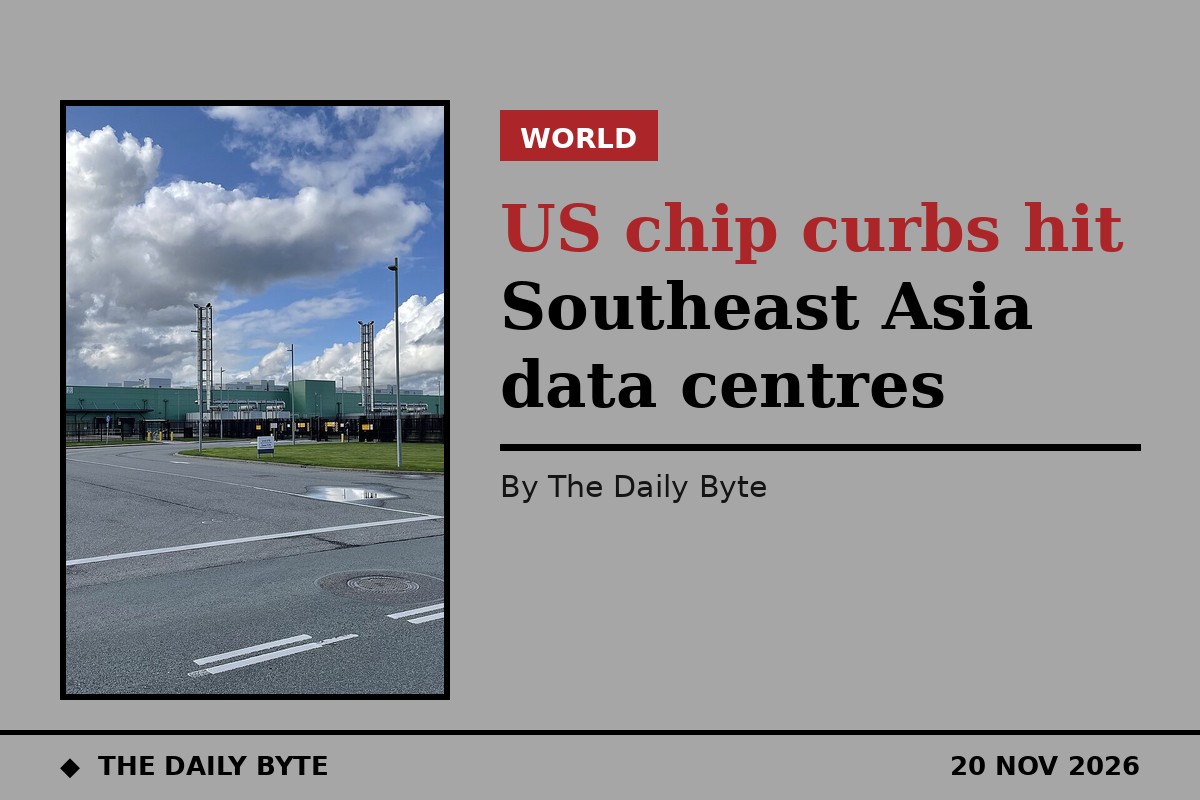
Southeast Asia's fast-growing data centre industry faces greater regulatory scrutiny and investment uncertainty after new United States restrictions on advanced artificial intelligence chips took effect on 19 November 2026. The rules extend American export controls beyond the physical shipment of chips to cover who is allowed to use the computing power those chips provide,
The US Commerce Department's Bureau of Industry and Security released the interim final rule on 16 November. It requires licences for shipments of specified advanced semiconductors to five countries identified as carrying a higher-than-normal risk of diversion: Indonesia, Malaysia, Singapore, Thailand and Brazil. Separately, data centres outside the US that provide more than 12 million aggregate total processing performance of computing capacity to companies headquartered in mainland China, Macau or other restricted destinations will also require US licences, according to analysis by BMI.
A threshold of about 750 advanced chips
The 12 million processing-performance threshold is estimated to be equivalent to roughly 750 Nvidia H100-class chips, with computing capacity aggregated across linked data centre sites. The measures are intended to close loopholes that allow companies in restricted countries to access advanced US computing technology through overseas data centres without physically importing the chips into their home markets.
BMI, a unit of Fitch Solutions, said chip and server suppliers, including Nvidia and Advanced Micro Devices, would face the most immediate compliance obligations. They will need licences for shipments of specified advanced chips to the five designated countries, unless the transactions qualify for an exemption involving US-headquartered customers and the required monthly reporting. Suppliers must also obtain information from data centre operators about the identity and ownership of their tenants, including customers accessing computing capacity through their facilities.
Existing data centre operators supplying computing capacity above the threshold to Chinese-headquartered customers will have 90 days from the rule's effective date to obtain the necessary licences. Assuming the ruling took effect on 19 November as scheduled, the compliance deadline falls on 17 February 2027. The Bureau of Industry and Security expects the new framework to generate about 100 additional licence applications a year, although approval rates remain uncertain because applications will be assessed case by case.
Malaysia tells operators to comply
Malaysia, which has emerged as a regional data centre hub, is among the countries most directly affected. Trade Minister Johari Abdul Ghani said on 18 November that the country's data centre operators should comply with the new US restrictions, Reuters reported. Malaysia has attracted nearly $100 billion in data centre investments since 2021, but analysts warn tighter scrutiny of AI chip deployment could slow growth in the sector.
"Malaysia remains open to investment, and the new US rules and regulation will give investors and partners clear direction when operating in Malaysia," Johari said. He added that Malaysia would seek clarification from US authorities on the restrictions, particularly on licensing and the provision of data centre services to third parties, and that Malaysia would inform all 117 approved data centre projects in the country to ensure compliance once the requirements were communicated.
Johari also said Malaysia had yet to receive evidence that data centre tenants in the country had traded or re-exported chips in violation of US rules. Malaysia is investigating the local unit of Singapore-based cloud computing firm Megaspeed, which faces a US probe into whether it was used to circumvent export controls on AI chips. Megaspeed, a customer of Nvidia, has denied the allegations, saying it takes its US compliance obligations extremely seriously.
A divide between US-linked and China-linked projects
BMI expects projects built around Chinese-based tenants to face the greatest exposure, while developments serving US technology companies are relatively better protected by the exemption provisions. The research house expects the requirements to influence how computing capacity is allocated in overseas data centres, with affected customers potentially shifting towards smaller, fragmented and more extensively documented computing arrangements rather than being shut out entirely. Computing capacity used solely for commercial recommender systems is excluded, provided the operator meets the relevant reporting requirements.
BMI also noted that licence decisions would take into account how effectively the five affected countries enforce export controls, potentially encouraging their governments to strengthen domestic rules. Singapore, for instance, has indicated it will explore trusted access arrangements for its companies. Looking ahead, BMI expects the substance of the restrictions to remain largely intact, although details could be revised after the consultation period, and it recommends businesses plan on full compliance by the February deadline, treating any regulatory relief as an upside rather than an expectation.
Sources: TNGlobal (BMI / Fitch Solutions) and Reuters.


