US Clears $128bn in Struck-Down Tariff Refunds
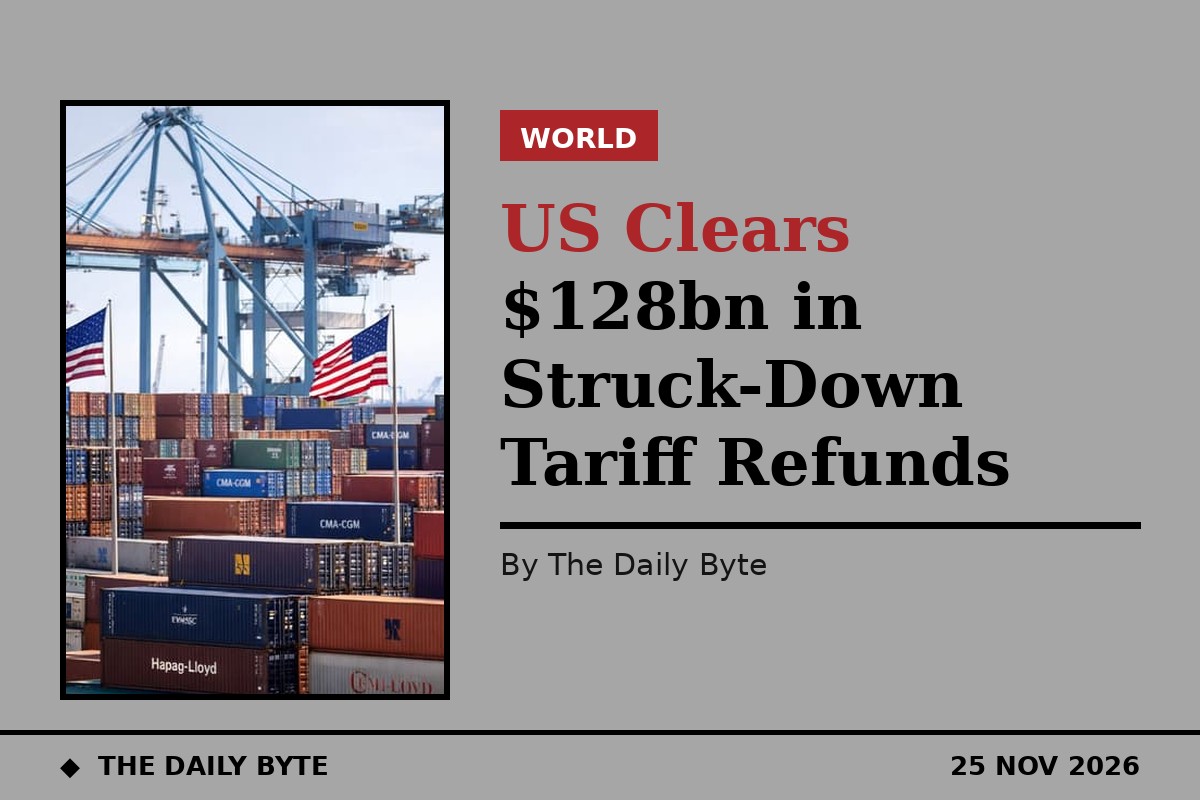
United States Customs and Border Protection has certified about $128.4 billion in refunds of the emergency tariffs struck down by the Supreme Court, and sent that money to the Treasury Department to be paid out. The figures come from a declaration by Brandon Lord, the agency's executive director for trade programmes, filed in the Court of International Trade on 10 November, with the numbers current as of noon Eastern time on 5 November.
The scale of the operation is vast. Customs said about $138.3 billion in potential and certified refunds had been accepted for processing through its online refund system, the Consolidated Administration and Processing of Entries, known as CAPE. Importers and customs brokers had submitted 321,021 declarations, of which 226,899 had passed file-level validation, and filings accepted for processing covered more than 16 million import entries.
The $737m stuck in the pipeline
Not all of the money can move yet. For 18,072 refunds worth roughly $737 million, Customs could name the exact hold-up: the importer had not supplied the bank account information needed for an electronic payment. Until that Automated Clearing House detail is on file, those refunds cannot be transmitted to the Treasury, however valid the underlying claim may be.
The gap between the $138.3 billion accepted and the $128.4 billion certified is about $9.9 billion, made up of claims still working through the system. The $128.4 billion figure combines the duties themselves with interest, while the estimated $166 billion originally collected under the emergency tariffs, cited in an October court opinion, is duty principal alone.
How the refunds arose
The refunds follow the Supreme Court's decision on 20 February 2026, when a 6-3 majority held that the International Emergency Economic Powers Act, a 1977 law known as IEEPA, did not authorise the president to impose tariffs. Chief Justice John Roberts wrote the majority opinion, joined by Justices Gorsuch and Barrett and the court's three liberal justices. Justices Thomas, Alito and Kavanaugh dissented. The ruling struck down the fentanyl-related tariffs on Canada, Mexico and China and the broader reciprocal duties imposed on what the administration called Liberation Day.
Customs opened the first phase of the CAPE refund portal in April. In October, Judge Richard Eaton of the Court of International Trade certified a class covering importers that paid the challenged duties on entries between 1 February 2025 and 19 February 2026 and had not separately sued to recover them. On 10 November the lead plaintiff in that case, Freestyle World, asked the court to order Customs to recalculate class members' bills without the unlawful duties.
Who is getting money, and who is waiting
Some large retailers have already booked refunds. Reporting based on the court filing says Target and Lowe's collected roughly $551 million in combined quarterly tariff refunds. For smaller importers, the picture is slower: many are still working through the portal, and some are waiting on the class action rather than suing individually.
On 13 November, Judge Eaton ruled that the start of the class action had paused the two-year statute of limitations for every class member, so importers that paid the tariffs and never sued no longer need to file their own case before the first deadlines run out in early February 2027. The government must respond to the request for class-wide relief by 9 December, and must file a short progress report on CAPE by 1 December, with a closed settlement conference to follow on 2 December.
The refund operation is running alongside a new tariff push by the administration under different legal authorities, including the Section 301 proposals announced on 25 November. The old duties are being unwound in court and through the refund portal at the same time as new ones are being designed, leaving importers to claim back money on one set of tariffs while preparing for the next.


