US Cuts Immigration Appeal Window to 10 Days
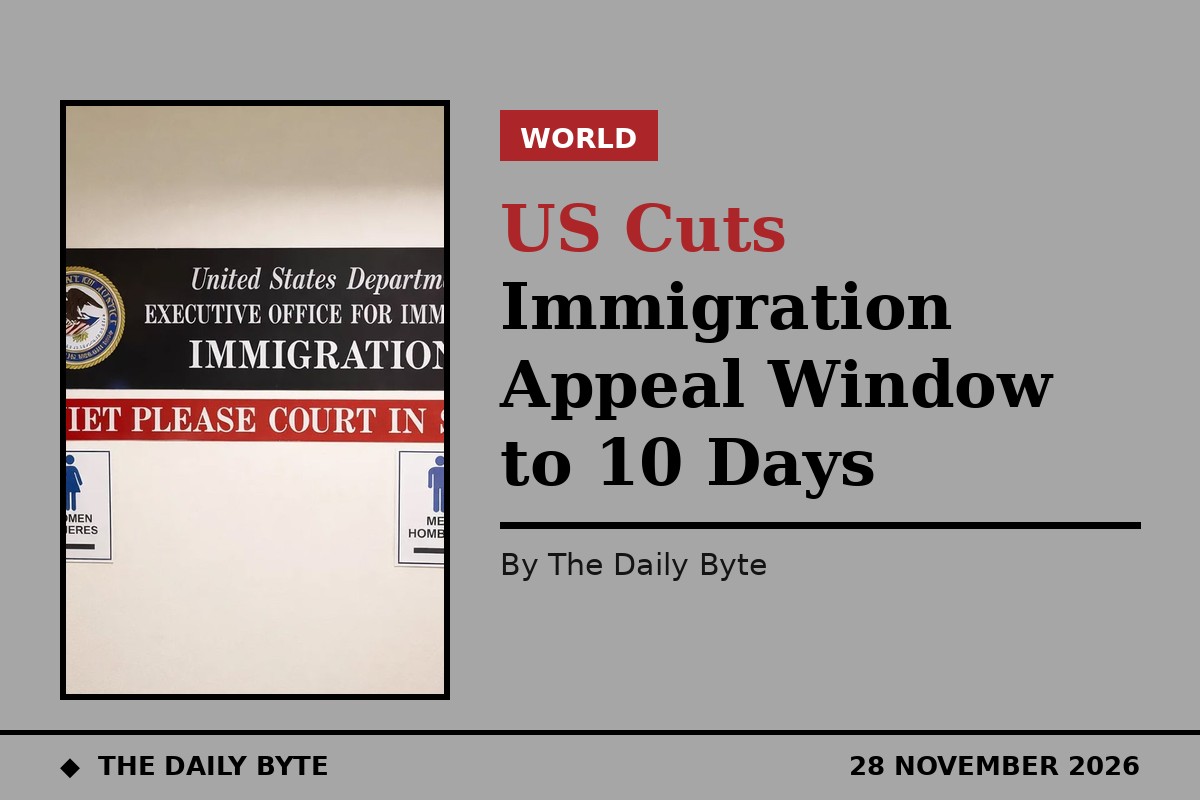
People ordered removed from the United States will soon have far less time to appeal. Under a final rule published by the Justice Department, the deadline to take an immigration judge's decision to the Board of Immigration Appeals will fall from 30 days to 10 in most cases, a change that takes effect on 17 December 2026.
The rule, titled Appellate Procedures for the Board of Immigration Appeals and published in the Federal Register on 17 November 2026 as 91 FR 73876, rewrites the timetable for one of the most consequential steps in the immigration system. An appeal must be filed on Form EOIR-26 and received by the Board within the deadline; the clock runs in calendar days, and the filing fee is $1,060, made up of a $110 Board fee and a $950 charge imposed by the One Big Beautiful Bill Act.
One exception survives
There is one significant exception. The 30-day window survives where an immigration judge decided an asylum application on its merits and did not deny it under the bars in section 208(a)(2)(A), (B) or (C) of the Immigration and Nationality Act. Every other appeal, including those involving other forms of relief and removal orders themselves, will be subject to the new 10-day limit.
The rule does more than shorten the clock. Summary dismissal by a single Board member within 15 days becomes the default outcome unless a majority of the Board's permanent members vote within 10 days to accept the case for full, en banc consideration. And any issue not raised in the Notice of Appeal itself will be treated as waived, which puts a premium on getting the initial filing right the first time, since there will be little room to add arguments later.
Why the government says it is needed
The Justice Department's stated reason is the size of the Board's backlog. The number of cases pending before the Board has grown from 35,837 in fiscal year 2017 to 325,774 in fiscal year 2026, a roughly ninefold increase in less than a decade. Officials argue that faster, more streamlined appellate review is needed to keep the system moving, and that the current timetable allows cases to linger for months or years after a judge has already ruled.
Immigration lawyers and advocacy groups see it differently. They warn that ten days is barely enough time to obtain a hearing transcript, consult a client who may be detained far from their lawyer, and prepare a reasoned appeal, particularly for people who do not speak English or who have no lawyer at all. The risk, they say, is that meritorious appeals will be lost not because they lack merit but because the paperwork could not be assembled in time, and that the summary dismissal procedure will compound that risk by deciding cases before a full panel has ever looked at them.
Second attempt after a court defeat
This is not the government's first attempt at the change. An interim final rule issued in February 2026 imposed similar measures, but a federal judge in Washington partially vacated three of its provisions on 8 March 2026 in Amica Center for Immigrant Rights v. EOIR, on the ground that the government had skipped the notice-and-comment process the law requires. The new final rule is the government's second attempt, issued after it received 1,615 public comments on the proposal.
The legal fight is not over. A hearing in the renewed litigation over the rule is scheduled for 14 December 2026, three days before the rule is due to take effect, so the courts may yet intervene before the 10-day deadline binds anyone. For now, though, the rule stands as published, and lawyers across the country are already advising clients and colleagues to treat every immigration court decision as if the appeal clock were about to shrink to ten days.


