US Deports Genocide Fugitive Teganya to Rwanda
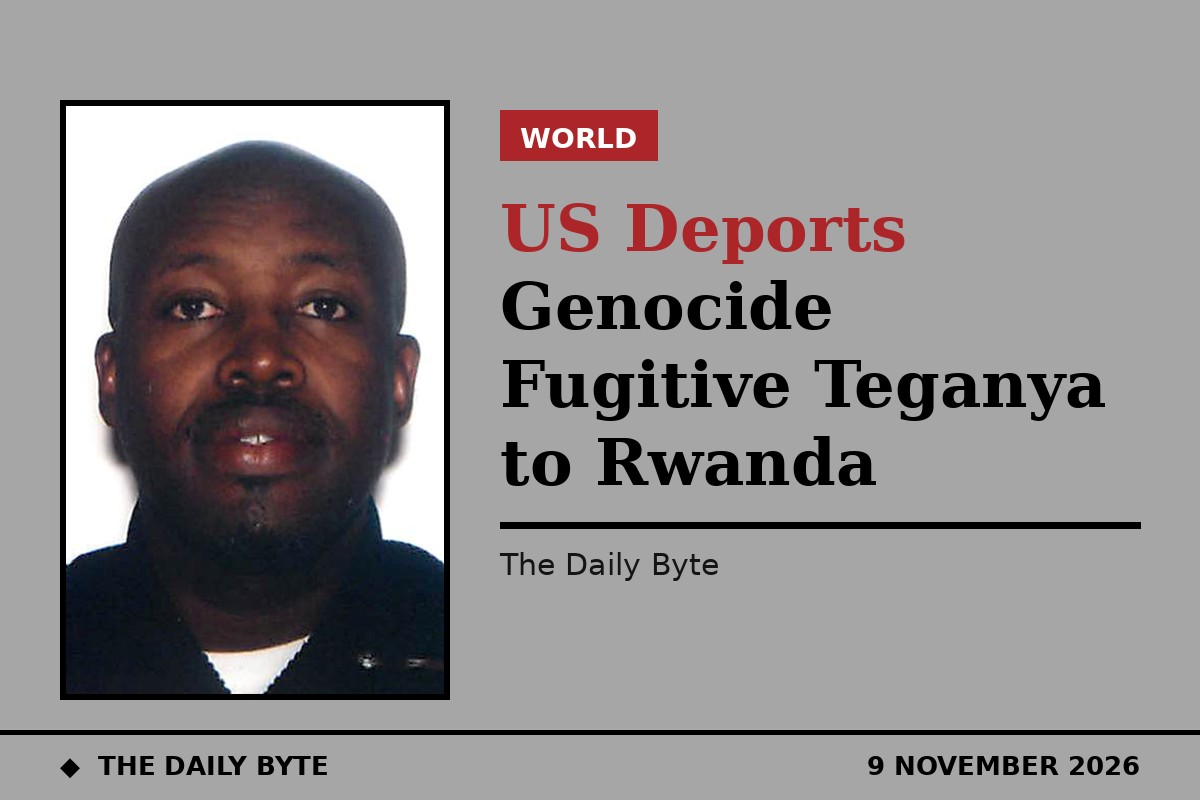
The United States has deported Jean Léonard Teganya, a Rwandan man wanted over alleged crimes during the 1994 Genocide against the Tutsi, back to Rwanda more than three decades after he fled the country.
Rwanda’s National Public Prosecution Authority said on Monday, 9 November 2026, that it had received Teganya following his deportation from the United States. His plane touched down at Kigali International Airport on Monday evening, several hours later than its scheduled morning arrival.
On the tarmac, Teganya was led from the chartered flight by police officers and placed in a waiting detention van. He is now in the custody of the Rwandan authorities, who say he will face the judicial process over crimes allegedly committed in Butare, in southern Rwanda.
Indicted since 2014
Teganya was indicted by Rwanda’s prosecution authority in 2014 over his alleged involvement in genocide and crimes against humanity committed in Butare, now part of Huye District in Southern Province.
He has never been tried in Rwanda for those allegations. The prosecution authority has not yet announced the charges that will formally be presented in court, or when he will first appear before a judge.
Prosecutors allege that Teganya, then a third-year medical student at the National University of Rwanda in Butare and an intern at the University Hospital of Butare, led soldiers and members of the Interahamwe militia around the hospital looking for Tutsi patients and refugees who were hiding there.
According to evidence presented during his later trial in the United States, people who were found were taken away and killed behind the maternity ward. Prosecutors also said he led groups that took Tutsi women from the hospital to be raped. The American case linked him to the killing of three Tutsi people at the hospital and four Tutsi students found in the dormitory where he lived, and to five rapes involving two Tutsi women. Teganya denied the extent of his involvement.
Flight through three continents
Teganya was born in 1971 in Gatumba Sector, in present-day Ngororero District in Rwanda’s Western Province. When the genocide against the Tutsi began on 7 April 1994, he remained at the hospital in Butare. Around 800,000 ethnic Tutsis were murdered during about 100 days of killing.
As the genocide ended in July 1994, Teganya fled Rwanda. He travelled through what was then Zaire, Kenya and India, and in 1999 used a false Zimbabwean passport to travel to Canada, where he applied for asylum.
Canadian authorities rejected his claim twice, finding he was not entitled to asylum because of his alleged involvement in atrocities at the Butare hospital. He was ordered to leave Canada but remained there in hiding, then crossed illegally into the United States at Houlton, Maine, on 3 August 2014.
Convicted in Boston
In the United States, Teganya applied for asylum without disclosing his membership of the MRND, the party that dominated the government before and during the genocide, or his activities during the killings. Federal prosecutors in Massachusetts charged him in 2017 with immigration fraud and perjury.
In April 2019, after an 18-day trial in Boston, a federal jury convicted him on five counts: two of immigration fraud and three of perjury. On 1 July 2019, US District Judge F. Denis Saylor IV sentenced him to 97 months in prison, finding he had also obstructed justice by committing perjury during his trial. The US First Circuit Court of Appeals later upheld the convictions and sentence.
That American case was not a genocide conviction. It established criminal liability for lying to immigration authorities, with the genocide allegations presented as evidence explaining why he had concealed his past. Teganya was deported immediately after completing his 97-month sentence.
What happens next
Rwanda’s prosecution authority expressed appreciation to the US judicial authorities for their cooperation in the deportation of genocide fugitives, and for continued work on mutual legal assistance and efforts to combat impunity.
For survivors and families of those killed in Butare, his return is another step in a long-running effort to bring suspected perpetrators before a court. For Rwanda’s justice system, it is the latest test of a principle that has shaped its pursuit of genocide fugitives for more than three decades: that crossing a border does not erase responsibility for crimes committed during the 1994 Genocide against the Tutsi.
Many suspects left Rwanda after the killings and built lives in other countries, some gaining refugee or immigration status before their alleged pasts became known. Teganya’s case shows how those cases can remain active for decades, crossing several legal systems before the accused finally faces the courts in the country where the alleged crimes took place.


