US Embassy Demands Cuba Free Political Prisoners
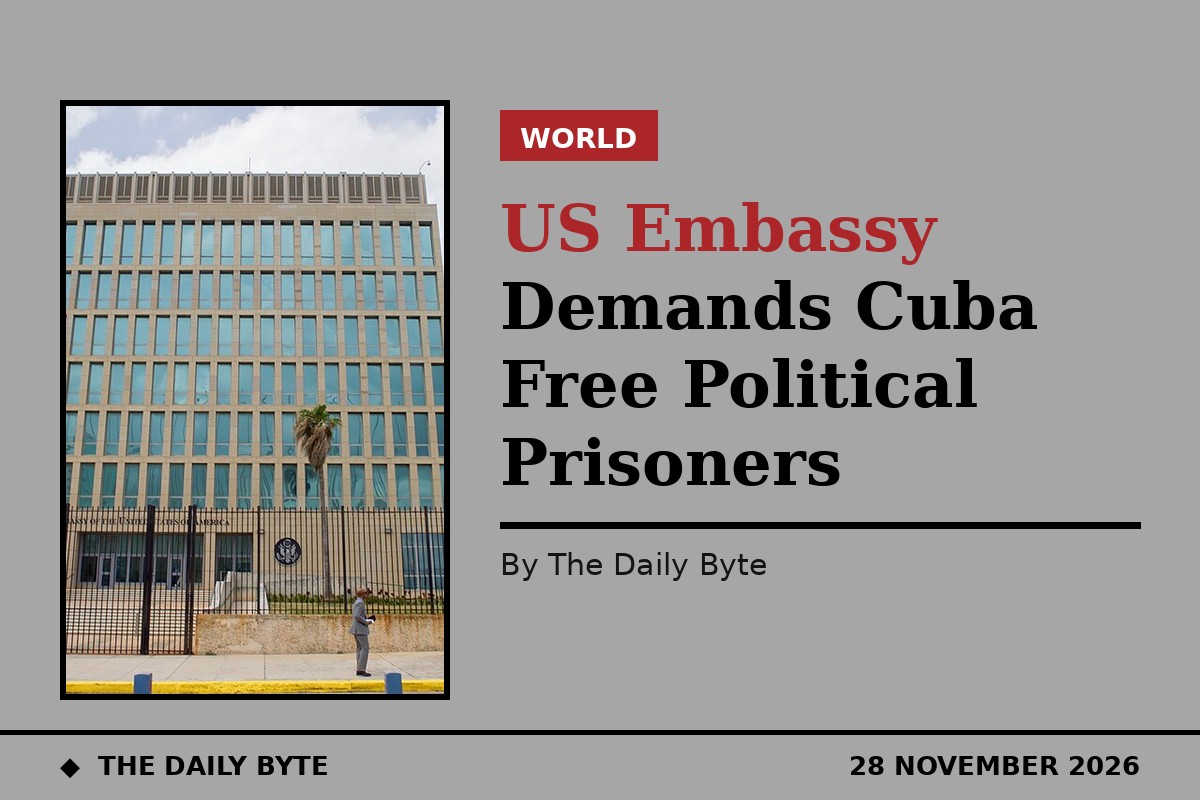
The United States Embassy in Havana has demanded the release of all political prisoners in Cuba, using the sixth anniversary of a landmark protest by artists and activists to renew pressure on the government in Havana.
The embassy issued the call on Friday 27 November 2026, exactly six years after the protest known as 27N, when a group of artists and activists gathered outside the Ministry of Culture in Havana on 27 November 2020 to demand freedom of expression. That demonstration, and the government's response to it, became a turning point for Cuba's independent cultural scene, and the anniversary has since become a date when the island's dissidents and their supporters abroad take stock.
The case of Maykel Osorbo
In its statement, the embassy said that freedom of expression is not a crime, and it singled out the case of the rapper Maykel Castillo Pérez, known as Maykel Osorbo. Castillo has been imprisoned since May 2021 and was sentenced to nine years in June 2022. He is a co-writer of Patria y Vida, the protest anthem that won two Latin Grammy awards and became the soundtrack of the island-wide demonstrations of July 2021. Amnesty International recognises him as a prisoner of conscience.
The embassy's demand comes against a bleak backdrop for political imprisonment on the island. According to the monitoring group Prisoners Defenders, Cuba held 1,353 political prisoners and prisoners of conscience at the end of October 2026, a record high, after 39 more people were added to the list during the month. The figure covers people detained for protesting, for dissent expressed online, and for taking part in the July 2021 unrest, many of whom received long sentences in trials that human rights groups say fell short of fair trial standards.
A stalled diplomatic effort
The statement also lands in the middle of a diplomatic effort that has so far gone nowhere. On 18 November 2026, two members of the United States Congress, Gregory Meeks and Joaquín Castro, wrote to the Cuban president, Miguel Díaz-Canel, urging the release of more than 200 political prisoners as a step towards unblocking talks between the two countries that have stalled. The letter framed prisoner releases as a practical confidence-building measure rather than a concession, and suggested that movement on the issue could open the door to broader engagement.
Havana has made limited gestures in this direction before. In March 2026, Cuba announced the release of 51 prisoners, a move that followed an earlier Vatican-mediated process, and in July 2026 the artist and activist Luis Manuel Otero Alcántara was released into exile in the United States. But rights groups say those releases have been dwarfed by new arrests, and the overall number of political prisoners has continued to climb to its current record.
No response from the Cuban government to the embassy's 27 November statement had been identified in reporting on the day. Havana has in the past rejected criticism of its treatment of dissidents as interference in its internal affairs, and has described those imprisoned after the July 2021 protests as criminals rather than political prisoners.
For the families of those still detained, the anniversary brought little beyond the renewed attention. The embassy's statement is a diplomatic gesture rather than a lever in itself, and the record prisoner count suggests that six years after the artists gathered outside the Ministry of Culture, the space for dissent on the island has narrowed rather than widened. Whether the congressional push or the embassy's public demand produces any movement will be measured in releases, and so far there is no sign of them.


