US industrial production falls 0.4% in October as utilities slump outweighs factory gains
By aminah
·17 Nov 2026
·3 min read
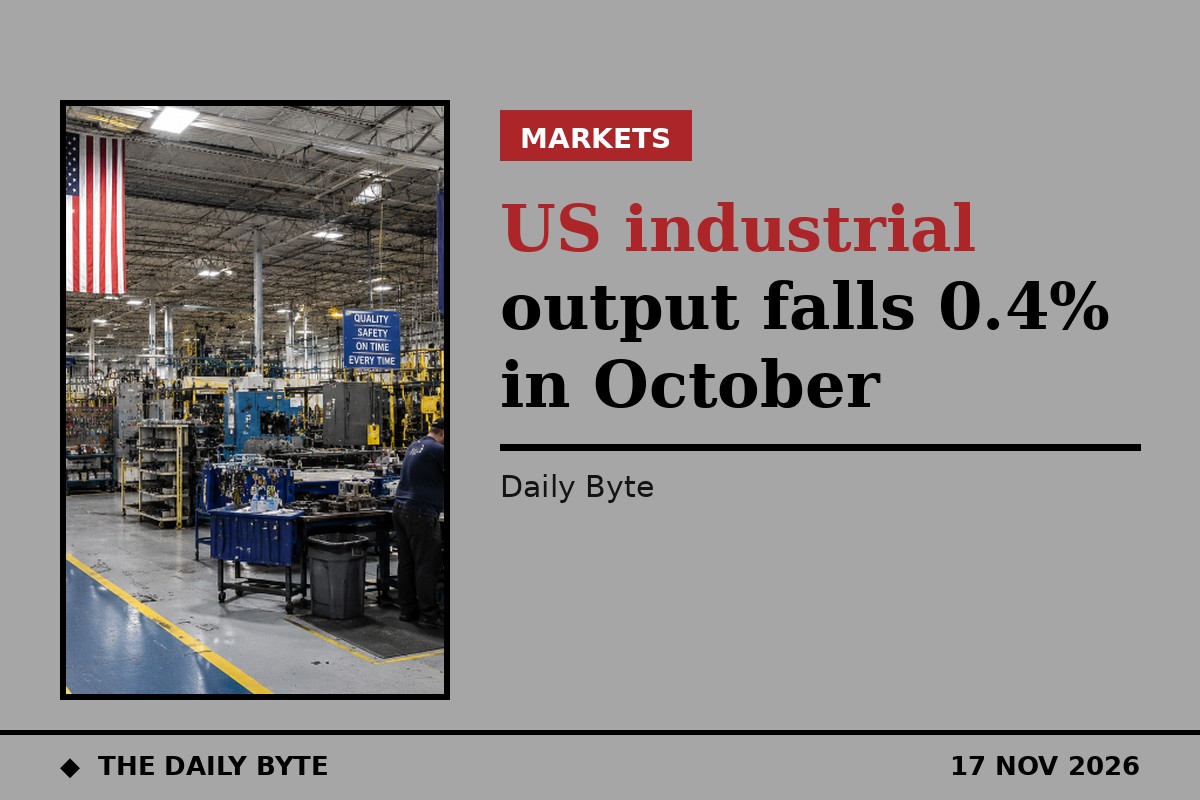
US industrial production fell 0.4% in October, the Federal Reserve said on Tuesday, missing forecasts of a small rise as a sharp drop in utilities output outweighed a gain in manufacturing. Production had risen 0.7% in September.
Manufacturing output rose 0.3% in October, slightly ahead of the 0.2% expected, while mining output fell 0.8% and the index for utilities dropped 4.3%. At 103.4% of its 2017 average, total industrial production in October was 2.1% above its level a year earlier.
Capacity utilisation — the share of industrial capacity in use — dropped to 76.4%, below the 76.8% expected and 3.0 percentage points below its long-run average from 1972 to 2025, the Fed said.
## Utilities gave back September's weather-driven jump
The miss was driven almost entirely by utilities. Electric output fell 4.2% and natural gas utilities fell 4.7%, giving back September's weather-driven jump, when utilities output had risen 3.5% as demand for air conditioning surged. Manufacturing excluding motor vehicles and parts edged down 0.1%, suggesting the factory gain was narrower than the headline suggested.
The split matters because manufacturing accounts for roughly three-quarters of industrial production, while mining and utilities make up the rest. A rise in factory output alongside a fall in total production points to a weather story rather than a broad industrial downturn — but it also shows how little slack the economy has absorbed: capacity utilisation remains well below its long-run norm.
Survey data had pointed to a firmer factory sector. The ISM manufacturing purchasing managers' index rose to 55.5 in October from 54.5 in September, with its production index reaching 59.0, the highest since November 2021, according to the Institute for Supply Management's report.
## Why the Fed watches this release
Industrial production is one of the Fed's earliest reads on the goods-producing economy each month, and it feeds into estimates of gross domestic product. The October figures arrived on the same day as retail sales data showing US shoppers spent 0.2% more in the month, and a day before the minutes of the Fed's October meeting are published.
The Fed said it plans to issue its annual revision to the industrial production and capacity utilisation indexes on 24 November, rebasing the indexes to 2022. That revision could redraw the recent picture, so economists will treat Tuesday's numbers as preliminary.
The release also comes as markets price a high chance of a Federal Reserve interest rate rise in December, after hotter-than-expected inflation data last week. Weaker industrial output on its own would argue against tightening, but the strength in manufacturing and the utilities payback make the signal mixed rather than clear.
## Frequently asked questions
**How much did US industrial production fall in October 2026?**
It fell 0.4%, against expectations of a 0.1% rise, after increasing 0.7% in September, according to the Federal Reserve's G.17 release.
**Why did production fall if manufacturing rose?**
Utilities output fell 4.3%, reversing September's weather-driven gain, and mining fell 0.8%. Manufacturing rose 0.3%, but not by enough to offset those drops.
**What is capacity utilisation?**
It is the share of industrial capacity in use. It fell to 76.4% in October, 3.0 percentage points below its long-run average, meaning a large share of US industrial capacity stood idle.
Sources: [Federal Reserve G.17 release](https://www.federalreserve.gov/releases/g17/current/default.htm) and [InvestingLive](https://investinglive.com/news/us-october-industrial-production-0-4-vs-0-1-expected/).
Source
Federal Reserve — https://www.federalreserve.gov/releases/g17/current/default.htm