US jobless claims rise to 203,000 in a week
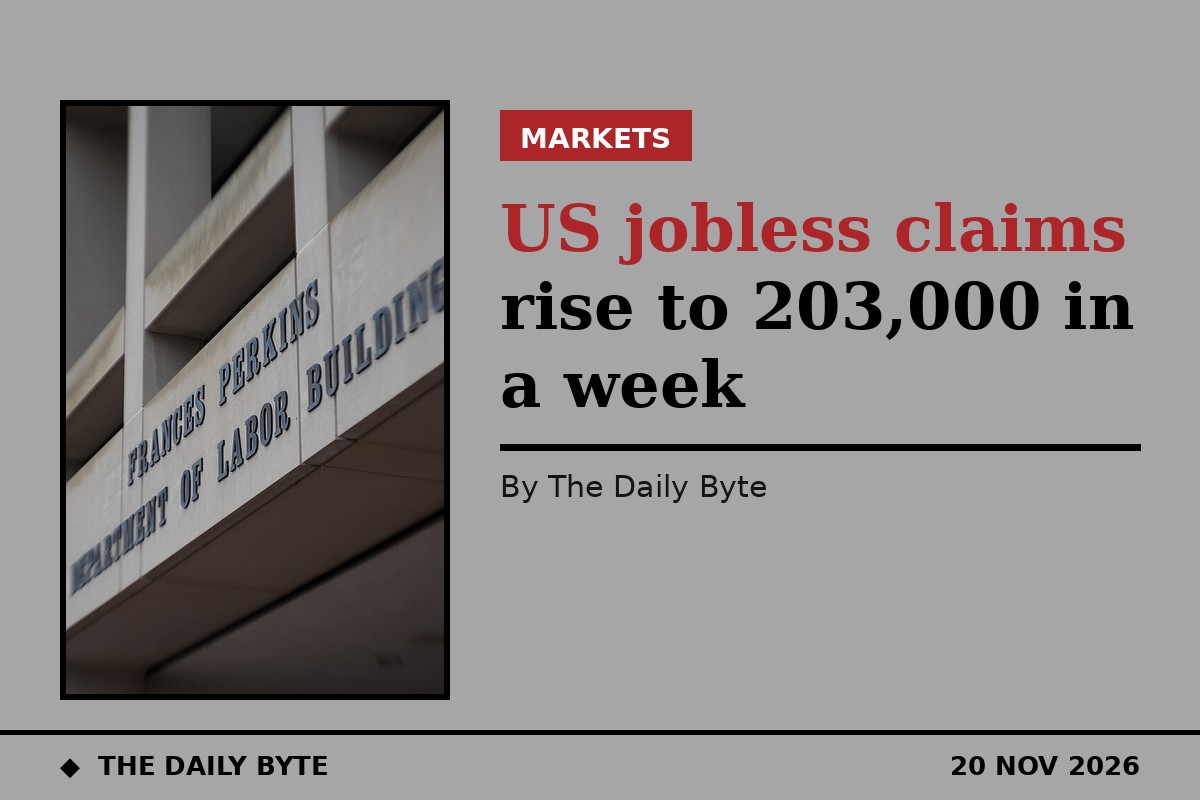
New claims for unemployment benefits in the United States edged higher last week, the Labor Department said on Thursday, 19 November 2026, although the labour market remained broadly stable. The figures were published a day after minutes from the Federal Reserve's October meeting showed officials saw signs of modest tightening in the jobs market.
Initial claims for state unemployment benefits rose by 1,000 to a seasonally adjusted 203,000 in the week ended 14 November, the department said. Economists polled by Reuters had forecast 197,000 claims for the latest week. The department revised the previous week's estimate up by 2,000 to 202,000.
Claims have hovered at or below 200,000 since mid-September, according to Reuters, a level that points to layoffs remaining contained even as hiring has slowed.
Continuing claims climb
The more notable movement was in continuing claims, which count people still receiving benefits after an initial week of aid and are watched as a proxy for hiring. They increased by 70,000 to a seasonally adjusted 1.763 million in the week ended 7 November, from a downwardly revised 1.693 million.
The four-week average of new claims, which smooths out weekly swings, rose by 2,000 to 197,750. A year earlier, new claims stood at 222,000 and the four-week average was 224,750. Continuing claims were also below the 1.949 million recorded a year earlier.
Before seasonal adjustment, new applications fell by 11,941 to 197,492, a decline of 5.7 percent — slightly smaller than the 6 percent drop the department's seasonal calculations had anticipated, according to Breitbart's report of the release.
What it means for the Federal Reserve
The claims report covered the period during which the government surveyed businesses for the November employment report. Nonfarm payrolls increased by 165,000 jobs in October, and the unemployment rate edged down to 4.1 percent from 4.2 percent in September, Reuters reported.
Minutes of the Federal Reserve's 27–28 October policy meeting, published on Wednesday, showed that "many pointed to signs of modest tightening in the labor market", and that policymakers generally expected conditions to remain stable in the near term, with upside and downside risks broadly balanced. The Fed left its benchmark overnight interest rate in the 3.75 to 4.00 percent range last month.
Fed Governor Christopher Waller said on Wednesday that the central bank needed to respond more aggressively to inflation, and either approve a half-point increase at the December meeting or communicate a faster pace of increases in 2027, Reuters reported. A stable labour market gives the Fed more room to focus on inflation, which officials have said is being fuelled in part by the continuing US-Israeli war with Iran.
A note of caution on the data
Analysts urged caution about reading too much into a single week. One analysis of the release noted that Michigan accounted for 91 percent of the national increase in unadjusted insured unemployment in the week ended 7 November, after the state rolled out a new online claims system, and that the state's figures had swung sharply in recent weeks. Until the next releases confirm the pattern, the national continuing-claims jump should be treated as partly distorted by that one state.
Even with that caveat, the headline picture was consistent: layoffs remain low by recent standards, with initial claims averaging about 208,000 a week so far this year — the lowest average for this period since 1969, according to Breitbart — while people who do lose jobs appear to be taking longer to find new work.