US Loses Measles Elimination Status, PAHO Rules
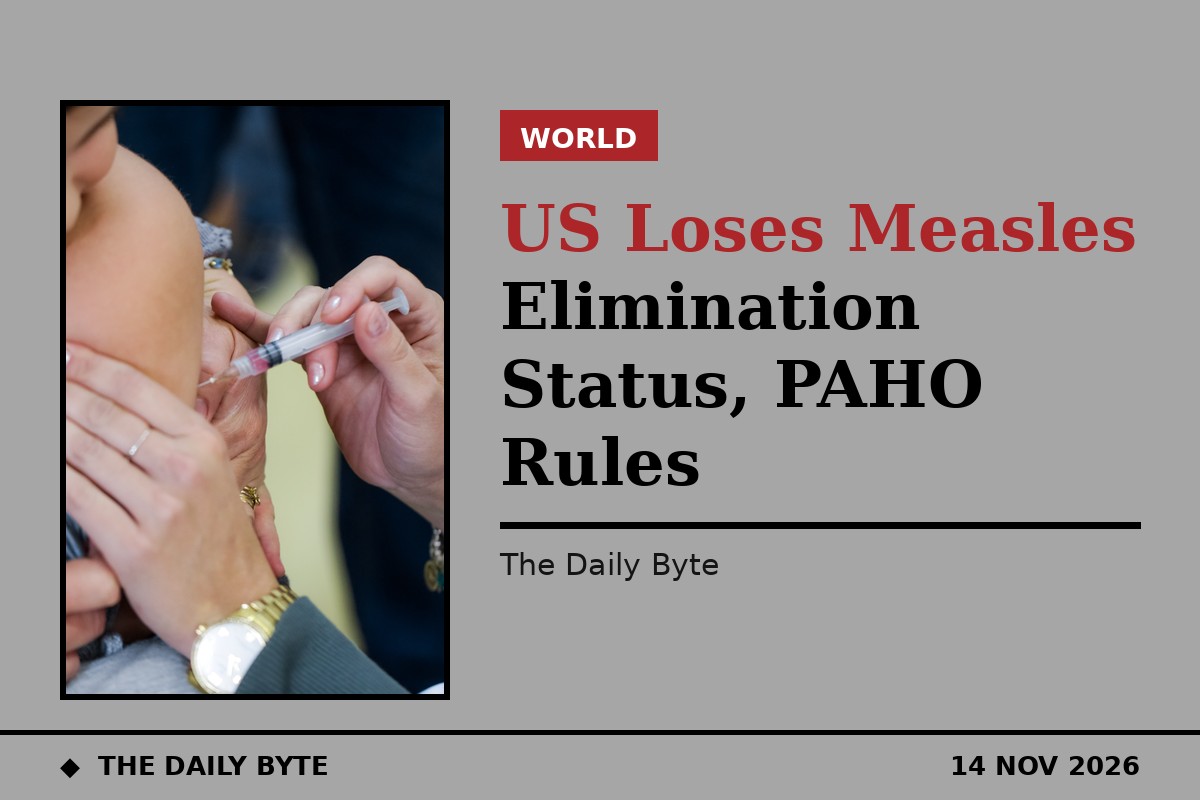
The Pan American Health Organization (PAHO) has revoked the United States' measles elimination status, people familiar with the matter told the Wall Street Journal, a striking reversal for a country that has kept the vaccine-preventable disease at bay for decades. The US first achieved elimination status in 2000 after sustained immunisation campaigns and a programme that made shots free for millions of children.
The decision follows a historic resurgence of measles in the US. The Centers for Disease Control and Prevention (CDC) has reported more than 5,400 cases in 2026 alone, a level not seen since before the disease was eliminated. States including Pennsylvania, New York and Wisconsin have reported five measles deaths so far in November from unrelated outbreaks. PAHO did not immediately respond to requests for comment, the Wall Street Journal reported.
How the decision was reached
Measles is considered eliminated when a country has no continuous spread of the virus for at least 12 months. PAHO makes its determination from a review of recent outbreaks and a CDC report showing whether separate outbreaks are linked or whether any single outbreak lasted more than a year. Its Regional Monitoring and Re-Verification Commission met in Washington from 10 to 13 November to assess the evidence from all 35 PAHO member states, with particular attention to countries experiencing prolonged outbreaks.
Under PAHO's criteria, a country loses its elimination status if the same measles virus strain keeps spreading without interruption for at least 12 months in a country or defined area. Investigators use genetic sequencing to establish whether infections are linked to the same strain, and weigh vaccination coverage, surveillance and the speed of outbreak responses. PAHO reported 57,666 confirmed measles cases across 17 countries and territories in the Americas between January and October 2026, according to 234Radio. Mexico, Guatemala, Peru and Bolivia were also at risk in this year's review.
Falling vaccination rates behind the resurgence
Public health experts have long expected the US to lose the status. "Runaway measles outbreaks in the United States, as well as the needless deaths, are all due to low measles vaccination coverage," said Noel Brewer, chair of an independent US committee that presented findings about the country's measles outbreaks to PAHO. "We've gotten comfortable letting children be stopped by a deadly disease and die from it."
Two doses of the measles, mumps and rubella (MMR) vaccine are 97 per cent effective in preventing the disease, and at least 95 per cent of the population needs to be vaccinated to stop it spreading. But MMR vaccination rates for kindergarten pupils dropped to 92.4 per cent in the school year that ended in June, down from 95.2 per cent six years earlier, according to the CDC, with rates far lower in some communities hit hardest by recent outbreaks.
To regain elimination status, the US must halt the continuing spread of the disease for at least 12 months, an effort that could take years of public health work. The US is not alone: Canada lost its measles-elimination status in 2025, and some European nations and the UK lost theirs earlier this year. Brazil lost its status in 2019 and re-established it in 2024 after a national vaccination campaign. Erica Schwartz, the director of the CDC, said this week that losing elimination status would not change the agency's approach to measles.


