US, Mexico and Bolivia lose measles-free status
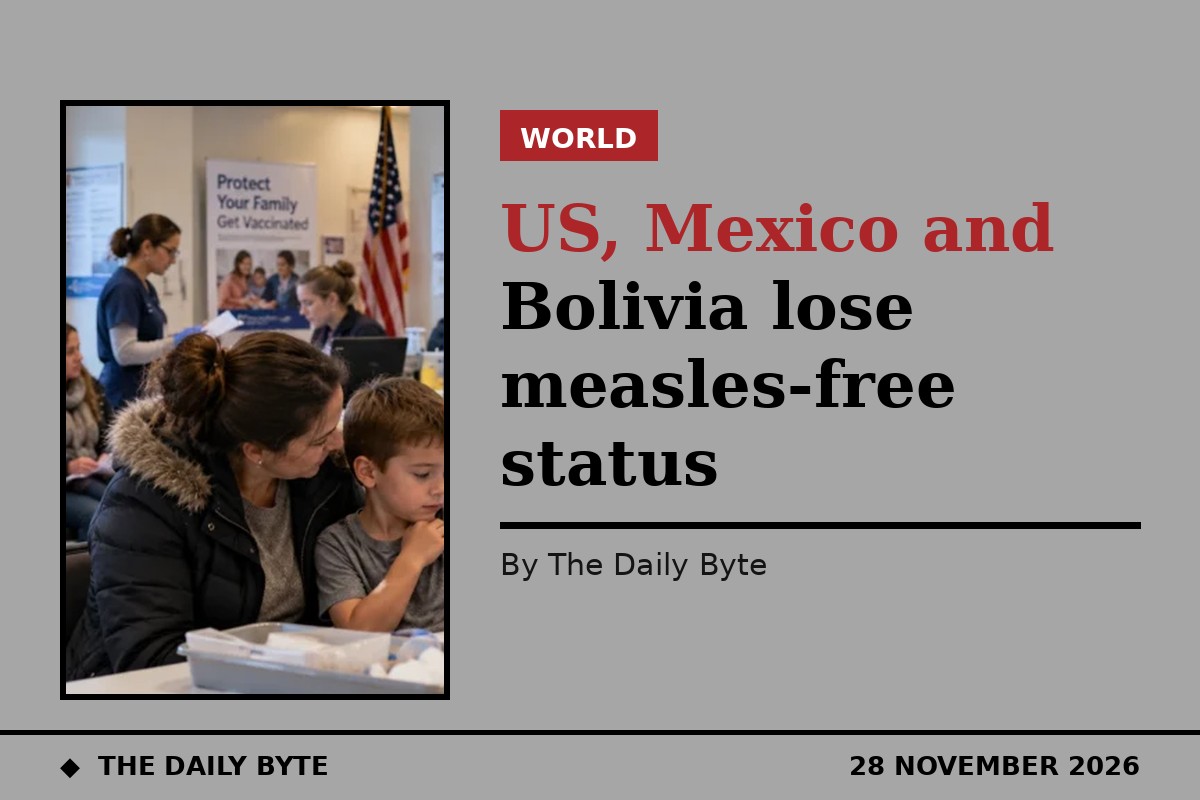
The United States, Mexico and Bolivia have lost their measles elimination status, the World Health Organization (WHO) said on Friday, after the virus circulated without interruption in each country for at least 12 months. The announcement marks a further setback for a region that was once the first in the world to eliminate the disease.
The decision followed a meeting of the independent Measles and Rubella Elimination Regional Monitoring and Re-Verification Commission, held from 10 to 13 November 2026. The commission reviewed epidemiological and laboratory evidence from all 47 reporting countries and territories in the Americas. Its findings were accepted by Dr Jarbas Barbosa, director of the Pan American Health Organization (PAHO), who informed each country's health authority.
Under the commission's criteria, a country loses its elimination status when the same measles virus genotype and lineage circulate without interruption for 12 months or more. The relevant periods of sustained transmission were: the United States, where the outbreak began on 20 January 2025; Mexico, where it began on 1 February 2025; and Bolivia, where it began on 16 April 2025.
The loss of status does not mean every part of these countries is experiencing outbreaks. It means the virus has circulated continuously for at least a year within the country. PAHO stressed that all three countries are working to close immunity gaps by strengthening vaccination, surveillance and outbreak response.
The Americas first eliminated measles in 2016 and regained its regional elimination status in 2024, after interrupting endemic transmission in Venezuela and Brazil. But the region lost that status for a second time in November 2025, when endemic transmission was re-established in Canada. Canada has since interrupted the chain of transmission linked to that outbreak and is working to regain its status.
The scale of the resurgence is clear in the case numbers. As of 13 November 2026, the region had reported 58,213 confirmed measles cases and 82 deaths, compared with 12,806 cases during the same period last year. In the Americas, cases have risen eightfold since 2000, to 73,000 in 2025.
Mexico has confirmed more than 13,900 cases so far this year, the highest number since the 1989-90 epidemic, according to the Ministry of Health, with children aged one to four carrying the highest burden. The United States has confirmed more than 5,400 cases this year, the highest annual total since the 1989-91 resurgence, according to the US Centers for Disease Control and Prevention. Bolivia has confirmed more than 100 cases this year, ending more than two decades without local transmission.
Globally, the picture is mixed. WHO said measles deaths fell to an estimated 72,000 in 2025, a 91 per cent reduction since 2000, and that vaccination has saved more than 60 million lives over that period. Nearly 10 million people were infected in 2025, among the lowest levels reported. But 92 countries are now verified as having eliminated measles, down from 95 at the end of 2025.
Measles is one of the most contagious diseases in the world: one infected person can transmit the virus to as many as 18 susceptible people. It can cause serious complications, including pneumonia, encephalitis and blindness, and can lead to death. Infection can also weaken the immune system for months afterwards.
WHO Director-General Tedros Adhanom Ghebreyesus said measles deaths had never been lower, thanks to the life-saving power of vaccines, but warned that measles does not forgive complacency. He said elimination is not a finish line and must be defended, with two doses of vaccine for every child, everywhere.
Dr Barbosa said losing measles elimination status was much more than losing a public health designation. He said it meant the virus had circulated for a prolonged period, putting families and communities at risk of preventable illness, hospitalisation and death. He added that the situation was a serious warning for the region, but not an irreversible setback.
PAHO said the resurgence reflected persistent gaps in population immunity, often concentrated in particular communities and areas. National vaccination figures can mask these disparities, while barriers to health services, missed vaccinations, misinformation and vaccine hesitancy leave children, adolescents and adults vulnerable.
Worldwide, coverage was largely unchanged in 2025, with 84 per cent of children receiving a first dose and 77 per cent a second. More than 29 million children were unvaccinated or under-immunised in 2025. Sustaining at least 95 per cent coverage with both doses of the measles vaccine in every community remains essential to closing immunity gaps and preventing further outbreaks, PAHO said.


