US Natural Gas Storage Falls 24 Bcf in First Winter Draw
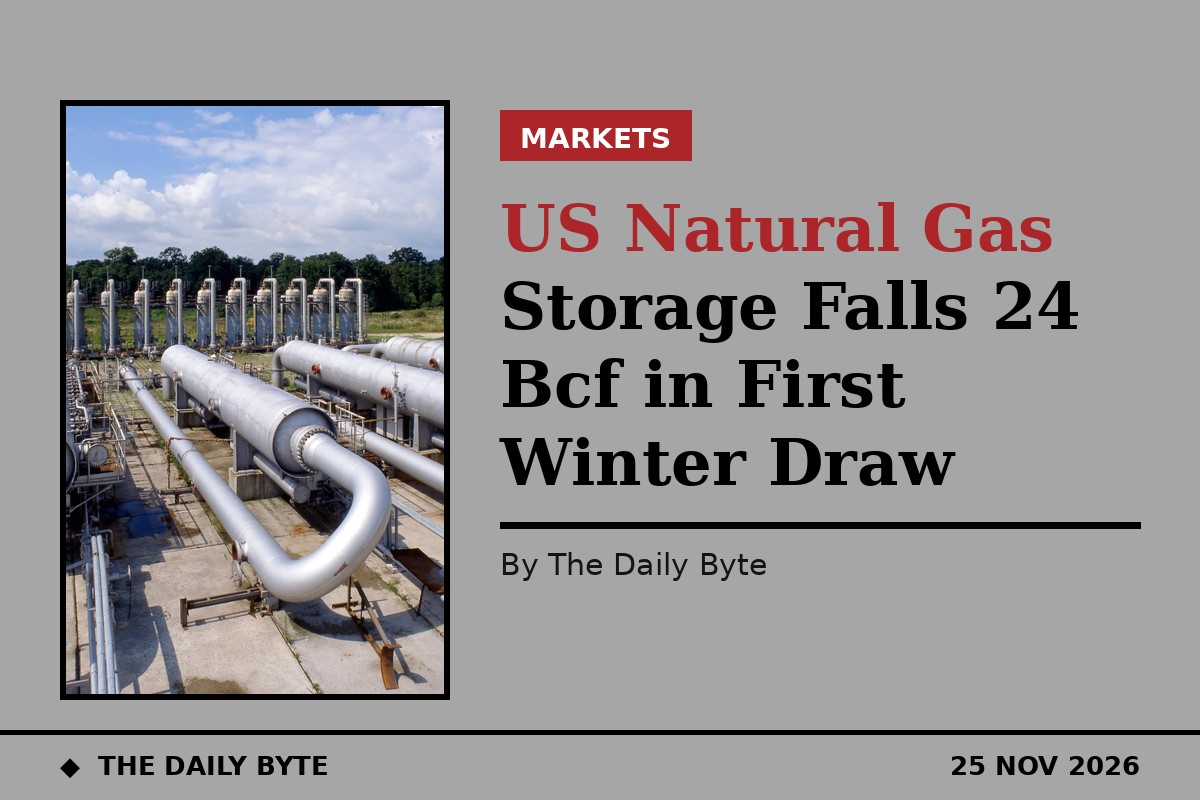
US natural gas storage recorded its first withdrawal of the winter heating season last week, falling by 24 billion cubic feet (Bcf) as colder weather lifted demand for heating, the US Energy Information Administration (EIA) said on Wednesday.
Working gas in underground storage across the Lower 48 states stood at 3,858 Bcf on Friday, 20 November, down from 3,882 Bcf a week earlier. The EIA published the report on Wednesday, a day earlier than its usual Thursday slot, because of Thursday's Thanksgiving holiday.
The draw matched the five-year average decline for the same week, and it was larger than the 17 Bcf fall analysts polled by The Wall Street Journal had expected. It also matched the 24 Bcf fall expected in a Bloomberg survey. Stocks ended the week 79 Bcf below the level a year ago, but 80 Bcf above the five-year average of 3,778 Bcf, and the EIA said total working gas remained within the five-year historical range.
East leads the draw
The East accounted for most of the withdrawal, with stocks there falling by 19 Bcf to 919 Bcf, nearly four-fifths of the national total. The Midwest drew down 11 Bcf to 1,117 Bcf. Stocks in the Mountain region slipped 1 Bcf to 264 Bcf and the Pacific region also fell 1 Bcf, to 302 Bcf. The South Central region was the only one to add gas, rising 8 Bcf to 1,256 Bcf, as salt caverns added 9 Bcf while non-salt storage slipped 1 Bcf.
The withdrawal marks the turn from the injection season, when producers and traders build stocks through the summer, to the withdrawal season, when cold weather draws them down. The EIA's November outlook expects 3,840 Bcf of gas to be held in storage at the end of November, close to the level reported for 20 November.
Futures mixed as December contract expires
Natural gas futures were mixed after the report. The Nymex December contract, which expired at Wednesday's close, was down 1.5% at $3.292 per million British thermal units (mmBtu), while gas for January delivery was up 0.5% at $3.681 per mmBtu, according to The Wall Street Journal. The December contract had closed on Tuesday at $3.323 per mmBtu, up 13.9 cents, or 4.4%, from Monday's close, energy analysts EBW Analytics said in a note carried by Rigzone.
Ritterbusch and Associates said the prompt-month contract had been "propped up considerably" by steady utility purchases despite a delayed start to heavy winter use, and it expects near-term trading to stay within the past week's range of about $3.45 to $3.80 per mmBtu into the middle of December.
Supply remains plentiful. US dry gas production is running at about 113 Bcf a day, according to Energy Edge Consulting, and nominations for liquefied natural gas (LNG) exports pointed to a daily record of 22.1 Bcf, EBW Analytics said. That export pull is one reason traders are watching storage closely: every cargo shipped abroad is gas that cannot be drawn on at home if cold weather bites.
Demand is expected to dip briefly over the holiday itself. EBW Analytics warned that daily gas demand could fall by 11 Bcf a day into the Thanksgiving holiday weekend, which may soften physical prices, before early-December weather and rising output set the tone for the rest of the month. The EIA expects the Henry Hub spot price to average $3.37 per mmBtu this year and $2.88 next year, as production growth outpaces demand.
For households, the storage position matters because it sets the starting point for winter. Stocks enter the coldest months about 2% below last year's level but about 2% above the five-year average, leaving the market with a cushion that is thinner than a year ago but still within its normal range. The next test comes with the first sustained cold snap, when daily withdrawals can run several times larger than this week's 24 Bcf.


