US Proposes 10% Tariff on Brazil Aircraft and Sugar
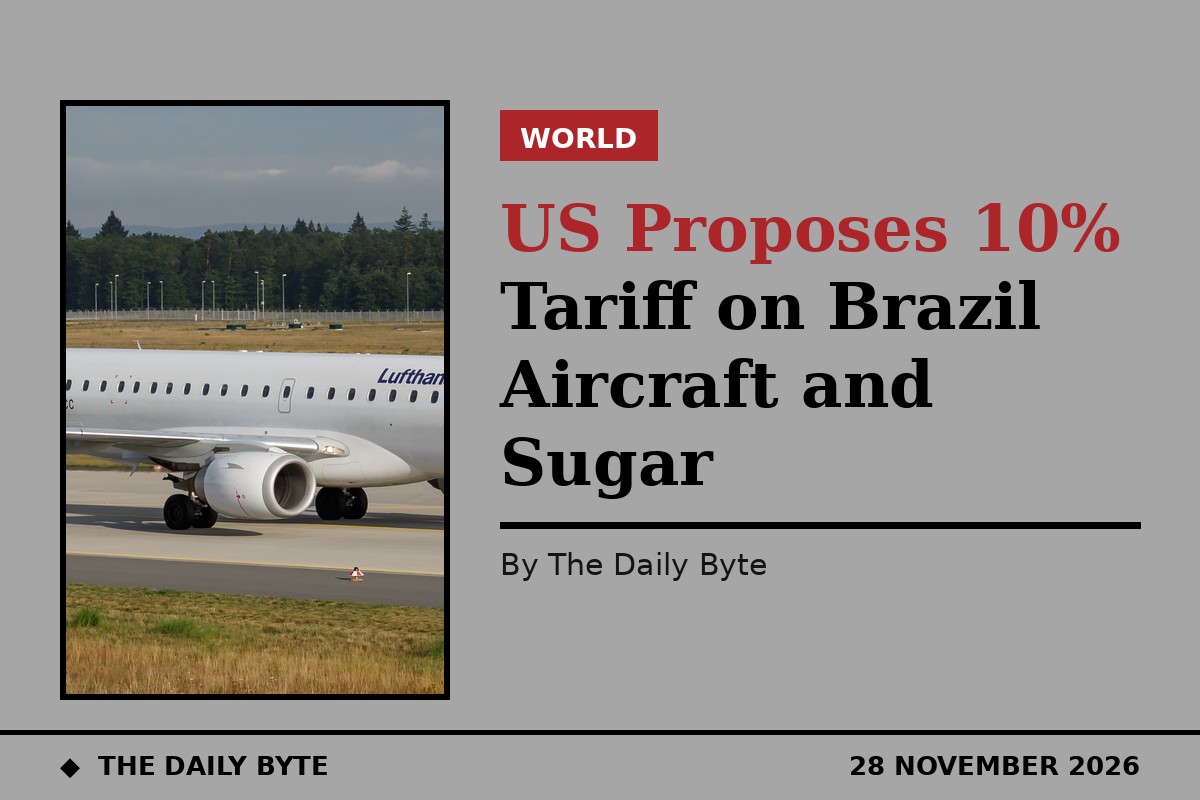
The United States has proposed a new 10% tariff on finished aircraft from Brazil and higher duties on sugar imports, escalating a trade dispute with Latin America's largest economy just weeks after Brazil's presidential election.
The Office of the United States Trade Representative (USTR) announced the proposal on Wednesday, 25 November, as a modification of the Section 301 action it imposed on Brazilian goods in July. Finished aircraft, currently exempt from those duties, would face a 10% ad valorem tariff, while out-of-quota raw and refined sugar would face new specific duties of $0.44 per kilogram for raw cane sugar and $0.60 per kilogram for raw beet and refined sugar.
USTR chief Jamieson Greer said the measures were designed to increase pressure on Brasilia. "Imposing an additional, specific tariff on sugar imports from Brazil and an additional 10% tariff on finished aircraft exports from Brazil is intended to help bring Brazil to the table," he said.
A direct hit on Embraer
The aircraft duty matters because finished aircraft are Brazil's fourth-largest export to the United States, and the country's planemaker Embraer is the leading exporter of regional jets to the American market. US airlines rely heavily on Embraer's jets for regional routes to smaller cities, where there is no domestic alternative.
Embraer shares fell more than 3% on Wednesday afternoon after the announcement. The company said it was reviewing the proposal and repeated its defence of the zero-tariff regime for the global aerospace industry that has been in place since the 1980s.
Washington says Brazil has made "no meaningful progress" on the trade practices behind the original July action, which imposed 25% tariffs on a range of Brazilian goods. A senior US official told reporters the two sides still had "substantial differences" despite several negotiating sessions over the past year.
The sugar proposal is deliberately broad. USTR says the higher out-of-quota sugar duties would apply on a nondiscriminatory basis, to sugar from all countries, to stop Brazilian exporters backfilling other suppliers' markets by shipping through third countries. Even so, the immediate impact on sugar may be limited: Brazil's sugar exports to the United States have fallen to just over 146,000 tons in 2026 through the end of October, down from more than 1 million metric tons in 2024, according to industry body UNICA. Washington already plans to cut Brazil's tariff-free raw sugar quota for 2027 by about a third, to 100,000 tons.
Brazil says it will not yield
Brasilia pushed back immediately, and its response hardened on Saturday, 28 November. The Brazilian government said it assessed the proposal as an attempt to discourage Brazil from regulating big tech platforms and to pressure it into a critical-minerals agreement that would help Washington compete with China.
Vice President Geraldo Alckmin called the decision to tax Brazilian aircraft "descabida", meaning unwarranted or absurd, and promised the government would work to reverse it. The presidency's communications secretariat said the unilateral USTR decision was "unacceptable" and that "Brazil will not yield to such threats".
Brazil's government points to a bill before Congress, the Digital Markets Bill, which would regulate competition and fees charged by technology companies such as Google, Meta, Amazon and Microsoft. It also notes that Brazil holds about 11 million tonnes of rare earth reserves, the second-largest mapped total in the world and about 14% of the global total, according to the US Geological Survey and Brazil's National Mining Agency.
Despite the dispute, Brazil's exports grew 13.3% between January and November 2026, with total trade up 10.9% in the year through November, according to the Ministry of Development, Industry and Trade.
What happens next
Nothing takes effect yet. The public comment period opened on Friday, 27 November. Requests to appear at the hearing are due by 7 December, written comments by 30 December, and USTR will hold a public hearing on 14 January 2027 before any measure can take effect.
The proposal was part of a broader round of tariff announcements on 25 November covering 14 economies, including China, Japan, the European Union and India. For Brazil, it landed barely a month after the presidential election in which US tariff policy was a central campaign issue, and it signals that President Luiz Inacio Lula da Silva's re-elected government faces the same trade pressure in its new term as in the last.


