US Backs Guyana in Essequibo Dispute with Venezuela
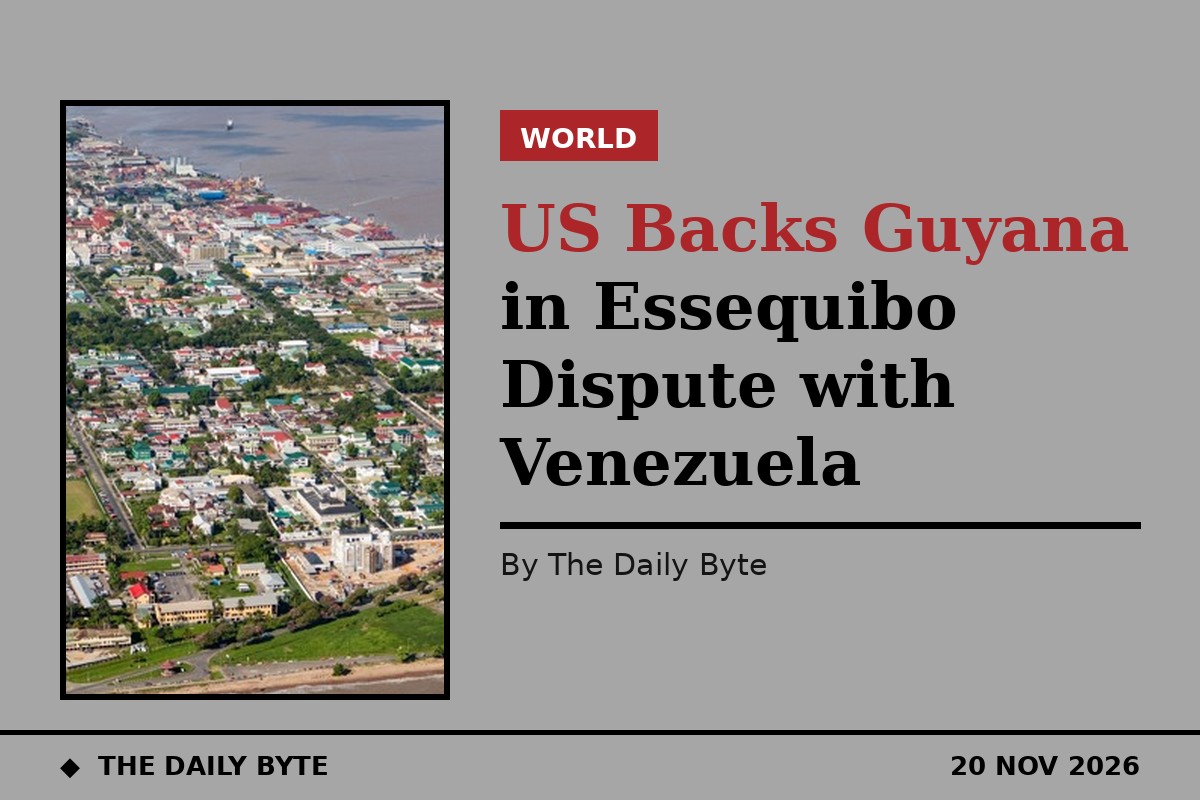
The United States has reaffirmed its support for Guyana in the country's long-running border dispute with Venezuela, insisting that its policy on the land boundary between the two neighbours has not changed.
The assurance, issued by the US Embassy in Georgetown on Thursday, backs the 1899 Arbitral Award that fixed the boundary between Guyana and Venezuela, and says the award should be respected unless a competent legal body sets a new boundary or both countries agree to one.
What Washington said
"The United States reaffirms its support for the 1899 Arbitral Award that determined the land boundary between Venezuela and Guyana, which should be respected unless or until a new boundary is set by a competent legal body or with the consent of both parties," the embassy said in a two-paragraph statement.
Guyana's Ministry of Foreign Affairs and International Cooperation said on Thursday that it had received the same assurance directly from Washington. The ministry said the border controversy had been raised during a meeting between Guyanese and US State Department officials in September, and that the discussion had focused on the pending ruling of the International Court of Justice (ICJ) and on reaffirming American support for the judicial process.
"Guyana has received the assurance of the United States Government that nothing has changed since," the ministry said.
President Mohamed Irfaan Ali also spoke on Thursday, restating Guyana's position that its sovereignty and territorial integrity are not open to negotiation and that the dispute must be settled through the ICJ. Guyana has consistently maintained that the status of Essequibo is not open to negotiation.
The report that prompted the clarification
The statements followed a Reuters report this week that Jeremy Lewin, then the State Department's director of policy planning, had raised the possibility of Venezuela taking partial control of the Essequibo region during discussions with Guyanese officials in Washington in September. Reuters, citing three people familiar with the matter, reported that Lewin had also offered to help arrange territorial talks between Guyana and Venezuela's acting president, Delcy Rodriguez.
Lewin, who left the State Department at the end of October, confirmed to Reuters that he had held preliminary discussions with representatives of both countries. He said the conversations were authorised by the White House and followed a May letter from Rodriguez to US President Donald Trump seeking American mediation. According to Lewin, Rodriguez also raised the issue during a meeting with him in Caracas in July.
The State Department said its official position on the boundary had not changed, and the White House referred questions to the department. The reported suggestion alarmed officials in Georgetown, who sought clarification from Washington about whether it represented a shift in US policy.
Why Essequibo matters
Essequibo covers about two-thirds of Guyana's territory and is rich in gold, diamonds and bauxite. Venezuela has claimed the region for more than 180 years, while Guyana maintains that the 1899 arbitration award settled the boundary conclusively.
The dispute intensified after major oil discoveries offshore Guyana in 2015. Georgetown took the case to the ICJ in 2018, seeking confirmation of the boundary set by the 1899 award. The court has yet to announce its ruling. Venezuela has continued to press its claim, including at the United Nations General Assembly in September, where Rodriguez called on Guyana to enter negotiations over the territory's legal status.
What happens next
The embassy statement gives Georgetown a public, on-the-record confirmation that Washington still backs the 1899 award, after days of uncertainty set off by the Reuters report. For now, the dispute remains before the ICJ, and neither side has announced any agreement or boundary change.
The clarification also comes at a sensitive moment in US-Venezuela relations. Just a day earlier, US Secretary of War Pete Hegseth made an unannounced visit to Caracas, where a military cooperation agreement was signed with Venezuela, covering joint training, intelligence sharing and equipment. Against that background, Guyana will be watching closely for any further sign of how Washington balances its warming ties with Caracas against its stated support for Georgetown.
Sources: CANA News | News Hub Guyana


