US Sanctions Comancheros Gang in Drug Crackdown
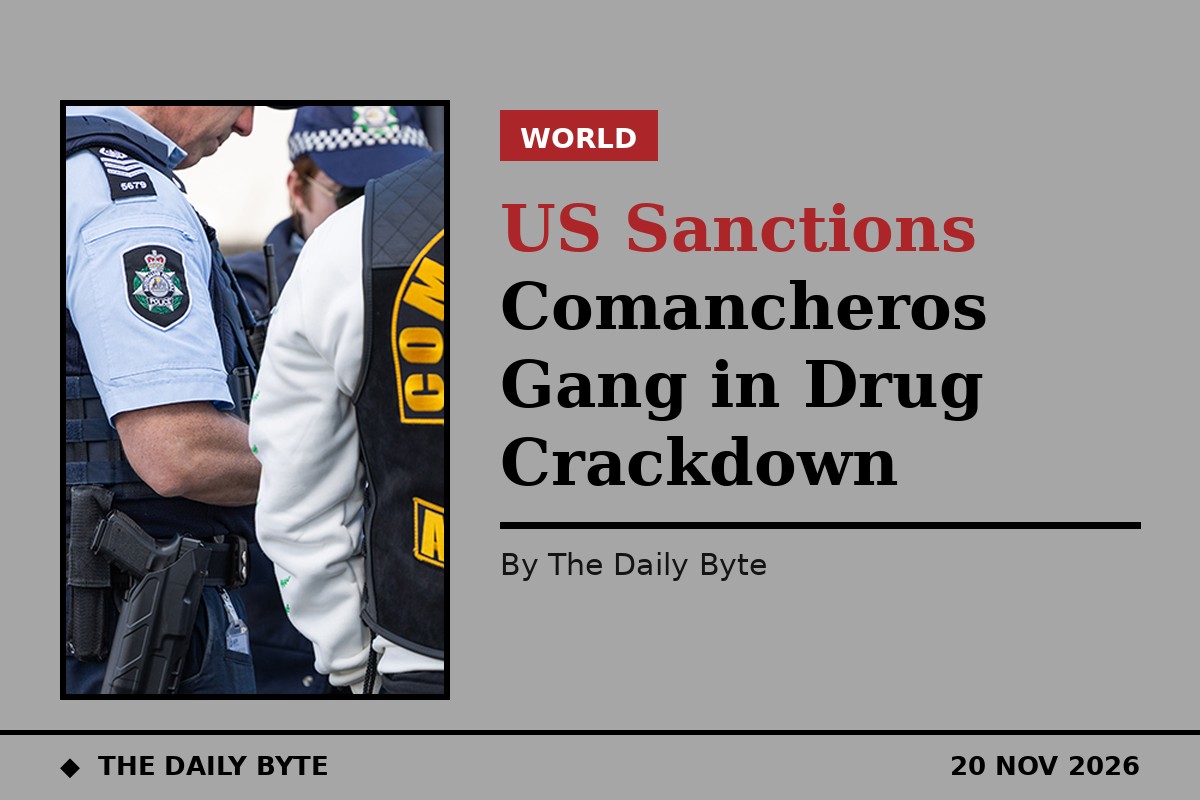
The United States has imposed financial sanctions on the Comanchero outlaw motorcycle gang and five senior figures, the first time its Office of Foreign Assets Control has designated an Australian-based organised crime group. The sanctions, announced on 20 November, freeze any assets the named people hold in the United States and bar US citizens and businesses, wherever they are in the world, from dealing with them.
Who was sanctioned
The designations were authorised on 19 November by OFAC Director Bradley T. Smith, with the approval of US Treasury Secretary Scott Bessent, under Executive Order 14059, which allows the US government to sanction people and organisations involved in the international proliferation of illicit drugs. The five people named are Alexandre Varela Villar, 34, the gang's Spain-based world commander; Allan John Norman Meehan, 39, its Australia-based world president; Pasilika Naufahu, 39, the national president of the Comanchero's New Zealand chapter; his brother Vetekina Naufahu, 41, a former national commander and now a senior patched member; and associate Marco Francis Coffen, 44, who authorities say supplied encrypted communications platforms to Australian criminal groups.
Treasury also listed a Tron cryptocurrency address linked to Varela Villar for sanctions screening. The action was coordinated with the Australian Federal Police, the Australian Transaction Reports and Analysis Centre, New Zealand Police and US agencies, and the same OFAC action also targeted figures linked to Italy's 'Ndrangheta.
Why the US acted
The Comanchero was designated because of its direct links and partnership with drug trafficking organisations the US has designated as foreign terrorist organisations, including Mexico's Sinaloa Cartel and Jalisco New Generation Cartel, Colombia's Clan del Golfo and Ecuador's Los Choneros. Authorities allege the gang provides logistical support to networks moving large quantities of cocaine from South America into Australia, the United States and Europe.
The Comanchero started in Australia in the 1960s and now has chapters around the world. Australian authorities describe it as among the most prolific and dangerous organised crime gangs in the country, responsible for the multi-tonne trafficking of cocaine and other illicit drugs globally, as well as violence, murders and corruption. Its money laundering activities, which rely on domestic and global criminal and financial networks, trusted insiders and professional facilitators, are treated as a threat to Australia's national security.
What the sanctions mean in practice
Although Australia does not enforce US sanctions, the measures can have real consequences. The Australian Federal Police said those named may face the closure or restriction of their Australian bank accounts, difficulty obtaining banking services including home loans, greater scrutiny of transactions and restrictions on international funds transfers. Any company owned 50 percent or more by a sanctioned person is also treated as sanctioned, and Australian banks that access the US financial system are expected to be cautious about providing services or processing transactions for them.
AUSTRAC has played a central role in building the financial intelligence behind the sanctions. Through its Fintel Alliance partnership with banks and other financial businesses, it has generated more than 230 suspicious matter reports linked to the Comanchero. AFP Assistant Commissioner Stephen Nutt said the objective was to make it harder, riskier and more expensive for the gang to operate, and to make membership increasingly unattractive. Treasury Secretary Scott Bessent said cartels relied on organisations like the Comanchero to move drugs, launder illicit proceeds and poison Americans with narcotics.
The New Zealand connection
New Zealand Police welcomed the sanctions, which follow six years of investigative work into the Comanchero's criminal operations. Two of the five people sanctioned live in New Zealand: Pasilika Naufahu, the national president and a founding member of the New Zealand chapter, and his brother Vetekina. Police said the group's bank accounts, businesses and assets were blocked, along with those of the named leaders. New Zealand Police have identified 119 Comanchero members and nominees in the country, of whom 59 are in custody and 41 are under supervision or subject to release conditions.
What happens next
The sanctions come five years after the AFP-led Operation Ironside, a joint operation with the FBI that infiltrated encrypted communications used by organised crime networks around the world. In Australia, 460 alleged offenders were charged under the operation, with authorities restraining $55 million in cash and $67 million in proceeds of crime. The AFP and AUSTRAC said they would keep working with the Australian Taxation Office and other government partners to find further ways to disrupt the gang's finances, using sanctions alongside banking, transport and logistics pressure to weaken it from several directions at once.


