US Sanctions Iran Shadow Banking Networks
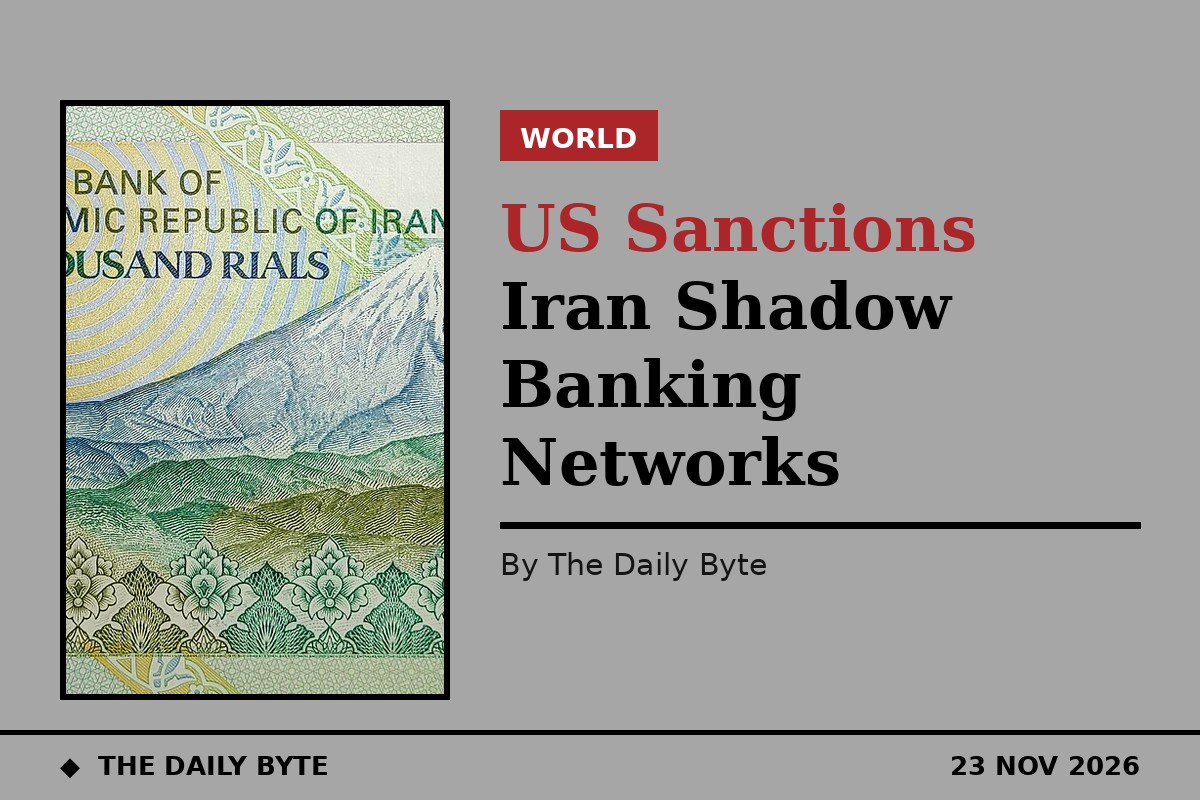
The United States has imposed fresh sanctions on Iran's informal financial networks, targeting more than two dozen exchange houses, front companies and individuals that Washington says keep Tehran's foreign trade running.
The Treasury Department announced the measures on Monday, 23 November, as part of a sweeping effort to disrupt what it calls Iran's global shadow banking networks. Its Office of Foreign Assets Control imposed the designations, while its Financial Crimes Enforcement Network, known as FinCEN, published an analysis of the money flows behind them.
Treasury Secretary Scott Bessent said the networks were keeping Iran's economy afloat. "Iran's economy is underwater, and its leaders are panicking," he said in a statement. "Iran's shadow banking system is the last financial lifeline of a bankrupt regime. Treasury will continue dismantling these illicit networks until we have buried the head of the snake."
What the sanctions target
The sanctions hit two dozen Iranian exchange houses and front companies, along with key personnel, including firms based in the United Arab Emirates, Turkey and Hong Kong. The action was described by the department as part of Operation Economic Outcast, a financial pressure campaign launched in late August.
Among the entities named was the Iran-based Iran Center for Exchange of Currency and Gold, which the Treasury said connects Iranian exporters holding foreign currency with importers seeking to buy goods overseas. The department said the centre facilitates tens of billions of dollars in trade each year, and that Iran's central bank uses bonds issued by the centre to support cross-border transactions in Russian roubles and Chinese yuan, allowing trade without the US dollar.
The Treasury also sanctioned 10 exchange-house front companies operating in the UAE, Turkey and Hong Kong, which it accused of moving billions of dollars on behalf of Iranian clients. Trade publication TradeWinds reported that the list included Dubai-based OGA Global General Trading, accused of overseeing payments for the sanctioned National Iranian Tanker Company.
Nearly $15bn in flagged activity
FinCEN's analysis identified nearly $15bn in financial activity between January 2025 and August 2026 that it said was potentially linked to Iranian shadow banking, based on data submitted by regulated US financial institutions. FinCEN stressed the activity was potentially linked rather than confirmed, since the transactions pass through legitimate banks as well as front companies.
According to the New York Post's account of the FinCEN report, at least $2.6bn of the funds came from China-based banks, $981m from Singapore-based banks and $922m from UK-based banks, with the money routed to financial institutions in the UAE. Overall, $11.3bn in transactions involved companies in the UAE between January 2025 and August 2026.
The report also highlighted around $1.8bn in transactions at Banque Misr's UAE branches between January 2024 and June 2026, involving 103 companies possibly linked to the networks. The Treasury proposed in August that the five branches be cut off from the US financial system, but the rule has not yet taken effect.
FinCEN said the volume of potentially linked activity fell between January and August 2026, which it said "may be indicative of at least partial disruption of Iran's ability to operate shadow banking networks".
How the networks operate
The Treasury said the system is overseen by the Central Bank of Iran and relies on dozens of Iran-based exchange houses and so-called "rahbar companies", bank affiliates that manage sanctions-evasion networks for Iranian clients, moving billions of dollars through the international financial system.
Reuters reported that the networks are connected most prominently in the UAE, Hong Kong and Singapore, through businesses spanning oil, shipping and investment. The Treasury said the system allows Tehran to evade US sanctions and move the proceeds of oil and petrochemical sales in currencies other than the dollar.
Pressure on Tehran grows
The sanctions come as Iran faces mounting economic pressure. A US naval blockade of Iranian oil exports, reimposed in July after an earlier agreement collapsed, has brought the country's visible crude exports to near zero, according to tanker trackers. Iran said on Monday that it would use all its tools to confront the blockade, a statement already reported earlier in the day.
The financial measures also follow warnings from President Donald Trump that the United States could resume military strikes against Iran after the new year if negotiations fail, although no decision of that kind has been announced.
What happens next
Sanctions of this kind freeze any assets the designated people and companies hold in the United States and generally bar Americans from dealing with them. Their practical effect depends on how far banks and businesses outside the United States follow them, since much of the activity runs through third countries. The Treasury has signalled that more designations will follow, and FinCEN's analysis suggests it will keep pressing banks in the Gulf and Asia to report and block suspect transactions.


