US Seeks Countries for Post-UNIFIL Lebanon Force
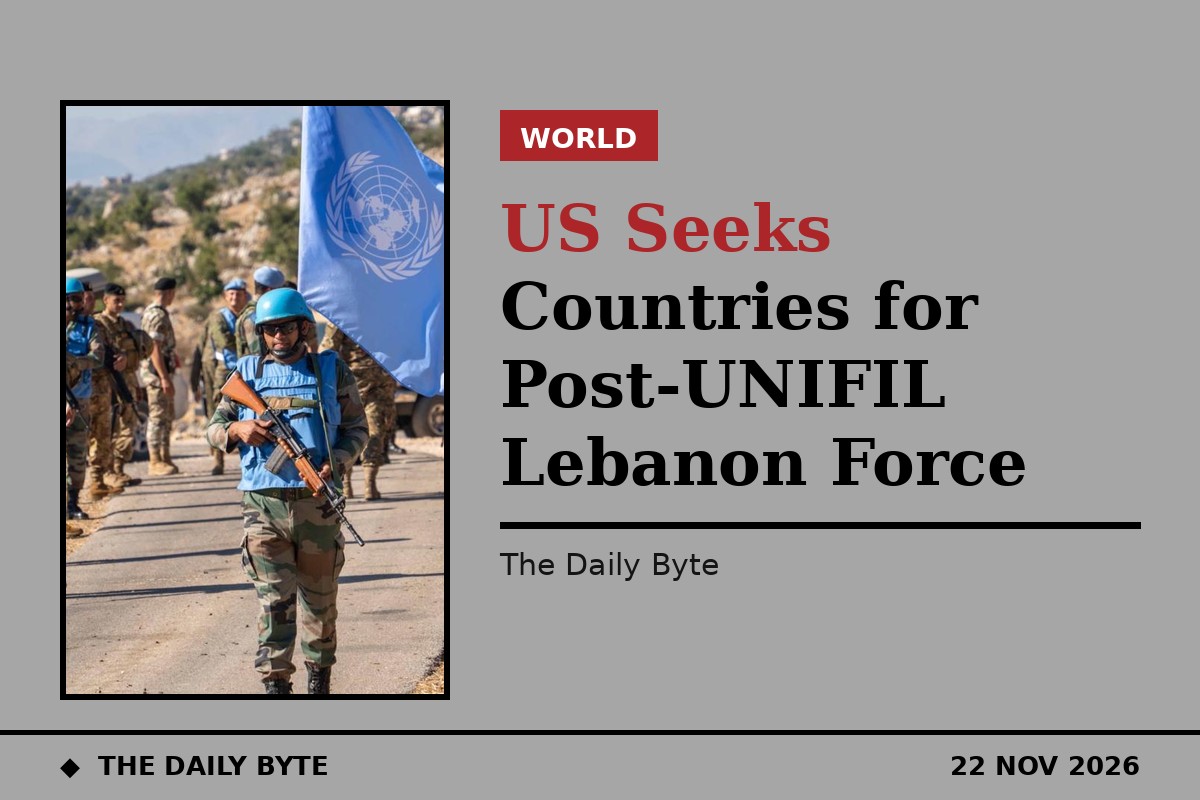
The United States is talking to several countries about setting up an international force to verify the removal of Hezbollah's weapons in Lebanon, Washington's ambassador to the United Nations has confirmed, with six weeks to go before the UN peacekeeping mission UNIFIL ends its operations. Mike Waltz said on Friday, 20 November 2026, that the proposed mechanism would independently confirm that weapons caches, tunnels and military facilities linked to Hezbollah have been removed.
The talks come as UNIFIL prepares to end its current operations on 31 December 2026 under UN Security Council Resolution 2790, adopted in August 2025, after which the mission will begin an orderly and safe drawdown and withdrawal within one year. No final agreement has been announced on a replacement, and the United States has not named participating countries or an agreed mandate.
What is being proposed
Washington favours a smaller, non-UN verification body, reportedly modelled on the Multinational Force and Observers in the Sinai, rather than renewing UNIFIL or creating another traditional UN peacekeeping force. The mechanism would be largely civilian or lightly staffed, monitoring and verifying compliance in designated pilot zones where the Lebanese Armed Forces deploy and Israeli forces withdraw.
A US-European proposal discussed in Beirut would field a force of up to 500 military experts to observe both sides of the border, documenting movements without combat duties, according to Sky News Arabia. That compares with about 15,000 troops in UNIFIL. France, meanwhile, is seeking support for a smaller European security force in the south, and any new mission operating under a UN mandate would require agreement within the Security Council.
Waltz's message in Beirut
Waltz visited Beirut on 16 November, meeting President Joseph Aoun, Parliament Speaker Nabih Berri and Prime Minister Nawaf Salam, and urged Hezbollah to give up its weapons voluntarily. "No country can have two armies," he said, adding: "I hope and pray Hezbollah will disarm. They should do that voluntarily."
Hezbollah has refused to surrender its weapons and has warned of internal conflict if disarmament is forced. The group was the only armed faction that refused to hand over its weapons after Lebanon's civil war ended in 1990, and it remains under pressure to disarm under the US-brokered framework agreed in June 2026.
What remains unresolved
Lebanon's preferred option remains an extension of UNIFIL's mandate, but Washington opposes that. Lebanese officials have said they want no security vacuum in the south after the mandate ends, full commitment to Resolution 1701, and support for the army to carry out its duties. The December deadline is approaching, but the political and security framework that could follow UNIFIL remains unresolved.
Frequently asked questions
When does UNIFIL's mandate end? UNIFIL ceases its current operations on 31 December 2026 under Security Council Resolution 2790, then begins an orderly drawdown and withdrawal within one year.
What would the new force do? It would verify, not enforce, the removal of Hezbollah's weapons, tunnels and military facilities. It would not be authorised to seize weapons or conduct compulsory disarmament.
Has anything been agreed? No. The United States has confirmed only that it is consulting several countries. No participating countries, mandate or deployment plan has been announced.
Sources: The National via Profile News; Sky News Arabia via Nibra News; Associated Press via Ya Libnan.


