S&P 500 enters correction as seven-day slide deepens
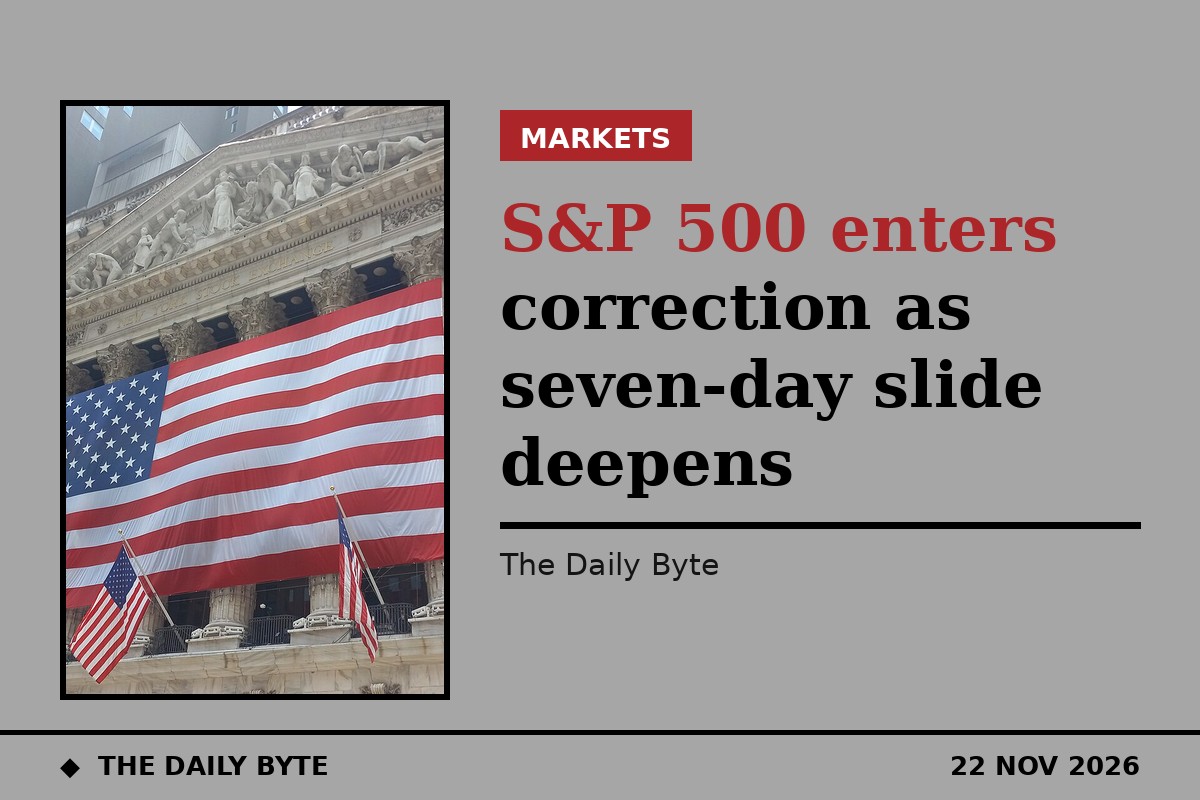
The S&P 500 entered correction territory on Friday, 20 November 2026, after a seventh consecutive daily fall took the index more than 10% below its record high of 6 October. The sell-off, which gathered pace through the week, has now wiped out most of the US market's gains for the year.
The S&P 500 fell 3.7% on Friday to close at 6,910.39, while the Nasdaq sank 5.61% to 25,028.98 and the Dow Jones Industrial Average lost 1.93% to 48,147.33, according to TipRanks. Reuters reported that the S&P 500 is now down 11.6% from its 6 October all-time high, after falling for seven straight sessions, its longest daily losing streak since the onset of the coronavirus pandemic in 2020.
A brutal week for US stocks
The week was the market's worst in more than 18 months. The S&P 500 fell 8.6% over the five trading sessions and the Nasdaq 100 dropped 10%, as investors pulled back from technology shares and other risky assets. The Nasdaq has now given up its entire gain for 2026 and is down 2.7% on the year, while the S&P 500 is up only 0.9% and the Dow 0.2%, according to Dow Jones Market Data cited by MarketWatch.
Volatility surged as the selling intensified. The Cboe Volatility Index, known as the VIX, closed on Friday at 35.89, its highest level since the tariff turmoil of April 2025. The 10-year US Treasury yield ended the week near 4.91%, down from about 5.15% a week earlier, as investors moved money into government bonds.
Why investors are selling
Two forces are driving the slide. First, doubts are growing about the artificial intelligence trade, including questions about whether heavy spending on data centres can be sustained. Second, the Federal Reserve has turned more hawkish: minutes from its 27-28 October meeting showed that nearly all policymakers expected another quarter-point interest rate increase in December, after the Fed raised its benchmark rate in September for the first time in three years.
Inflation is also running hotter than expected. The consumer price index rose 3.7% in the year to September, the highest reading since May, and the Cleveland Fed estimates headline inflation is trending towards 3.9% in November.
What happens next
Investors are now watching for signs that the selling is nearing an end. Some strategists say valuations have reset to more attractive levels and that weak investor sentiment has historically been a signal to buy, but others warn that negative momentum could push the market deeper. The Federal Reserve's next rate-setting meeting on 8-9 December is seen as a potentially pivotal moment.
Trading will be thinner next week, with US markets closed on Thursday for Thanksgiving and closing early, at 1 p.m. Eastern, on Black Friday.
Frequently asked questions
What is a stock market correction? A correction is a fall of at least 10% from a recent closing high. The S&P 500 has now fallen more than 10% from its 6 October record high.
How long is the S&P 500 losing streak? Seven straight daily falls, the longest run of declines since the coronavirus pandemic began in 2020.
Why is the VIX so high? The VIX, Wall Street's fear gauge, closed at 35.89 on Friday, its highest since April 2025, reflecting a sharp rise in expected market volatility.