US tightens Iran blockade with curbs on ship-to-ship oil transfers at sea
By The Daily Byte
·20 Nov 2026
·4 min read
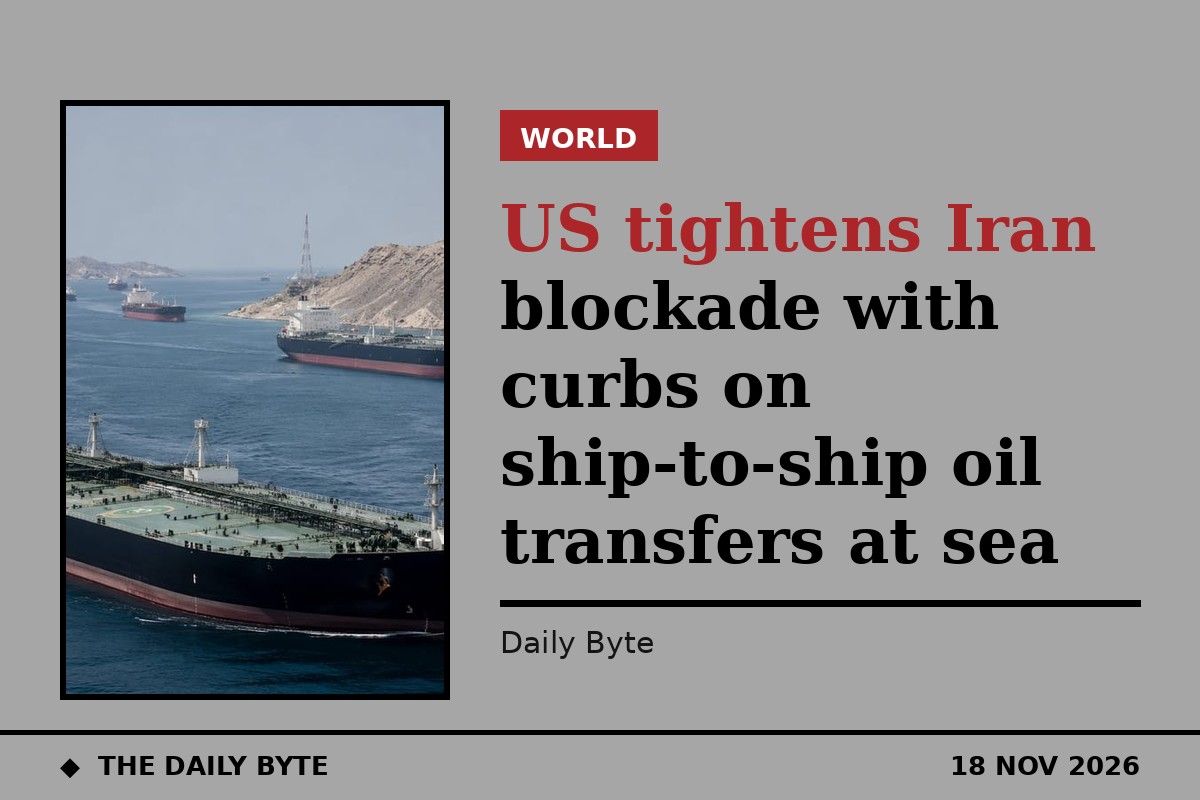
The United States has tightened its naval blockade of Iran, warning that ships which receive cargo at sea from vessels loaded in Iran may be treated as trying to evade the blockade and could face action. The new guidance was set out in an advisory issued by US Central Command (CENTCOM) on Wednesday 18 November 2026.
Under the advisory, a ship that takes cargo in a ship-to-ship transfer from a vessel subject to the blockade, where the cargo was loaded at an Iranian port or along Iran's coastline, may be considered to be evading the blockade — even if the receiving ship has never entered an Iranian port or approached the Iranian coastline.
"Any ship that receives cargo via a ship-to-ship transfer with a vessel subject to the blockade and carrying cargo loaded at an Iranian port or coastline may be considered to be evading the blockade, even if it has not entered Iranian ports or the Iranian coastline," CENTCOM said in the update.
## What happens to ships that break the rules
CENTCOM said such ships "may be stopped, boarded, diverted, captured, or directed to proceed to the Iranian port where the cargo originated". Ships that fail to comply immediately with lawful orders from blockade or boarding forces could face enforcement action, "including the use of force consistent with applicable law", the advisory added.
The update does not close the Strait of Hormuz to ordinary shipping. The blockade "will not impede neutral transit passage through the Strait of Hormuz to or from non-Iranian destinations", according to the CENTCOM guidance reported by maritime specialists.
## How the blockade has developed
The US naval blockade on Iran-related oil exports was first imposed on 13 April 2026. It was lifted in June after Washington reached a draft understanding with Tehran, then reimposed on 14 July after the agreement collapsed. Wednesday's advisory closes a gap in that enforcement: cargo can change vessels at sea without the receiving ship ever calling at an Iranian port, making the origin of the oil harder to trace.
Ship-to-ship transfers are a legitimate part of international oil transport, but they can also be used to move restricted cargo between vessels before it reaches its final destination. The new guidance makes clear that Washington will treat the receiving vessel, not only the ship that loaded in Iran, as part of the evasion.
## Has the blockade stopped Iranian exports?
Iran's crude exports have remained near a standstill for months, shipping sources say, although Iran has managed to export some liquefied petroleum gas and jet fuel since July despite the blockade, according to shipping intelligence and security sources who spoke to Reuters in October.
The advisory came a day after US fighter jets fired on a Revolutionary Guards missile launch site on Qeshm Island in the Strait of Hormuz, and on the same day Iran launched drone and missile attacks on US-linked targets in Kuwait and Bahrain. The exchanges underline how the maritime and military pressure on Tehran is running in parallel, even as Qatari-mediated talks continue in an effort to bridge the gap between the two sides.
The advisory was reported by [Reuters](https://www.reuters.com/business/energy/us-tightens-iran-blockade-with-curbs-oil-transfers-sea-advisory-shows-2026-11-18/) and by maritime news outlet [gCaptain](https://gcaptain.com/u-s-targets-ship-to-ship-transfers-in-expanded-iran-maritime-blockade/), which carried the full CENTCOM wording.
## Frequently asked questions
**What has changed?**
Ships receiving cargo at sea from a vessel loaded in Iran may now be treated as evading the blockade, even if they never entered Iranian waters or ports.
**What can the US do to such ships?**
CENTCOM says they may be stopped, boarded, diverted, captured or ordered back to the Iranian port where the cargo originated.
**When was the blockade imposed?**
It was first imposed on 13 April 2026, lifted in June, and reimposed on 14 July after a draft understanding between Washington and Tehran collapsed.


