US and Venezuela sign military deal in Caracas
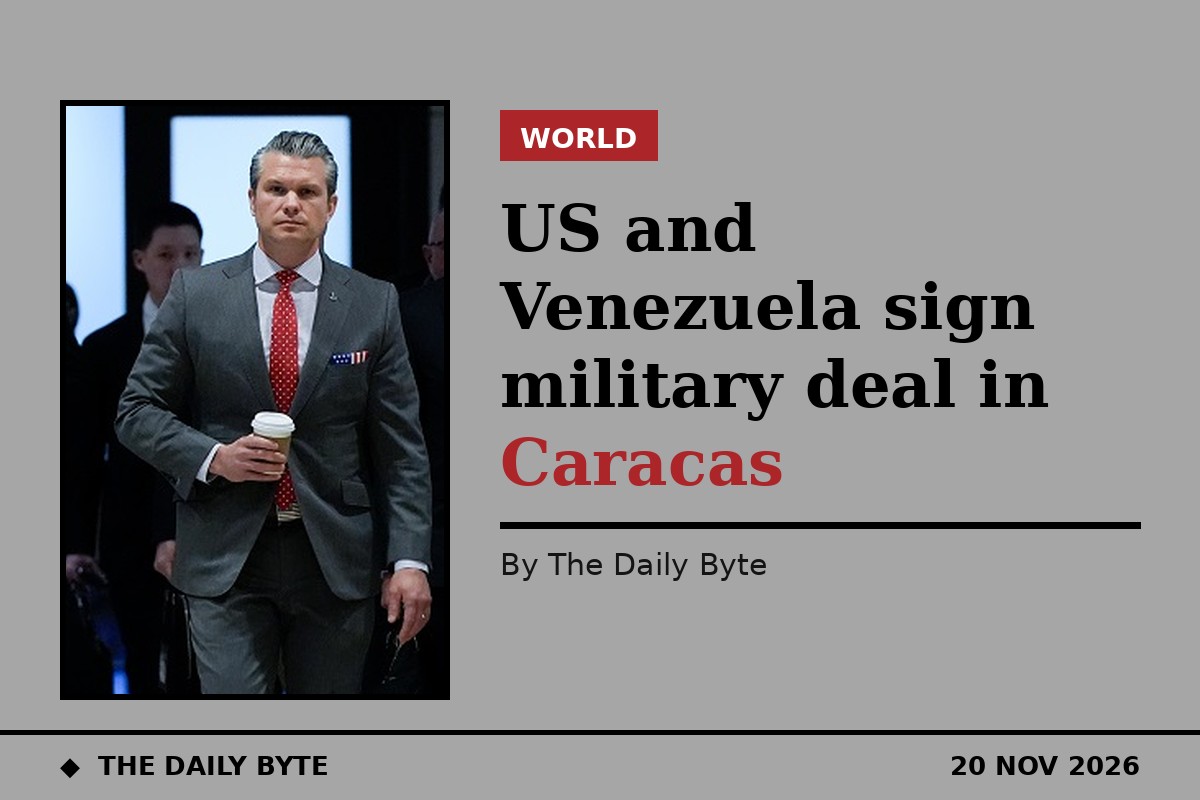
The United States and Venezuela have signed an agreement to re-establish military cooperation, in the most striking turn yet in relations between the two countries since American forces seized the former Venezuelan president Nicolas Maduro in January.
US Defence Secretary Pete Hegseth announced the deal on Wednesday, 18 November, during a surprise visit to Caracas, where he met the interim president, Delcy Rodriguez, at the Miraflores presidential palace. The agreement, signed with the Venezuelan defence minister, Gustavo Gonzalez Lopez, covers joint training, intelligence sharing and the supply of defence equipment, according to reports of the visit.
Speaking alongside Rodriguez in comments broadcast by state television, Hegseth said the two countries had agreed to strengthen their military forces and border security. He described Venezuela as having gone from America's "most aggressive regional threat to a compliant security partner", a phrase he repeated later at the newly reopened US embassy in Caracas.
Rodriguez welcomed what she called a restart of military cooperation to face "common threats". She said the renewed opportunity to strengthen the training of Venezuela's Bolivarian National Armed Force, improve its operational equipment and gain access to new technologies was highly beneficial for her country's military personnel. She offered no further detail on what the collaboration would involve in practice.
The visit was not announced in advance by the Pentagon, which provided no daily schedule for the secretary on the day of the trip. Hegseth had visited the headquarters of US Southern Command in Doral, Florida, the day before, and his tour of Latin America was reported to include further stops in Colombia, Ecuador and Honduras.
Few details of the agreement itself have been made public. The timeline and the scope of the deal remain unclear, and the US Defence Department has not answered questions about its terms. Hegseth said only that the two militaries would be "training together, partnering together, sharing intelligence, more defence equipment and capabilities together".
The pact restores a relationship that was frozen for two decades. Military cooperation between the two countries, once among the closest in the region, was largely suspended after the United States imposed an arms embargo on Venezuela in 2006, during the presidency of Hugo Chavez. Hegseth is the first US defence secretary to visit Venezuela in the 21st century.
The change follows Operation Absolute Resolve in January, in which US special forces flew into Caracas and captured Maduro and his wife, Cilia Flores, taking them to the United States to face drug-trafficking charges. Hegseth has called the operation, which he said lasted 48 minutes, the most sophisticated military operation in Latin American history and a "day of liberation" for Venezuela.
Since then the two governments have signed oil deals and worked together against armed groups inside Venezuelan territory. Hegseth pointed to the killing in June of Hector "El Nino" Guerrero, the leader of the Tren de Aragua gang, as an example of that cooperation. He also repeated his support for President Donald Trump's three-phase plan for a democratic transition in Venezuela.
Trump described Venezuela on Wednesday as an American "acquisition", underlining how far Washington's posture has shifted from confrontation to direct involvement in the country's affairs. What remains uncertain is who will lead Venezuela in the coming months and years, and whether the new military partnership will survive the political transition that Washington says it wants to see.
Sources: Reuters; Associated Press


