Third US Carrier Joins Middle East Iran Standoff
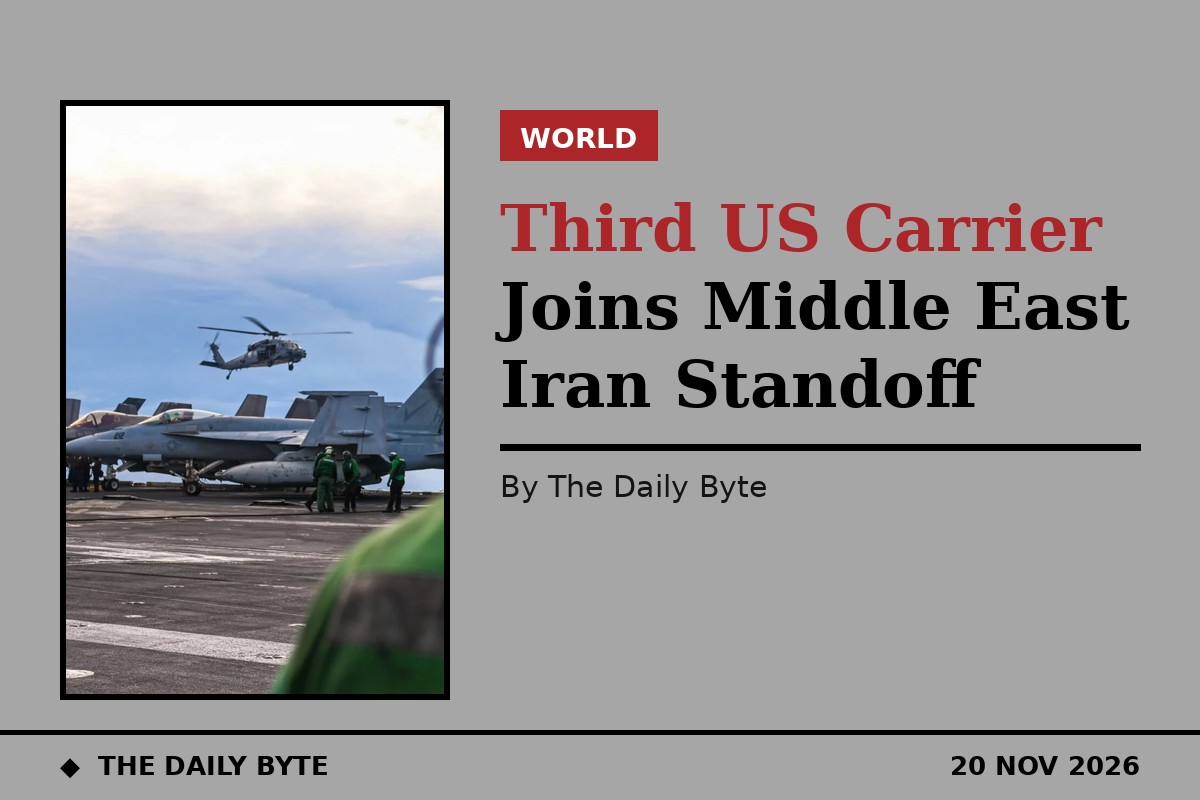
A third American aircraft carrier has arrived in the Middle East, a US official said on Monday, in a show of naval strength as President Donald Trump keeps his options open in the war with Iran. The USS Theodore Roosevelt joins two other carriers already enforcing a naval blockade of Iranian shipping.
The Roosevelt, along with its accompanying strike force, left San Diego in September and entered the US 5th Fleet area of operations on Sunday, according to USNI News. It joins the USS George H.W. Bush, which arrived in the region in April, and the USS George Washington, which arrived in August. The Associated Press reported that three carrier strike groups operating together in the Middle East is rare: the Navy previously reached that number in April, for the first time since the 2003 invasion of Iraq.
What the flotilla now looks like
Alongside the three carriers, the flotilla in the Arabian Sea now includes 13 destroyers, two cruisers and a littoral combat ship, according to the Navy, with two more destroyers in the Red Sea. The Roosevelt is expected to relieve the George Washington, although it is not clear how long the George Washington will remain in the region.
The Roosevelt deployed together with the USS Makin Island amphibious readiness group, which includes the landing ships USS John P. Murtha and USS Anchorage and around 2,000 Marines. Those ships have yet to reach the region. The carrier's arrival also closes a long deployment for the ships it follows: the USS Abraham Lincoln headed home after 321 days at sea, while two of its escorts, the destroyers USS Michael Murphy and USS Spruance, returned to San Diego after 346 and 357 days respectively. The Spruance's deployment was the longest for a destroyer on record, and during it the ship disabled a cargo vessel as part of the blockade and shot down 12 drones and four anti-ship cruise missiles, according to the Navy.
Why the build-up matters now
The carrier's arrival comes as the conflict simmers in the Strait of Hormuz, the waterway through which a fifth of the world's oil passed before the war. US Central Command said it has redirected 150 merchant vessels and disabled five since June under the blockade, and independent assessments from Lloyd's List, a maritime tracking firm, show traffic through the strait remains at less than a third of pre-war levels.
Iranian state television, quoting the naval arm of the Revolutionary Guard and the army, warned shipping companies on Monday that a US-supported route through the waterway was dangerous because of mines. The Revolutionary Guard's navy said mines had damaged six oil tankers since Sunday. Separately, a projectile struck a tanker trying to transit the strait, starting an engine-room fire, the United Kingdom Maritime Trade Operations said, with no casualties reported. The mine claims have not been independently verified.
A president keeping his options open
The build-up lands in the middle of a shifting message from Washington. Mr Trump has oscillated between threatening additional large-scale strikes on Iran and insisting that the more than eight-month-old war is "militarily effectively over". Last week he warned Iran that the US military was "locked and loaded" and that it was watching Pickaxe Mountain, a facility linked to Iran's nuclear programme, for signs of activity. "If something does not work out, I would not hesitate" to act, he said.
At the same time, he has told reporters he believes it is highly unlikely he will need to order new major strikes, and has said the United States no longer needs a deal with Tehran. Negotiations have stalled over Iran's nuclear programme, which Mr Trump insists must be part of any deal, while Iran wants the United States first to agree to several conditions, including lifting the naval blockade that is stopping its oil from reaching world markets. The Roosevelt's arrival adds weight to both halves of that message: a force ready to strike, and a blockade intended to make striking unnecessary.


