Vanguard West and East Wind Farms Explained: £12bn Deal
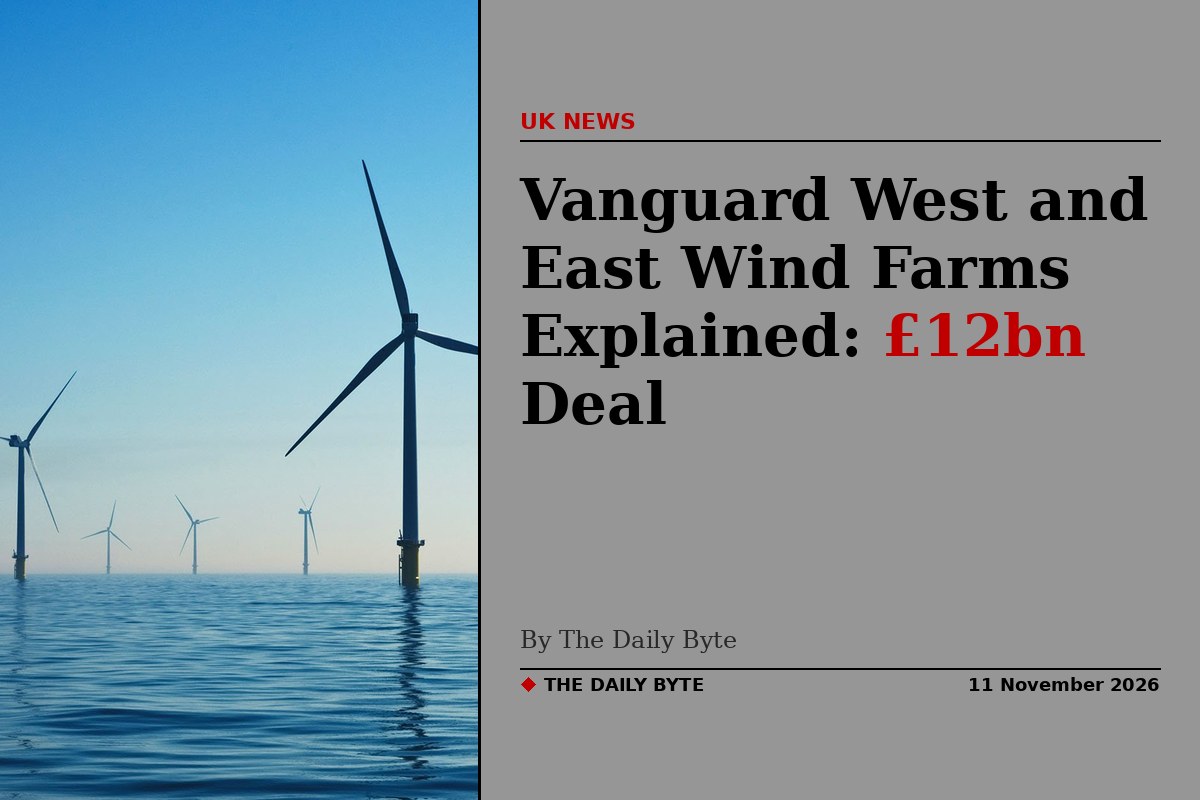
German energy company RWE and investment firm KKR have given the final go-ahead to two huge offshore wind farms off the Norfolk coast, in a £12 billion investment the government says is believed to be the biggest of its kind in UK history. The Vanguard West and Vanguard East wind farms will have a combined capacity of 2.8 gigawatts, enough to supply the equivalent of around three million UK homes, and are set to be fully operational by 2030. The announcement was made on Wednesday 11 November 2026, as Prime Minister Andy Burnham travelled to the COP31 climate summit in Antalya, Türkiye.
The decision, known in the industry as a final investment decision, means the developers have committed the money and the projects will now be built. Onshore works are already well advanced, offshore construction is due to begin in early 2027, and the first foundations for Vanguard West are expected to be installed in the first half of that year. For households, the promise is more homegrown electricity that is not exposed to the swings of global fossil fuel prices. For the coastal communities of East Anglia and Scotland, the promise is thousands of jobs.
What are Vanguard West and Vanguard East?
Vanguard West and Vanguard East are two offshore wind farms planned for the North Sea, between 50 and 80 kilometres off the Norfolk coast. Each will have an installed capacity of 1.4 gigawatts, giving a combined 2.8 gigawatts. Together they form one of the UK's largest offshore wind developments. Vestas has already secured contracts to supply 92 of its 15-megawatt turbines for each project, a combined order of 184 turbines.
Offshore wind farms work like onshore wind farms, but at a much larger scale. Turbines are fixed to the seabed in relatively shallow water, and their blades turn generators that produce electricity, which is then carried ashore through subsea cables. Being far out at sea means the turbines can be bigger and catch stronger, steadier winds than those on land, which is why a single modern offshore turbine can generate far more power than an older onshore one. The Vanguard turbines, at 15 megawatts each, are among the largest in commercial use.
| Detail | Vanguard West and Vanguard East |
|---|---|
| Location | 50 to 80 km off the Norfolk coast, North Sea |
| Capacity | 2.8 GW combined, 1.4 GW each |
| Turbines | 184 Vestas 15 MW turbines, 92 per project |
| Total investment | Around £12 billion, about $16 billion |
| Jobs | More than 2,400 during construction and operation |
| Homes supplied | Equivalent of around three million UK homes |
| Offshore construction | Begins early 2027; first Vanguard West foundations in the first half of 2027 |
| Fully commissioned | 2030 |
Who is paying the £12 billion?
The £12 billion covers the wind farms and their associated transmission infrastructure, and it comes from a mix of private money, bank lending and public investment. RWE and KKR have completed a 50:50 joint venture for the two projects, with KKR acquiring a 50 per cent stake in each. The two companies first announced their joint venture partnership in January 2026, and RWE will lead construction and project delivery.
The partners have secured £11.1 billion in cash financing and a further £1.7 billion in ancillary facilities from a consortium of 35 international banks, which the companies describe as the largest non-recourse project financing secured for UK offshore wind. Non-recourse financing means the loans are secured against the projects themselves and their future revenues, rather than against the wider balance sheets of the companies behind them. The financing also includes a £1 billion commitment from the UK's National Wealth Fund, alongside credit support from Germany's Euler Hermes and Denmark's EIFO, the export credit agencies of the two countries.
Reuters, reporting the deal on 11 November, put the total at around £12 billion, or $16.02 billion, and described it as one of the biggest renewables investments in the country. The government said it believed the investment was the biggest of its kind in UK history to date.
How many jobs will the wind farms support?
The government says the investment will support more than 2,400 jobs during the construction and operation phases. Those jobs span manufacturing, engineering, construction and the long-term operation and maintenance of the turbines once they are generating power. Prime Minister Andy Burnham said the investment was a vote of confidence in building in Britain, and that coastal communities from Scotland to East Anglia would benefit from the jobs and opportunities it brings.
The announcement also included news from SSE, the Scottish-headquartered energy company, about its Berwick Bank B project. SSE said the latest phase of its major offshore wind farm, off the east coast of Scotland in the outer Firth of Forth, around 38 kilometres offshore, will back 2,677 skilled jobs in manufacturing, engineering and project delivery across the north of England and Scotland. That includes the creation of 130 new project delivery roles, 80 new SSE roles in Glasgow and 50 new Siemens Energy roles at Montrose Port. Siemens Energy has been chosen as the preferred supplier for turbines and substation platforms for Berwick Bank B. At its full capacity, Berwick Bank could become the world's largest offshore wind farm, capable of meeting more than 6 per cent of current UK electricity demand.
What is a Contract for Difference, and what price did Vanguard secure?
One detail matters a great deal to how much the electricity will cost. Both Vanguard projects secured 20-year Contracts for Difference in the UK's Allocation Round 7 auction in January 2026, at a strike price of £91.20 per megawatt hour in 2024 prices. A Contract for Difference, usually shortened to CfD, is a government-backed contract that gives a wind farm a stable price for the electricity it generates. If the market price falls below the agreed strike price, the government tops it up. If the market price rises above it, the generator pays the difference back. The system is designed to give investors the certainty they need to build expensive infrastructure, while protecting consumers from paying more than the agreed price when wholesale prices spike.
The strike price is set in 2024 prices and indexed to inflation, so the figure that applies when the wind farms start generating in 2030 will be higher in cash terms. The 20-year term means the price support runs well into the 2050s. Supporters of the system argue it has been central to the fall in offshore wind costs over the past decade. Critics note that the price agreed in the latest auction round is higher than in earlier rounds, reflecting higher construction costs, interest rates and supply chain pressures. Either way, the CfD is the financial foundation that allowed RWE and KKR to reach financial close on a £12 billion project.
What is the National Wealth Fund, and why is it involved?
The National Wealth Fund is the UK's publicly owned policy bank, and its £1 billion investment in Vanguard is its largest in offshore wind to date. The fund aims to drive more than £100 billion of finance into the UK economy, using public money to unlock private investment and generate a return for the taxpayer. The idea is that a public commitment of this size reduces the risk for private investors and helps very large projects reach the point where they can be built.
The government also recently announced a new, additional Energy Wealth Fund, which will be linked to the government's future revenues from the North Sea. It will invest in renewable and low-carbon energy projects and support the net zero transition, starting with a £2 billion injection of funding. Energy Secretary Miatta Fahnbulleh said that as the world gathers at COP31, Britain is leading from the front as a renewable energy powerhouse, turning the fight against climate change into a brighter future for British companies, industrial communities and future generations.
Why does this matter for energy bills and energy security?
The government presents the Vanguard investment as serving two goals at once: cheaper bills over time and greater energy security. Electricity generated in British waters is not exposed to the global gas and oil price shocks that pushed household energy bills sharply higher in recent years. Prime Minister Burnham said every turbine put up was power under British control, not at the mercy of events on the other side of the world, and that a clean energy future was one that brings down bills.
RWE chief executive Markus Krebber said the two companies were delivering two of the UK's largest offshore wind projects, strengthening domestic electricity generation and making an important contribution to the country's long-term energy security. KKR's co-head of European infrastructure, Vincent Policard, said private capital could help turn the UK's energy ambitions into reality, supporting economic growth and delivering infrastructure capable of powering around three million UK homes.
There are limits to what the announcement promises. The wind farms will not be generating power until 2030, so they will not affect bills this winter. The government is separately protecting households this winter through removing standing charges and giving households £100 to help them pay their bills. Last week also saw the introduction of the Energy Independence Bill, which the government describes as a down payment on reforms to put affordability at the heart of the energy system, including bringing rogue operators under greater public oversight, strengthening protections for households and businesses, and giving local people more control over the clean energy projects built around them.
Why was the announcement timed with COP31?
The timing was deliberate. COP31, the 31st United Nations climate conference, opened in Antalya, Türkiye, on 9 November 2026 and runs until 20 November, with a World Leaders' Summit on 11 and 12 November. Prime Minister Burnham is attending the summit and is due to deliver a speech on Thursday. The government framed the Vanguard announcement as evidence of Britain's action on climate change and clean energy ahead of that appearance, and SSE chief executive Martin Pibworth said there was already a clear acknowledgement that clean electrification was the route to decarbonisation, greater energy security and sustainably lower bills, and that he hoped to see the ambition needed to turn that recognition into more investment like this.
What happens next?
The project now moves from financing into construction. Onshore works, including cable works and substation construction, are already well advanced. Offshore construction is scheduled to begin in early 2027, with the first foundation installation for Vanguard West planned for the first half of that year, followed by Vanguard East. Both developments are scheduled for full commissioning in 2030, when they should be generating enough electricity to supply the equivalent of approximately three million UK homes. For Norfolk, the next visible signs will be offshore: installation vessels, foundation works and, over the following years, 184 turbines rising from the North Sea.
Frequently asked questions
Where are Vanguard West and Vanguard East? Both wind farms are in the North Sea, between 50 and 80 kilometres off the Norfolk coast in East Anglia.
How much power will they generate? The two projects have a combined capacity of 2.8 gigawatts, 1.4 gigawatts each, enough to supply the equivalent of around three million UK homes once fully operational.
When will they be finished? Offshore construction starts in early 2027, with the first Vanguard West foundations in the first half of 2027. Both projects are scheduled to be fully commissioned in 2030.
Who owns the projects? RWE and KKR own them through a 50:50 joint venture, with KKR holding a 50 per cent stake in each project. RWE leads construction and project delivery.
What is the National Wealth Fund's role? The fund is investing £1 billion, its largest investment in offshore wind to date, as part of the financing package. It aims to use public money to unlock private investment.
Will the wind farms lower my energy bill? Not immediately. They will not generate power until 2030. The government's argument is that more homegrown clean power will protect the UK from global fossil fuel price shocks and help bring bills down over the longer term.
Sources: GOV.UK, 11 November 2026 and Reuters, 11 November 2026. Further project details confirmed in Splash247, 11 November 2026.