Venezuela workers stage 12-hour national strike
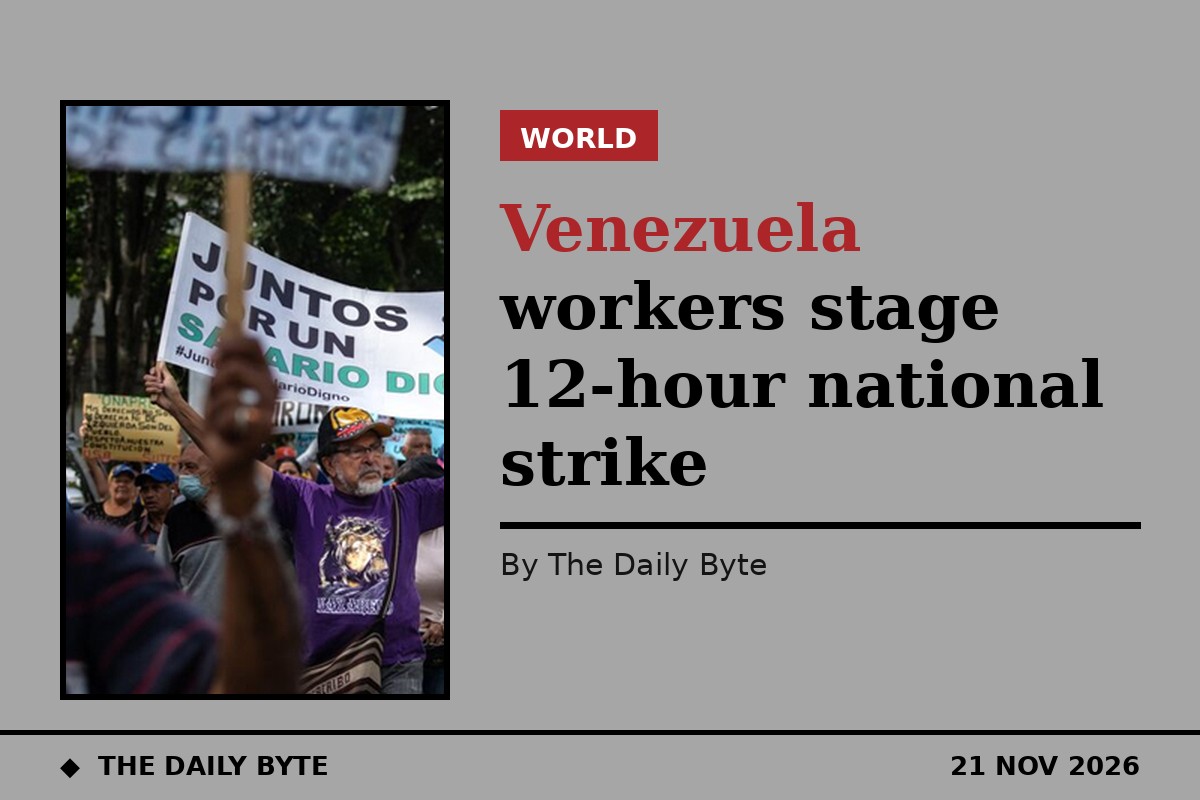
Healthcare workers, public school teachers and employees at Venezuela’s public universities held a 12-hour nationwide strike on Monday, demanding decent wages and year-end bonuses they say are worth a fraction of what they are owed.
More than 120 labour unions and professional associations organised the walkout, which ran from 7am to 7pm. It was the first nationwide strike to confront the interim government of acting President Delcy Rodríguez.
Unions are demanding year-end bonuses calculated on a monthly income of $240, equivalent to $960 for four months. The government has announced payments totalling $150 in two instalments.
A $74 payment sparked the walkout
The protest gained momentum after public employees began receiving their first year-end bonus payment on Friday 13 November: 67,500 bolívares, approximately $74 at the Central Bank’s exchange rate.
José Gregorio Afonso, president of the Central University of Venezuela Professors’ Association, reported that all 19 universities affiliated with the Federation of University Professors’ Associations joined the strike. He described the payment as “something absolutely outrageous when ministers claim we earn $500”.
Afonso said the strike followed the government’s failure to respond to a list of demands submitted on 13 October at Miraflores Palace. Workers are seeking a genuine salary increase rather than additional bonuses, he said.
Eduardo Sánchez, a representative of the Central University of Venezuela Workers’ Union, said “all university faculties are closed” and warned that the protests are only beginning.
Schools empty, hospitals at 80 per cent
Carmen Teresa Márquez, president of the Venezuelan Federation of Teachers, estimated that 80 per cent of schools took part. She thanked parents for keeping their children home and said schools were “open, but there are no students or teachers”.
Márquez rejected the $150 bonus, demanded a year-end payment exceeding $500, and called for negotiations to review collective bargaining agreements and social security benefits.
In the healthcare sector, Mauro Zambrano, coordinator of the Venezuelan Trade Union Network, reported that more than 80 per cent of the country’s hospitals participated, including the Concepción Palacios Maternity Hospital and Vargas Hospital. He warned that without answers, “we will block the highway every day” until workers secure decent bonuses.
Nursing unions and healthcare workers’ organisations took part while maintaining emergency services and critical care. The Venezuelan Medical Federation did not officially join the strike, saying organisers had not consulted it and describing the call as poorly timed.
“What can a worker do with 4,000 bolívares?”
Workers at the demonstrations spoke of pay that barely covers the basics. “We are protesting for decent wages and decent year-end bonuses. The government has mocked us,” worker Luis Gómez told The Daily Journal. He said he had received 4,000 bolívares in year-end bonuses. “What can a worker do with 4,000 bolívares?”
One teacher at the protest demanded a $1,500 year-end bonus, a collective bargaining agreement, health insurance, a professional development bonus and food allowances. “I earn 359 bolívares every two weeks. That’s not even half a dollar,” she said.
Pablo Zambrano, a union leader and secretary-general of FETRASALUD, questioned the government’s statements about national revenue, noting that Rodríguez had spoken of 23 consecutive quarters of economic growth. “They talk to us about money, they talk about funds… where is the money?” he asked.
Demonstrators also denounced what one worker described as a “disproportionate” deployment of military and police personnel against teachers and healthcare workers.
Highway blocked in Caracas
In Caracas, workers gathered at the covered plaza of the Central University of Venezuela Rector’s Office and near the Ministry of Finance. Before noon, protesters blocked the westbound lanes of the Francisco Fajardo Highway near Plaza Venezuela.
Demonstrations also took place in Lara, Carabobo, Portuguesa, Barinas, Monagas and Bolívar states.
Rodríguez has promised that workers’ incomes will increase every quarter throughout 2027. Union representatives were due to meet on Tuesday 17 November to assess the strike and determine their next steps.


