Victoria Election Result: Liberals Win, Jess Wilson Premier
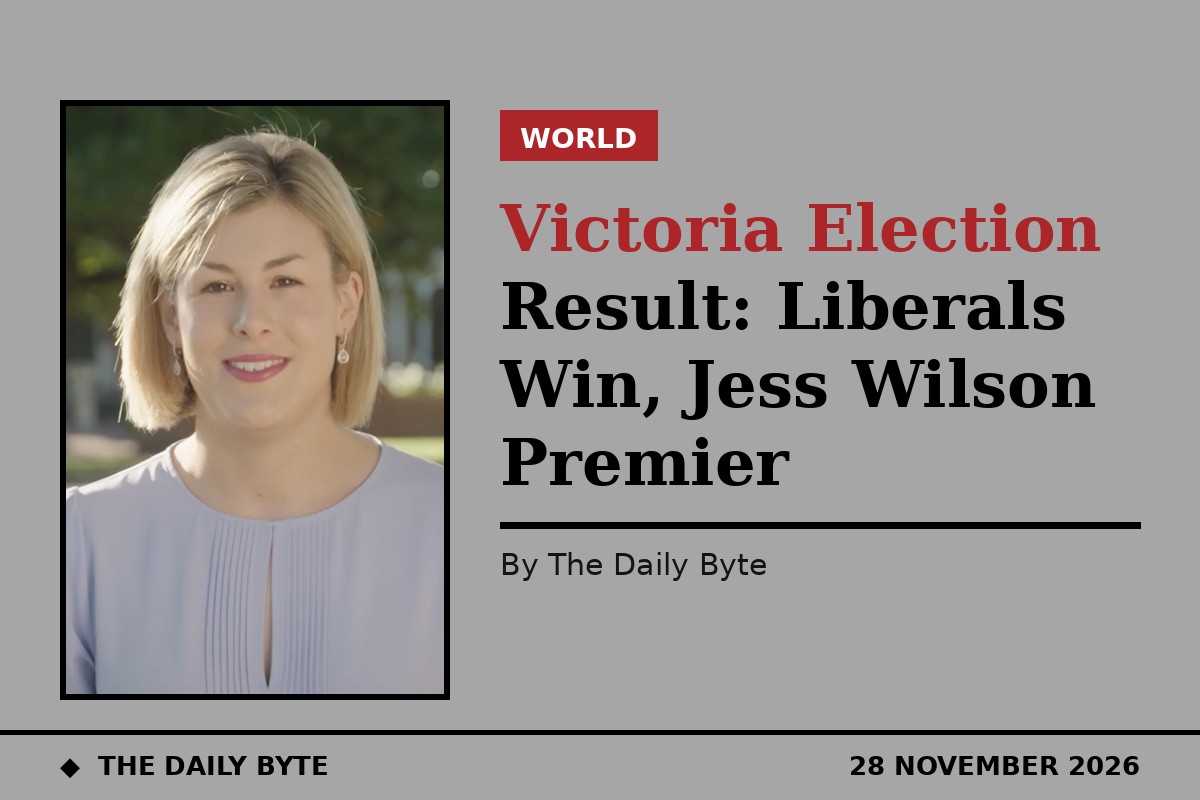
The Liberal-National Coalition has won the 2026 Victorian state election, ending 12 years of Labor government in Australia's second most populous state. Liberal leader Jess Wilson, 36, will become Victoria's 51st premier.
The ABC's election analyst, Casey Briggs, called the election for the Coalition shortly before 8pm on Saturday, after polls closed at 6pm. By 8pm, with 6.4 per cent of the vote counted, the Coalition had won 28 of the 88 seats in the Legislative Assembly, with 56 seats still in doubt. Forty-five seats are needed for a majority.
Early counting showed the scale of Labor's collapse. The Coalition was on about 34 per cent of the primary vote, while One Nation was on about 23.5 per cent, the Greens on 15.9 per cent and Labor on only about 15.6 per cent. That represents a swing of about 21 points against Labor.
A historic defeat for Labor
Labor has governed Victoria since Daniel Andrews led the party back to power in 2014. The party was seeking a fourth consecutive term under Ben Carroll, who became premier in July 2026 after Jacinta Allan stepped down. Allan is retiring from parliament at this election.
Carroll was projected to lose his own seat of Niddrie, in Melbourne's inner west, which he has held since 2012. At the first booth counted there, he was third on 11 per cent of the vote, and the ABC reported a 17.7 per cent swing to the Liberals with 7.9 per cent of the vote counted. The last time a Victorian premier lost their seat was Ian Macfarlan, a Liberal, in 1945.
Deputy Premier Gabrielle Williams described the result as "simply devastating". She said Labor's primary vote had fallen by more than 25 points in seats such as Yan Yean, Eureka and Ripon. Former premier Steve Bracks said it was going to be a big loss for Labor and suggested the party may have done better if Carroll had been given longer to set out a new direction. "I would've liked Ben to have a bit more time, he came in too late," he said.
Carroll later called Wilson to concede defeat, according to Guardian reporting, and the ABC reported his concession to supporters at Labor headquarters.
One Nation emerged as a serious force in a state where it has never held a lower house seat. Federal MP Barnaby Joyce, at the party's election night event, said the party would do very well in the upper house. The Greens also ran ahead of Labor in the early count, taking Northcote in Melbourne's inner north from Labor.
Who is Jess Wilson?
Wilson, born in 1990, will be Victoria's first millennial premier and the first woman to lead the state's Liberal Party. She entered parliament in 2022 as the member for Kew and became party leader unopposed in November 2025, after Brad Battin was ousted. It was the party's fifth leadership change in seven years.
The daughter of former Liberal MP Ron Wilson, she is a former president of the Victorian Young Liberals. She worked at KPMG, as an adviser to former federal treasurer Josh Frydenberg and as a policy adviser at the Business Council of Australia. She has described her politics as "classic Liberal".
The Liberals have been in opposition since 2014 and had formed government only once this century before Saturday, winning the 2010 election. Wilson has promised to serve as her own treasurer for at least the first 100 days of government.
Her costings, released two days before the vote, rested on a 90-year lease of Melbourne's sewerage network to cut about $20 billion from state debt, with savings from level crossing removals and kindergarten hours.
What happens next
Counting continues on Sunday, including postal and pre-poll votes. More than half of the state's eligible voters had already voted before election day, according to the Victorian Electoral Commission. The final shape of the parliament, including how many seats One Nation and the Greens win and whether Carroll holds Niddrie, may take days to settle.
Wilson is expected to be sworn in once the result is formally confirmed. If Carroll loses his seat, Labor will need a new leader. The result will also be read in Canberra as a warning about where disaffected Labor voters are going, with Victoria having been Labor's strongest state for a decade.


