Vietnam Ends Death Penalty for Drug Trafficking
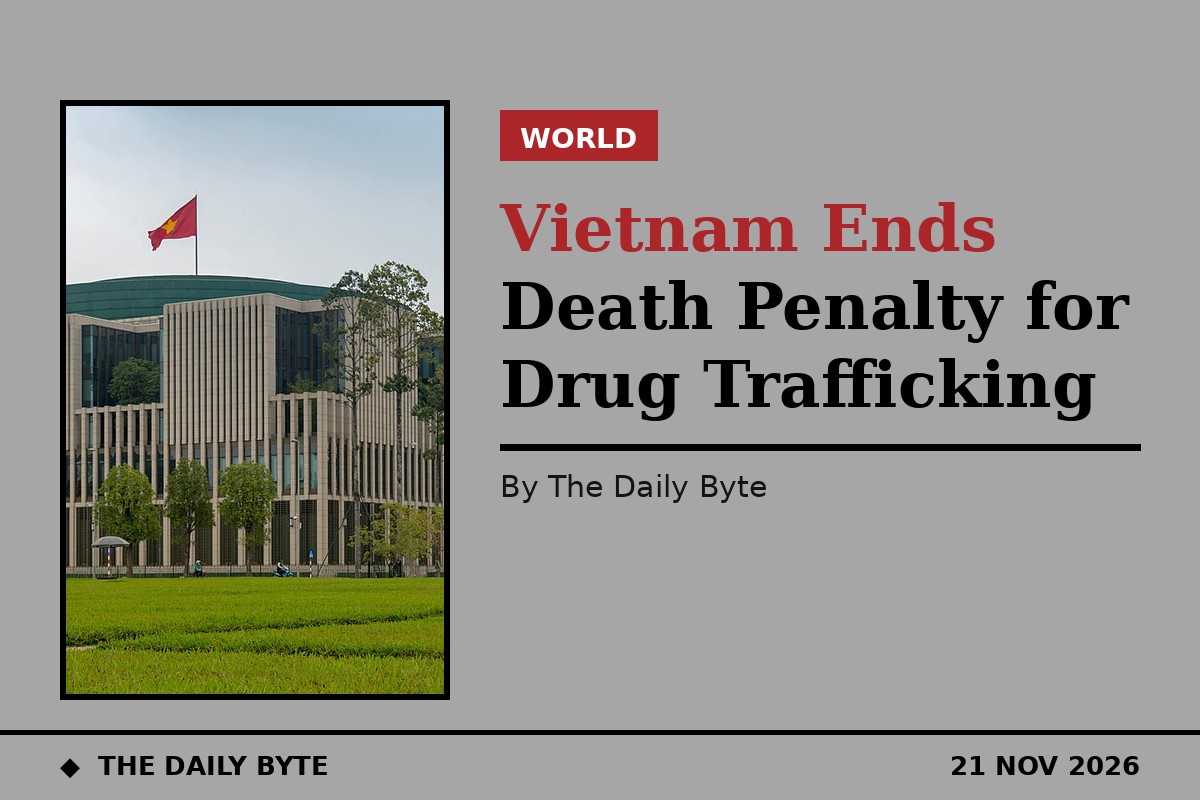
Vietnam’s National Assembly has voted to remove the death penalty for drug trafficking and five other offences, in the most significant narrowing of capital punishment in the country for decades.
The revised Penal Code was passed in Hanoi on Friday 20 November, with 463 of the 472 deputies present voting in favour. From 1 March 2027, when the code takes effect, life imprisonment will be the harshest sentence available for the six offences removed from the capital list.
The six are illegal trafficking of narcotic substances, rape of a person under 16, rebellion, crimes against humanity, war crimes, and terrorism aimed at opposing the people’s administration. The last of those will be folded into the broader offence of terrorism, which remains punishable by death.
Once the change takes effect, execution will remain available for only four crimes: treason, murder, terrorism and the illegal production of narcotic substances. Drug trafficking had been one of 10 capital offences, and the original 1985 Penal Code listed 44.
Why the government backed the change
Public Security Minister Luong Tam Quang defended the proposal in the Assembly despite reservations from some deputies, who argued that capital punishment should be kept for drug trafficking and the rape of children because of the seriousness of the crimes.
Quang told lawmakers that evidence showed some people involved in trafficking had been drawn into it through deception or force, and that they could be rehabilitated. “They can still be rehabilitated, educated and given the chance to make amends for their actions. So it’s not necessary to impose the death sentence,” he said.
The government also argued that there was no convincing evidence execution deters drug crime more effectively than life imprisonment, saying traffickers usually expect their operations to go undetected rather than weighing the difference between possible sentences. It said stronger investigation, faster detection, the dismantling of criminal networks and the seizure of criminal profits were better deterrents.
The government drew a line between trafficking and the illegal production of drugs, which stays a capital offence, saying the two crimes differ in nature and seriousness.
What happens to people already sentenced to death
The new rules will apply to trials held on or after 1 March 2027, even when the alleged offence took place earlier. People already sentenced to death for any of the six offences will have their sentences changed to life imprisonment if they have not been executed, with the chief justice of the Supreme People’s Court to issue the commuting decisions.
A separate resolution on how to put the revised code into effect is due to take effect on 3 December 2026. The code also allows courts, in specified circumstances, to impose a sentence below the minimum for an offence, including where a defendant voluntarily confesses, cooperates or compensates for the harm caused.
The change arrives as Vietnamese courts have been handling major trafficking prosecutions. In September, 11 people were sentenced to death in a case involving an alleged network that moved drugs from France to Vietnam; they were among 227 defendants, and around 20 others received life sentences.
The case began in March 2023, after four Vietnam Airlines flight attendants arrived in Ho Chi Minh City from Paris with more than 10 kilograms of drugs concealed in 157 toothpaste tubes. The attendants were not prosecuted, with the authorities saying they had carried the drugs unknowingly. Investigators named Ha Danh Nam as the alleged mastermind, and prosecutors said transactions linked to the network totalled nearly 29 trillion Vietnamese dong. If any of the 11 death sentences remain unexecuted when the revised code applies, they will have to be commuted to life imprisonment.
A long, gradual reduction
The vote continues a long reduction in the use of capital punishment in Vietnam. Amendments that took effect in July 2025 removed the death penalty for eight offences, including embezzlement, and the 1985 code’s 44 capital offences have been cut step by step ever since.
Vietnam changed its method of execution in 2013, replacing firing squads with lethal injection. The government has not publicly disclosed the number of executions. Amnesty International estimated that more than 1,200 people were on death row at the end of 2023, although the number of sentences that will be commuted under the new law has not been announced.
For the six offences, the maximum sentence from March will be life imprisonment. For the four that remain capital, the death penalty stays. The Assembly’s vote settles the question for now, but the test of the change will come in the courts, as judges begin applying the new code to the trafficking cases that have filled Vietnam’s dockets.


