Vietnam Passes SME Law Backing Small Firms
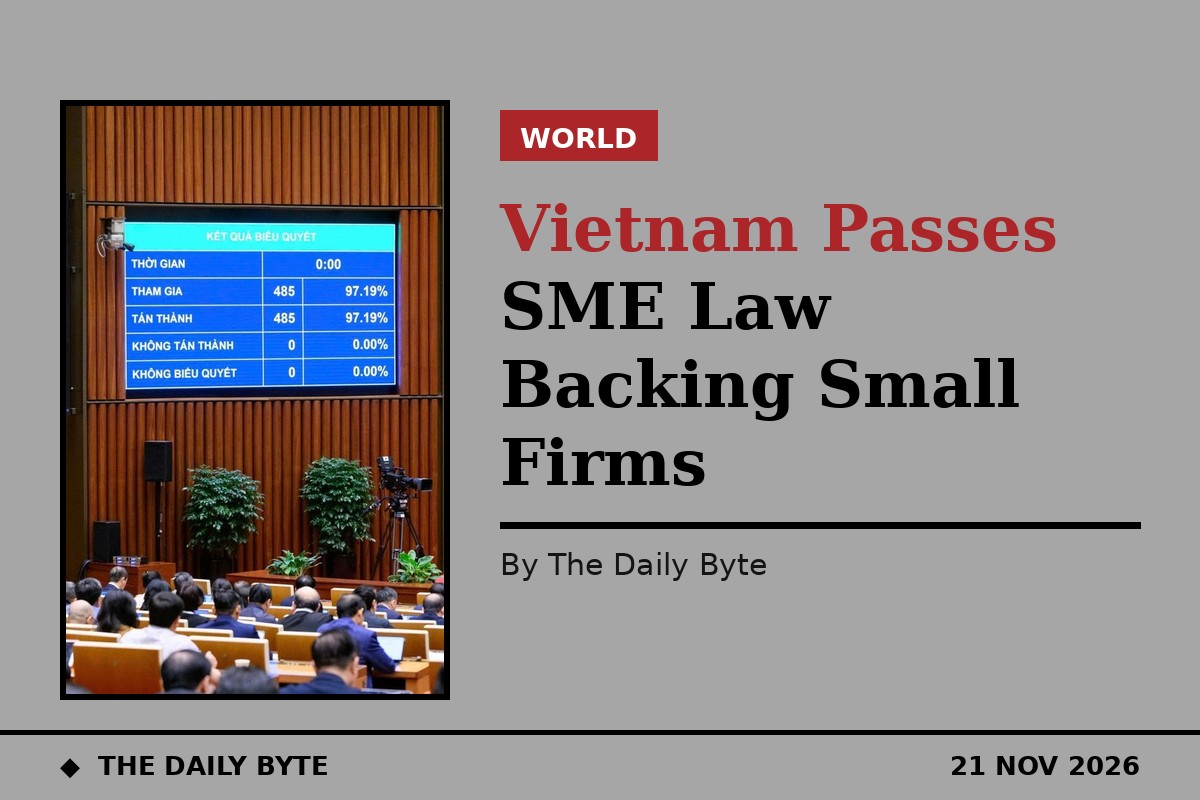
Vietnam's National Assembly has passed a new law to support small and medium-sized enterprises, voting unanimously in favour of measures that ease tax, registration and land rules for the businesses that make up almost the entire private sector.
The Law on the Development of Small and Medium-Sized Enterprises was passed on 20 November with 100 percent of participating lawmakers voting in favour, providing a legal basis for coordinated support for smaller businesses, from tax incentives and simplified procedures to help for household businesses converting into companies.
Vietnam has more than 1.1 million businesses, and nearly 98 percent of them are small and medium-sized enterprises. The law defines them as micro, small and medium-sized enterprises with an average workforce of no more than 300 employees in the preceding year, and meeting one of two tests: total capital of no more than 150 billion dong in the preceding year, or total revenue of no more than 400 billion dong.
Businesses are classified into three sector groups, agriculture, forestry and fisheries; industry and construction; and trade and services, and the Government will set detailed criteria for identifying each group, including for newly established businesses.
Tax breaks and a choice of tax method
Support will come not only from the state budget but also through policies cutting taxes, fees, charges, land rentals and land-use levies, as well as other legitimate resources from domestic and foreign organisations and individuals. State budget support can take several forms, including vouchers, placing orders, directly carrying out support tasks and selecting contractors under the bidding law.
On tax, micro and small enterprises may apply corporate income tax rates lower than the standard rates under the corporate income tax law, and newly established small and medium-sized enterprises are exempt from corporate income tax in their initial period after establishment. Businesses with annual total revenue of no more than 10 billion dong, or a threshold adjusted by the Government from time to time, may choose the method for calculating corporate income tax.
Small and medium-sized enterprises in high-tech and strategic technology sectors are entitled to corporate income tax incentives under the corporate income tax and high-technology laws, and micro enterprises may use simplified accounting regimes and tax administrative procedures. The specific tax rates, conditions and durations sit in separate tax legislation also before the National Assembly at this session, rather than in the SME law itself.
Household businesses get a route into the formal economy
One of the law's most notable features is a set of policies for household businesses and individual businesses converting into companies. Converted businesses may inherit the lawful rights, obligations and interests of the household business. Where a limited liability company or joint stock company is set up through conversion, the household business owner must be liable with all of their assets for the household business's unpaid debts, unless otherwise agreed.
Registration is designed to be fast and cheap. Businesses will be issued an enterprise registration certificate within one working day of the registration authority receiving a valid application, and they are exempt from several registration and publication fees.
Converted businesses may continue to use valid permits, certificates, licences and approvals issued to the household business before conversion, and changing the entity name on those documents is exempt from fees. For 36 months from the date they are first issued a registration certificate, they may use the simplified tax and accounting regime for micro enterprises, with free compliance guidance, shared digital platforms and accounting software, and support for digital solution and accounting service costs.
Land, premises and public contracts
On premises, local authorities must disclose information about available land and premises and the rental prices before and after support, and the support amount will be deducted directly from the sum the business owes. Transitional provisions align the law with the National Assembly's Resolution 198 of 2025, under which high-tech firms, small and medium-sized enterprises and start-ups receive a land-rent reduction of at least 30 percent for the first five years after signing contracts in industrial parks and similar zones.
The law also opens up public contracts. The Government will set mechanisms for cases where the total value of state-funded procurement packages does not meet the prescribed share for small and medium-sized enterprises, or where agencies have no packages worth less than 20 billion dong reserved for them. Packages subject to international bidding are excluded, to comply with the international treaties Vietnam has signed.
Before the vote, Justice Minister Hoang Thanh Tung presented the report explaining and revising the draft. The Government accepted the views of the National Assembly Standing Committee and deputies on the criteria for identifying small and medium-sized enterprises, with detailed provisions to follow in the decree guiding implementation of the law.


