EU budget rejected by Visegrad Four and Austria
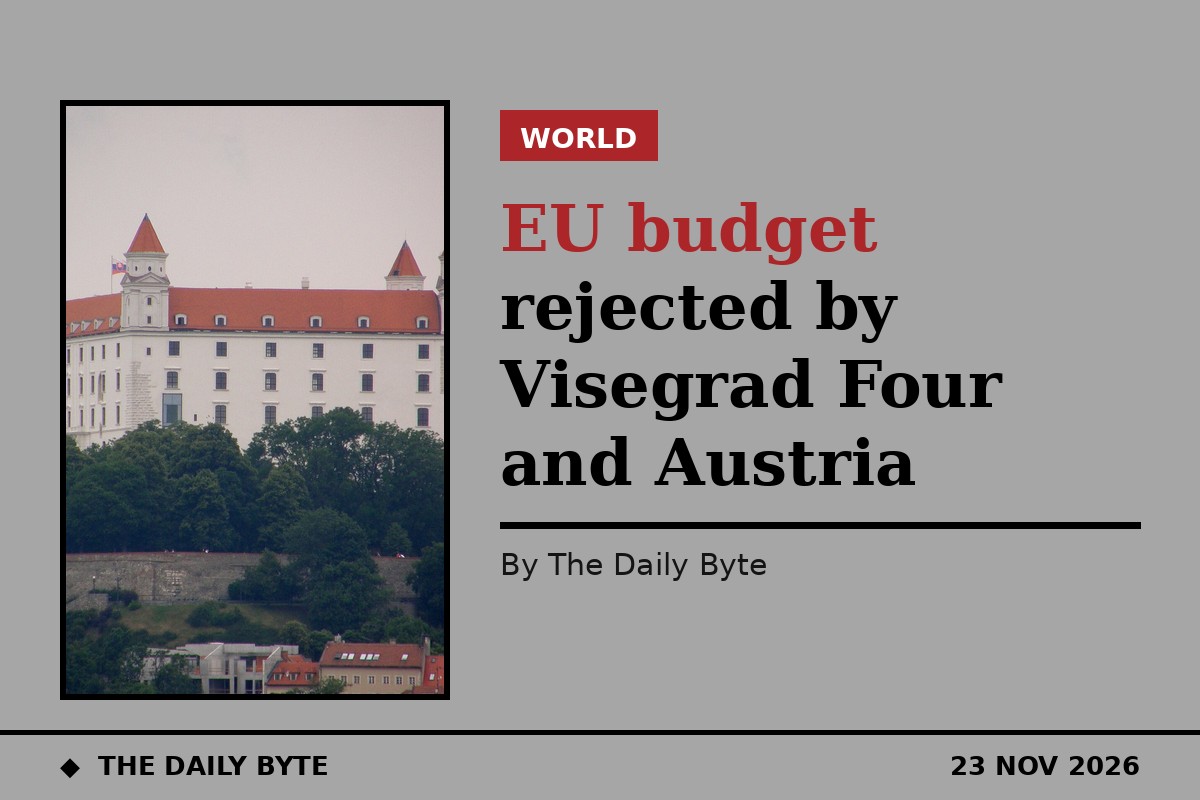
The leaders of the Visegrad Four countries and Austria have jointly rejected the European Union's proposed long-term budget for 2028 to 2034, calling it unacceptable days before a crucial European Council summit. The five leaders met at Bratislava Castle on Monday, 23 November, and said they would coordinate their negotiating positions before the summit on Thursday.
Slovak Prime Minister Robert Fico, speaking at a joint press conference after the summit, said all five leaders shared the same view of the document drawn up under European Council President António Costa. "All five of us here share the same view that this document is unacceptable because it fails to address fundamental issues," he said, adding that numerous rounds of negotiations would be needed to reach agreement.
The meeting brought together the prime ministers of Czechia, Hungary, Poland and Slovakia, the Visegrad Group, with Austrian Chancellor Christian Stocker. Czech Prime Minister Andrej Babiš, Polish Prime Minister Donald Tusk and Hungarian Prime Minister Péter Magyar attended alongside Fico and Stocker.
What the leaders object to
Costa's revised package, known as the "nego box", offered a cut of €204 billion to the European Commission's original pitch for the seven-year budget, but that has failed to satisfy either net contributors or countries seeking stronger farm and cohesion funding. Fico said the group would keep pressing for cohesion policy to be protected and for the Common Agricultural Policy to continue.
The leaders also object to a proposed mandatory cap of around €100,000 on subsidies for large farms, which Fico said must be considerably higher given the large agricultural holdings in their countries. All five agreed that an immediate reduction in electricity prices was key to making Europe more competitive, and Fico recalled that the group had long argued for decoupling electricity prices from gas prices.
Call to delay the carbon market
The five countries are also jointly writing to EU leaders about the bloc's new carbon market for buildings and road transport, known as ETS2. Fico said their proposal was to postpone its introduction until 2030, and to stop individual allowances from being traded on the exchange as early as January. The system, which would put a carbon price on heating and road fuels, is currently due to start in January 2028 after already being delayed by a year.
The call puts the group at odds with eight other member states, including Denmark, Germany, the Netherlands, Portugal, Spain and Sweden, whose climate ministers wrote to the EU's climate commissioner on the same day urging that ETS2 go ahead in 2028 without changes or further delays.
Ukraine funding divides the group
The leaders were united on the budget but divided on how Ukraine should be financed. Magyar said Hungary would continue to provide assistance to Kyiv but would not accept mandatory financial contributions imposed through budget negotiations, and he rejected linking Ukraine's funding to the EU's multiannual financial framework. Babiš expressed similar reservations, arguing that Ukraine's funding should sit outside the seven-year budget.
Fico said Slovakia understood the need for solidarity but fundamentally rejected being told what form its assistance should take. Tusk, by contrast, made an emphatic case for continued support, describing an independent Ukraine as the most cost-effective way of deterring Russian aggression and warning that recent Russian missile incidents affecting Poland showed Moscow's aggression was no longer confined to Ukraine. Stocker also defended continued assistance to Kyiv as both a European responsibility and a security interest.
What happens next
The five leaders said they would coordinate their positions at Thursday's European Council, particularly on cohesion funding, agricultural subsidies and energy policy. Costa has pressed for a budget agreement by the end of the year, before national elections change the make-up of the Council, but the budget requires unanimity. Magyar said he did not consider the current proposal a basis for negotiation and had written to Costa questioning the point of spending two days negotiating without significant changes.
The row is separate from the EU's annual budget for 2027, which the Council formally adopted on the same day. That budget, worth €199.7 billion in commitments and €211.5 billion in payments, was provisionally agreed with the European Parliament on 11 November and still needs the Parliament's final approval, expected on 25 November.


