Voestalpine Hit by Brussels Carbon Vote and Guidance Cut
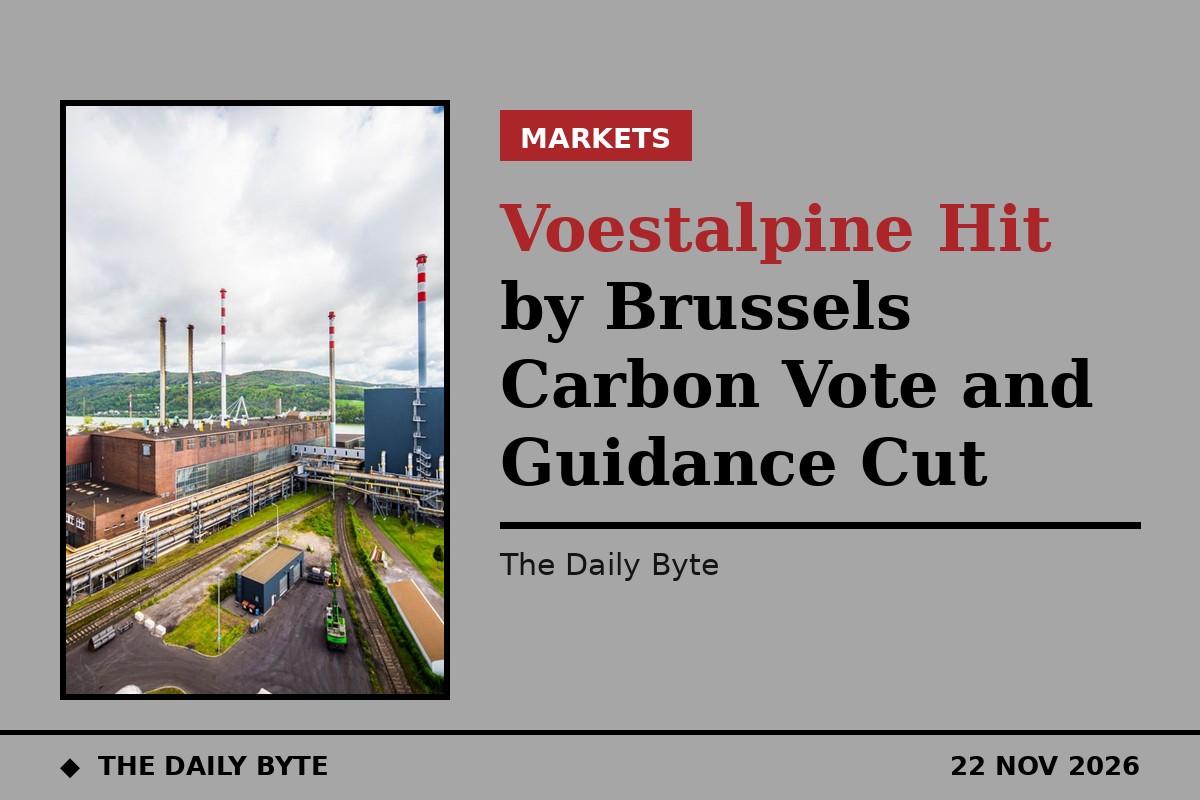
Austrian steel and technology group Voestalpine has suffered a double setback in Brussels and at home, after a European Parliament committee rejected a carbon-allowance rule the company had hoped for and the group trimmed its full-year profit outlook.
The European Parliament's industry committee, ITRE, voted on Thursday 19 November by 33 votes in favour to 41 against, rejecting an opinion on the overhaul of the emissions trading system that would have backed a special rule for Voestalpine extending its access to free carbon allowances. The vote leaves the company's hopes of longer free allocation on shakier ground, although the committee's rejection is not the final word on the revision, which continues through the EU legislative process.
Shares slip as brokers react
Voestalpine shares dropped 3.1% after the vote. Jefferies responded by cutting its price target on the shares to €48 from €52. The stock was quoted at €31.89 on Lang & Schwarz at 11:48 CET on Saturday 21 November.
The Brussels decision adds regulatory pressure to a company already navigating higher energy and logistics costs, US tariffs and weak demand in parts of its business. The Austrian group's decarbonisation programme depends heavily on how long it can count on free certificates while it replaces blast furnaces with electric arc furnaces at its Linz and Donawitz sites, due to be commissioned from 2027.
Guidance ceiling cut
Alongside half-year results announced on 11 November, Voestalpine lowered the upper end of its EBITDA outlook for fiscal 2026/27 to €1.70 billion from €1.85 billion, while keeping the lower end at €1.60 billion. Management attributed the reduction to higher energy and logistics costs and additional US tariffs.
The first-half figures themselves were stronger. Revenue for the first six months of 2026/27 was €7,656 million, with EBITDA of €846 million, up 17.1% year on year, and profit after tax of €290 million, up 46.1%. Roughly €100 million of the EBITDA gain came from positive one-off items, the company said, which cannot simply be extrapolated into the second half.
The group's own investor presentation for the half year confirms the narrowed guidance range of €1.6 billion to €1.7 billion, down from €1.6 billion to €1.85 billion, and lists short-term cost inflation, additional US duties and low water levels among the pressures on the outlook.
Job cuts at Kindberg
The tariff pressure is already showing at operating level. Voestalpine Tubulars opened talks with the works council on 13 November over a social plan for its Kindberg site, where about 150 positions are to be cut by the end of March 2027. The company cited steep US duties and difficult alternative markets in the Middle East as the reasons, and the social plan for affected employees is expected to be finalised by the end of November, according to ORF.
That sits alongside a wider reorganisation in the group's high performance metals division, which is almost complete, and a transformation project that the company says is on time and on budget. The investment in electric arc furnaces at Linz and Donawitz totals €1.5 billion, with the furnaces due to cut carbon dioxide emissions by 30% by 2029 as part of the group's path towards net-zero emissions by 2050.
What comes next
The next scheduled quarterly release is 10 February 2027. By then, the focus will be on whether EBITDA continues to support the narrowed guidance, how management sizes the energy, logistics and tariff burden, and where the EU emissions trading revision lands for free allowances.
For now, Voestalpine presents a mixed picture: a first half that beat the previous year by a wide margin, a full-year ceiling that has been cut, a Brussels vote that went against it, and a workforce reduction under way at one of its Austrian sites. The bull case requires the new furnaces to start on schedule and the underlying business to hold up without similar one-off gains, while longer free allowance allocation would smooth the passage. Neither is assured.