Volkswagen seeks two-year pay freeze in union talks
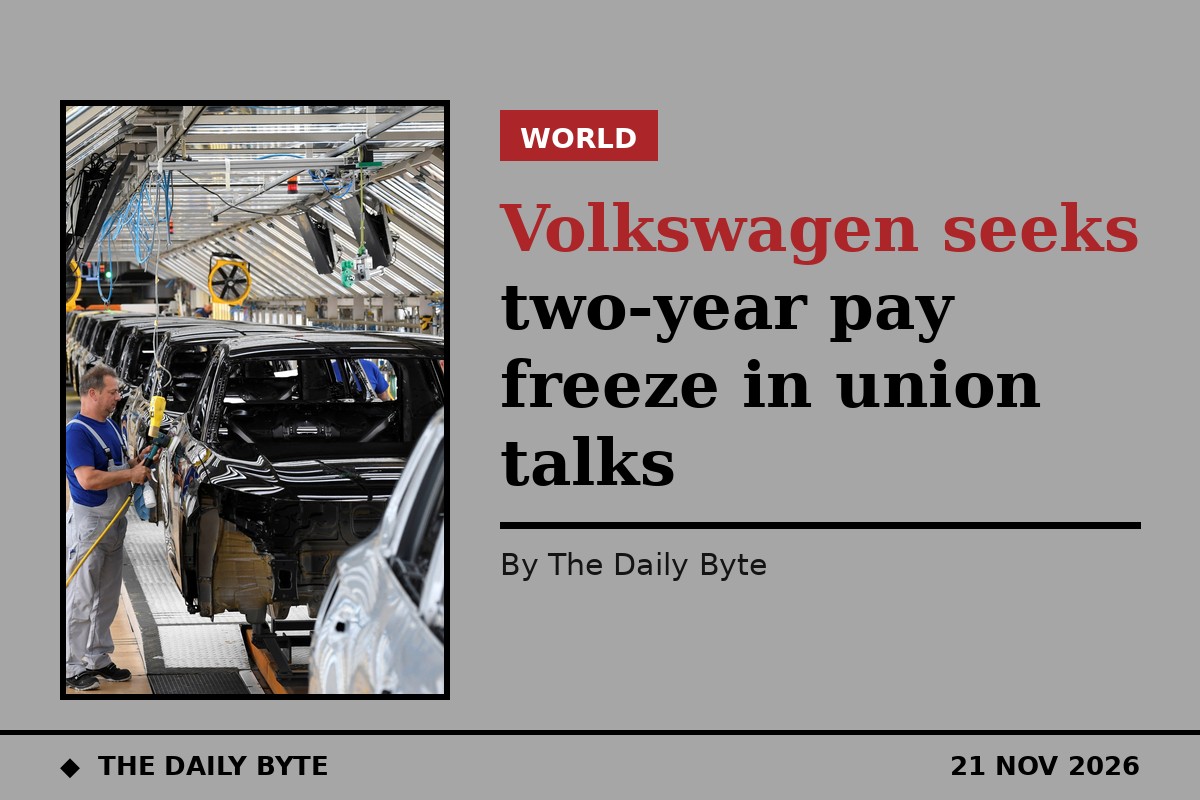
Volkswagen has asked Germany's IG Metall union to accept a two-year pay freeze, setting up a hard confrontation with workers at Europe's largest carmaker. The company submitted its demands for the next round of collective bargaining on Thursday, 19 November 2026, and said it needed significant relief in labour costs.
Negotiations on the Volkswagen AG company agreement are due to start on Tuesday, 24 November, in Emden. They cover about 120,000 employees, and the union has already warned that the dispute could run into strikes in the new year.
What Volkswagen wants
The centrepiece of the company's package is a pay freeze for 2027 and 2028, meaning no wage increases for two years. Volkswagen also wants to scrap two collectively agreed payments: an additional payment worth 27.5 per cent of average monthly earnings, or six days of paid leave instead, and a monthly allowance of 167 euros.
The carmaker is also seeking much greater flexibility in working hours. Under its proposal, the 35-hour contractual week would become a starting point rather than a fixed limit: hours could rise without extra pay when order books are full, and fall with a proportional cut in pay when demand slackens. Volkswagen said the changes were part of a broader effort to align capacity with demand and modernise structures that have grown up over many years.
Volkswagen's chief negotiator, Kerstin Scholz, said the company was not taking the step lightly. "In the negotiations, we will also talk about willingness to change and more flexible deployment of personnel," she said. "In doing so, we are not questioning our arrangements lightly. But the overall conditions have deteriorated significantly." Scholz will lead the talks jointly with Frank Ischner after Arne Meiswinkel, the Volkswagen brand's human resources board member, leaves the company as planned on 31 December 2026.
Union response
IG Metall has rejected the package and is demanding a 5 per cent pay rise over 12 months, along with job security and profit-sharing. The union described Volkswagen's demands as a catalogue of horrors in a bulletin to workers, and warned of a long and bitter conflict. A second round of talks is scheduled for 15 December in Zwickau.
The current industrial peace obligation runs until 31 December, after which warning strikes become possible. IG Metall was already staging 24-hour warning strikes across the wider German metal and electrical industry in the same week, at BMW, Audi and suppliers including Bosch Rexroth, in a separate dispute over pay. Workers at Volkswagen have threatened to strike from January if the opening talks go the company's way.
Why Volkswagen says it needs relief
Volkswagen points to tariffs, a shrinking market in China and growing competition in Europe as the pressures behind its demands. The company, which employed more than 600,000 people at the end of September, is in the middle of a far-reaching restructuring programme. Months ago its supervisory board approved a plan to double job cuts to 100,000, and an agreement reached in 2024 already envisages reducing more than 35,000 jobs at its German sites by 2030.
Management presents the talks as part of its Future Plan 2030, an efficiency drive covering development, procurement, production, quality and sales. For IG Metall, the package is a test of whether the union can defend pay and conditions while the company sheds jobs. With the two sides so far apart on wages before hours and allowances are even discussed, the Emden talks are likely to be only the start of a dispute that will shape pay at one of Germany's biggest employers well into 2027.


