Von der Leyen and Kushner Clash Over Ukraine Peace Talks
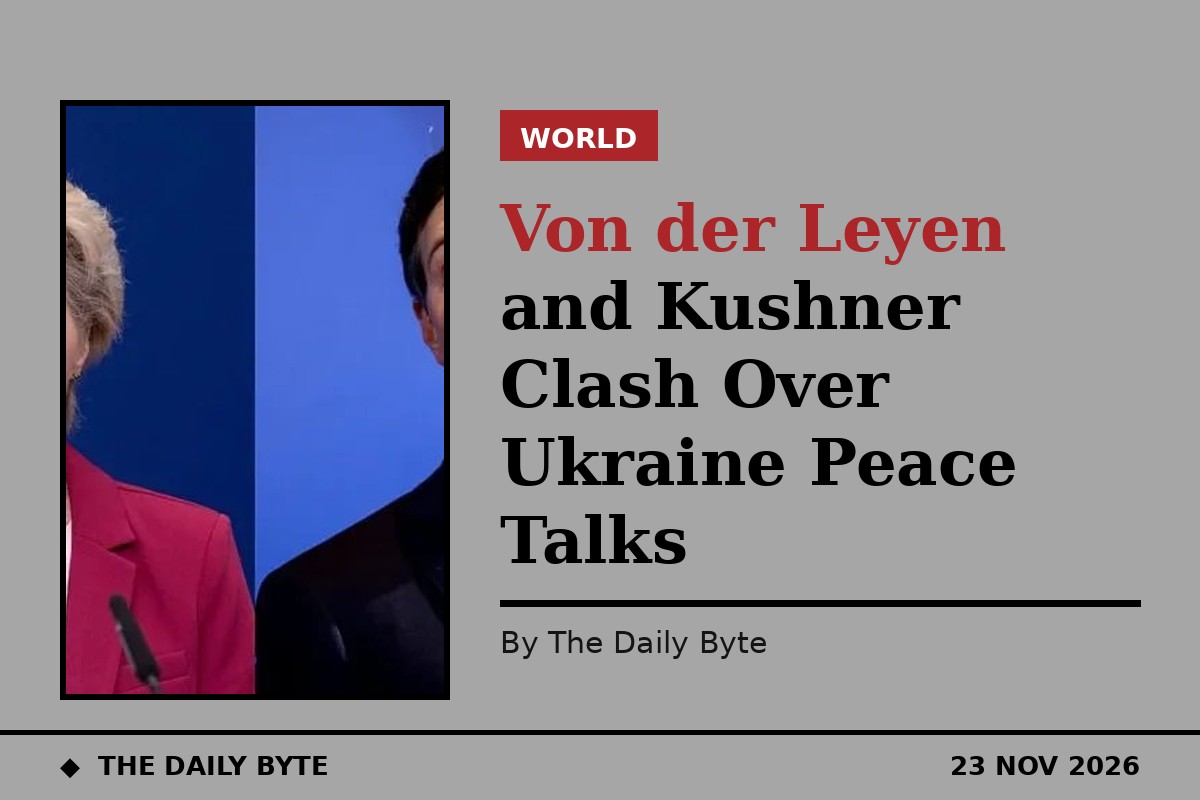
The European Union and the United States disagreed openly on Monday over the order in which the war in Ukraine should be brought to an end, after Washington's envoy argued that Europe's future security arrangements should be negotiated now, rather than after a ceasefire.
The dispute broke into the open when Jared Kushner, the United States special envoy brokering the talks, said in a social media post that Ukraine's security guarantees and Europe's post-war security arrangements could not be settled separately.
What Kushner proposed
In his post, Kushner wrote that security guarantees for Ukraine could not be finalised in isolation from the wider European security architecture. "Security guarantees for Ukraine cannot be finalised in isolation from post-war European security architecture. The two must be considered together," he wrote.
Among the guarantees under discussion, Kushner said, is a provision modelled on NATO's Article 5 collective-defence clause, under which Ukraine would receive assistance if Russia attacked again. He added that US President Donald Trump would approve such a clause only if the broader security arrangements made it highly unlikely that the guarantee would ever need to be invoked.
That condition, Kushner argued, means the issue has to be discussed from the outset as part of a broader deal. "Nothing is agreed until it is agreed," he said. He also said the United States intended to reach a "common understanding" on the security architecture over the coming weeks, and proposed talks involving Ukraine, European partners and Russia, covering permanent communication channels, crisis management, military deconfliction and greater transparency.
Kushner also described Russia's willingness to discuss Article 5-like guarantees as a possible sign that Moscow was serious about peace.
Brussels holds the line
Von der Leyen's position is that talks on the security architecture depend on Russia agreeing to a ceasefire in Ukraine and showing a genuine commitment to peace. European leaders argue that it is up to Russia to restore the security arrangements European countries established after the Second World War through treaties and conventions, which Moscow broke when it invaded Ukraine.
Asked about Kushner's post at the Commission's briefing on Monday, chief spokesperson Paula Pinho said the bloc's position had not changed since last week. "So once there is a ceasefire, then discussions can take place on Europe's security architecture. Those discussions need to take place in the appropriate forum, meaning with NATO allies and with the EU member states fully involved," Pinho said. "So we stick to our position."
The Commission also confirmed that it remained in regular contact with Kushner and with Steve Witkoff, the other US envoy, over possible multilateral talks. It acknowledged an invitation for European representatives to go to Moscow, while declining to give details, and no date for a new negotiating session was announced.
Merz and Rutte back the ceasefire-first order
German Chancellor Friedrich Merz expressed the same view last Thursday, when he hosted allies, including Kushner, at a meeting of the Coalition of the Willing in Berlin. Participants at that meeting pushed back strongly against efforts to divide the continent into spheres of influence.
"What's needed now is the right sequence, the right order: first peace in Ukraine, then agreements on Euro-Atlantic security," Merz said at the closing news conference. "Moscow knows: Its maximalist demands from December 2021 are unrealistic."
Those demands reappeared in a paper Russia presented at the latest round of talks in Abu Dhabi. The wish list calls for NATO to halt its expansion, withdraw troops to its 1997 borders and stop military support for Ukraine. European leaders have rejected the requests, saying they are an attempt to distract from Ukraine and secure veto powers to which Russia is not entitled.
NATO Secretary General Mark Rutte made the same point on Monday. "What cannot happen is that we are forced to roll back NATO to the 1997 borders or that we should have others to decide our posture other than allies themselves," Rutte said.
What happens next
With Moscow and Washington both giving greater prominence to Europe's security architecture, European officials privately acknowledge the issue will have to be discussed. The key test will come if Russia agrees to multilateral talks involving the United States, Ukraine and Europe simultaneously, a format it has so far refused.
For now, the public positions remain opposed. Kushner wants the guarantees and the architecture settled together, from the start. Von der Leyen, Merz and Rutte want the guns to fall silent first. Read the original reporting at Brussels Reporter.


