Burnham 'does not view Wales as an equal nation'
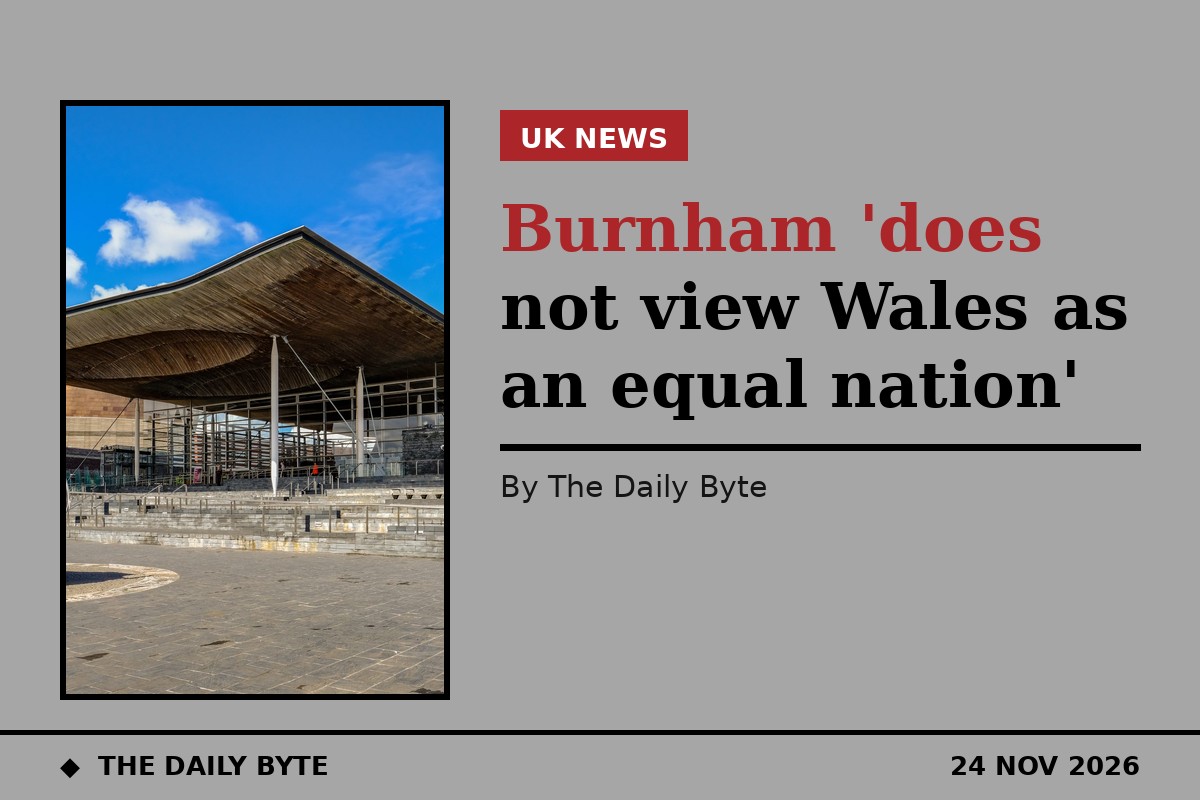
Wales' First Minister has accused Prime Minister Andy Burnham of not viewing Wales as an equal nation, after Burnham rejected calls to hand Cardiff control of policing, justice, the Crown Estate and rail infrastructure. Rhun ap Iorwerth said he was deeply disappointed by the decision and has asked for an urgent meeting with the prime minister to discuss the evidence and agree a substantive way forward.
The letter that started the row
In a letter to Mr ap Iorwerth last week, seen by BBC Wales, Mr Burnham said he was not persuaded by the case for transferring any of the four areas from Westminster to Cardiff. The BBC reported that the letter followed talks between the two leaders in Glasgow last month that had been seen as positive. Asked afterwards about policing, Mr ap Iorwerth said he thought instinctively the prime minister wants to go there.
The Welsh Government had named all four areas as its immediate priorities for further devolution in a written answer to the Senedd on 11 November, and Mr ap Iorwerth has called for Wales to have the same powers as Scotland. Policing and justice are currently reserved to Westminster, unlike in Scotland, while the Crown Estate manages the seabed and foreshore around the Welsh coast and rail infrastructure is also controlled from London.
Unfair, unjust and unsustainable
In a written statement to Senedd members on Monday, the first minister said the refusal to even explore the devolution of the Crown Estate, justice and policing, and rail infrastructure proves that the prime minister does not view Wales as an equal nation. He said the case in favour of Wales having control over these areas of responsibility, just like Scotland, is compelling, and that several commissions have argued for the devolution of justice and policing, yet the UK government seemingly prefers to put unionist ideology before hard evidence.
Mr ap Iorwerth added that his government is not interested in more powers for power's sake, and that the current settlement is unfair, unjust and unsustainable. In a letter to the prime minister, he asked Mr Burnham to reconsider the work of previous reports on the issue, and said he would welcome an urgent meeting to discuss the evidence and agree a substantive way forward.
The response from the First Minister's office was sharp. A spokesperson said his warm words on devolution are now ringing hollow and there is no longer any doubt that when he talks of driving power out of Whitehall, he only means to the regions of England.
A split inside Welsh Labour
Mr Burnham's position also puts him at odds with Welsh Labour leader Ken Skates, who told his party's conference last weekend that devolving policing and the Crown Estate remained Welsh Labour policy. Mr Skates has called for greater detail on why further devolution of policing was not happening, and said he will be meeting with Mr Burnham himself. Welsh Labour has not dropped its calls for the devolution of justice, the Crown Estate and rail investment.
The row is awkward for the prime minister because, when he addressed Welsh Labour's conference in Llandudno, he spoke of a stronger relationship between the UK Government and Wales, and of the importance of ensuring that devolution delivered practical improvements rather than simply changing where decisions were made. Six days later, in his letter to the First Minister, he set out the limits of that ambition.
Why Burnham said no
According to reporting of the letter, Mr Burnham argued that existing UK-wide arrangements provided important advantages, including specialist resources, cross-border cooperation and integrated national systems. On rail, he said he was not persuaded by the case for full devolution of rail infrastructure, as it would fragment the current system and affect the service provided to the public by the highly integrated cross-border network.
What happens next
The Welsh Government is expected to keep pressing its case in Westminster and in the Senedd, and Mr ap Iorwerth has made parity with Scotland a defining goal of his administration. The rejection itself was first reported last week, but the First Minister's formal response on Monday turns a private disagreement into a public test of Mr Burnham's devolution promises, with neither side showing any sign of backing down.