Wales Travel Survey: Cars Take 74% of Journeys
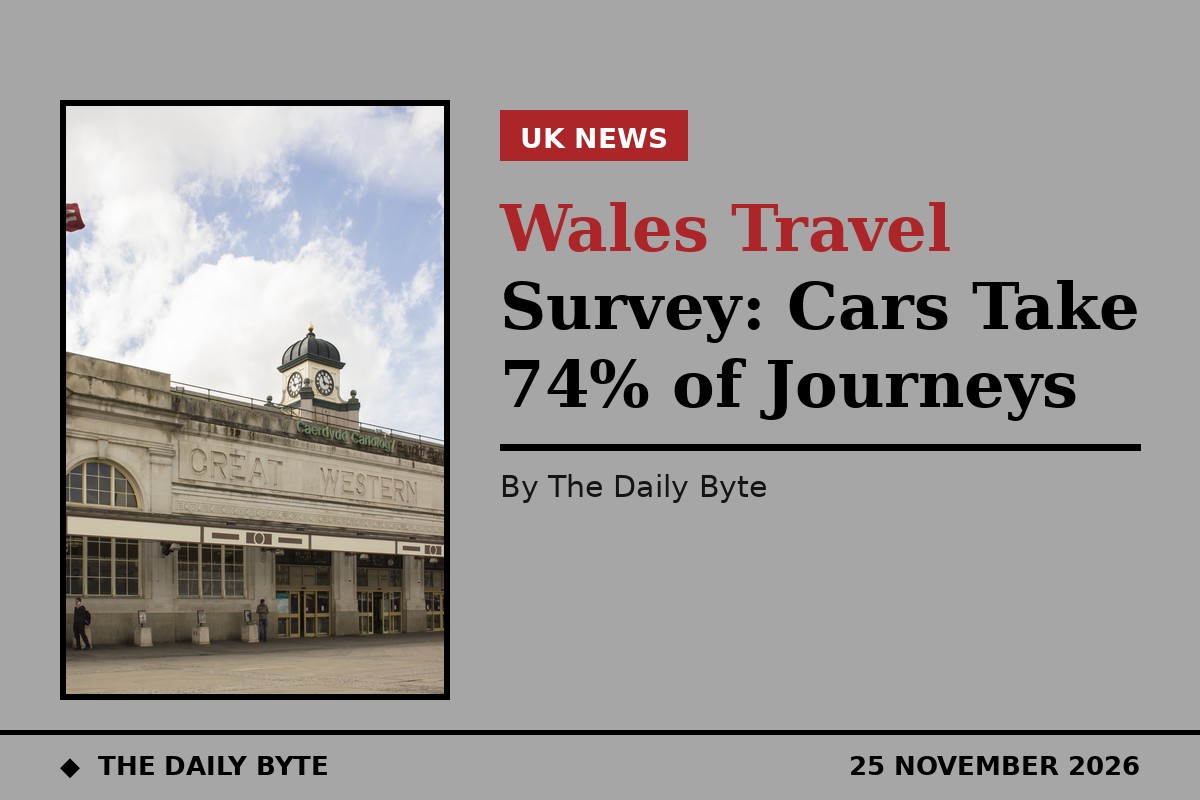
The first full-year results of the Wales National Travel Survey have been published, giving the clearest picture in more than a decade of how people across Wales actually get around. More than 6,100 people aged 16 and over took part during the 2025/26 survey year, recording more than 18,000 journeys in two-day travel diaries as well as answering questions about their travel habits and attitudes.
Published on Tuesday 25 November by Transport for Wales and the Welsh Government, the survey is the first dedicated Wales-wide study of travel since 2012. Its findings are intended to shape transport planning and policy in Wales, including work under the Welsh Government's Llwybr Newydd transport strategy, and the results will now be repeated annually so changes over time can be tracked.
Cars dominate, walking second
The headline finding is the scale of car dependence. Almost three-quarters of journeys, 74.3%, were made by car, either as the driver (59.6%) or as a passenger (14.7%). Walking and wheeling accounted for 17.5% of journeys and cycling for 1.4%, giving active travel a combined share of 18.9%. Public transport made up a much smaller slice: 3.7% of journeys were by bus and 1.9% by rail, a combined 5.6%.
Looked at by how often people use each mode, the car still leads. More than eight in ten respondents, 82.7%, used a car at least once a week, while 69.2% walked or wheeled at least weekly. Around one in ten journeys, 10.5%, were multimodal, using two or more modes, although journeys combining bus or rail accounted for only 1.7% of those multimodal trips.
Why people travel
Shopping was the most common reason for travelling, at 23.1% of journeys, followed by commuting to or from work at 19.3% and social or entertainment trips at 17.7%. On average, people in Wales travelled 9,670.6 km over the year, or 15.5 km per journey.
Satisfaction was generally high but uneven. Most respondents said they were very or fairly satisfied with their overall journey and with safety across all modes, but the figures were lowest for cycling: overall journey satisfaction ranged from 66.3% for cyclists to 96.0% for people who used a ferry or boat, and satisfaction with safety ranged from 59.4% for cyclists to 96.3% for ferry and boat users. Cyclists also felt least welcome, with 66.9% saying they felt welcome when cycling, against figures typically around or above 90% for other modes.
What would change minds
The survey also asked what would encourage people to travel more sustainably. Among people who walk and wheel, better maintained routes was the most common answer, chosen by 37.7%. Nearly half of cycle users, 46.9%, said more routes away from traffic would encourage them to cycle more often. For bus users, 40.7% pointed to better route, bus stop and timing information, while 60.2% of rail users said cheaper, simpler tickets would encourage them to travel by train more often.
There are limits to how far such changes might reach. Among non-users of each mode, around 30% said none of the options listed would encourage them to travel by walking and wheeling, cycle, bus, rail or taxi.
A new baseline for policy
The full-year results replace preliminary findings based on the first six months of the survey, published in April 2026. Three headline reports cover travel behaviour, travel attitudes and the factors that could encourage a shift towards more sustainable travel, supported by seven further reports on walking and wheeling, cycling, buses, rail, taxis, cars and other modes.
Deputy Minister for Transport Mark Hooper said good transport policy starts with understanding how people really get around. "For the first time in over a decade, the Wales National Travel Survey gives us a full year of Wales-specific evidence on how, why, and when people travel, and what could help them choose more sustainable journeys," he said.
Geoff Ogden, Transport for Wales' chief transport planning and development officer, said the evidence would help the organisation, the Welsh Government and local authorities plan transport around people's everyday needs. The Office for Statistics Regulation has previously described the survey's initial outputs as a "strong set of official statistics in development".
Sources: Transport for Wales, New Civil Engineer.