Walton 29.2m grant backs six Africa wildlife parks
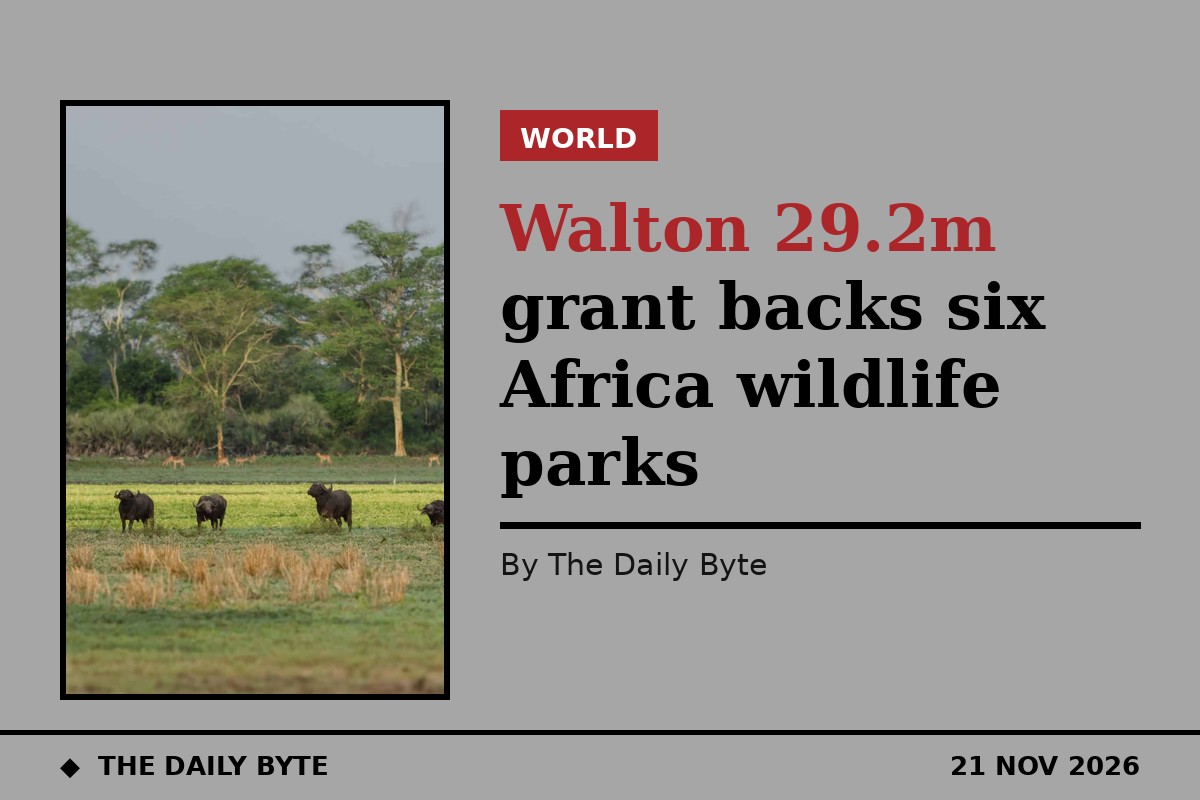
The Rob Walton Foundation has committed 29.2 million dollars to support the long-term management of six protected areas across four southern African countries, Peace Parks Foundation announced on 19 November in Stellenbosch, South Africa.
The six sites, in Angola, Malawi, Mozambique and Zimbabwe, cover 82,000 square kilometres, an area more than nine times the size of Yellowstone National Park. In Mozambique the grant covers Limpopo, Zinave and Banhine national parks; in Zimbabwe it supports the Greater Mana Pools Ecosystem; in Malawi the Nyika-Vwaza Complex; and in Angola the Luengue-Luiana National Park.
Aid cuts push parks towards private money
The grant lands as conservation groups turn increasingly to philanthropists because state aid is drying up. Peace Parks said bilateral funding from foreign-state agencies fell to 6 percent of its income in 2025, down from an average of 36 percent over the previous decade. Over the same period, funding from foundations and trusts rose to 45 percent, from a 39 percent average, while private individuals supplied 8 percent, up from 1 percent.
Peace Parks chief executive Werner Myburgh said German aid had been slashed, support from the United States had gone to zero, and backing from the British government had also stopped. “Thank goodness the private philanthropists seem to be stepping up,” he said. The Rob Walton Foundation money will finance core operational expenses, and Peace Parks has committed to raise additional finance alongside it.
Five of the six protected areas are already covered by long-term partnership agreements between Peace Parks and national governments. In Angola, Peace Parks and the government have signed a memorandum of understanding to develop a partnership framework for managing Luengue-Luiana National Park.
Why these six landscapes matter
Southern Africa is home to more than half of the world’s African elephants, and some reserves now hold too many of the animals, damaging vegetation and reducing biodiversity. Elephants are being encouraged to move into the funded reserves from overpopulated zones in Botswana, Zimbabwe and South Africa. In Mozambique, sustained investment has already turned Zinave National Park from a heavily depleted landscape into the country’s first Big Five national park, while ranger housing and anti-poaching camps in the Greater Mana Pools Ecosystem support teams working in remote areas.
The six sites are part of a wider group of 162 protected and conserved areas across 33 African countries identified through the Africa Keystone Protected Area Partnership for their exceptional ecological importance. Together those areas contain 71 percent of Africa’s threatened vertebrate species, provide water resources on which nearly 250 million people depend, and store an estimated 5.8 billion tonnes of carbon.
“Peace Parks has established strong working relationships with governments and demonstrated what sustained investment in protected area management can achieve,” said Duko Hopman, executive director of The Rob Walton Foundation. “We see an opportunity to build on that experience across six important landscapes and encourage other funders to join this effort.”
Peace Parks Foundation was founded in 1997 by then South African president Nelson Mandela, luxury-goods billionaire Anton Rupert and Prince Bernhard of the Netherlands. It works with governments and communities to establish and co-manage transfrontier conservation areas across southern Africa, and says it has helped establish 780,000 square kilometres of such areas. Through its Vision 2050 it aims to secure 14 functioning transboundary conservation landscapes covering 980,000 square kilometres across 10 countries.


