War remnants still killing children in Syria, toll rises
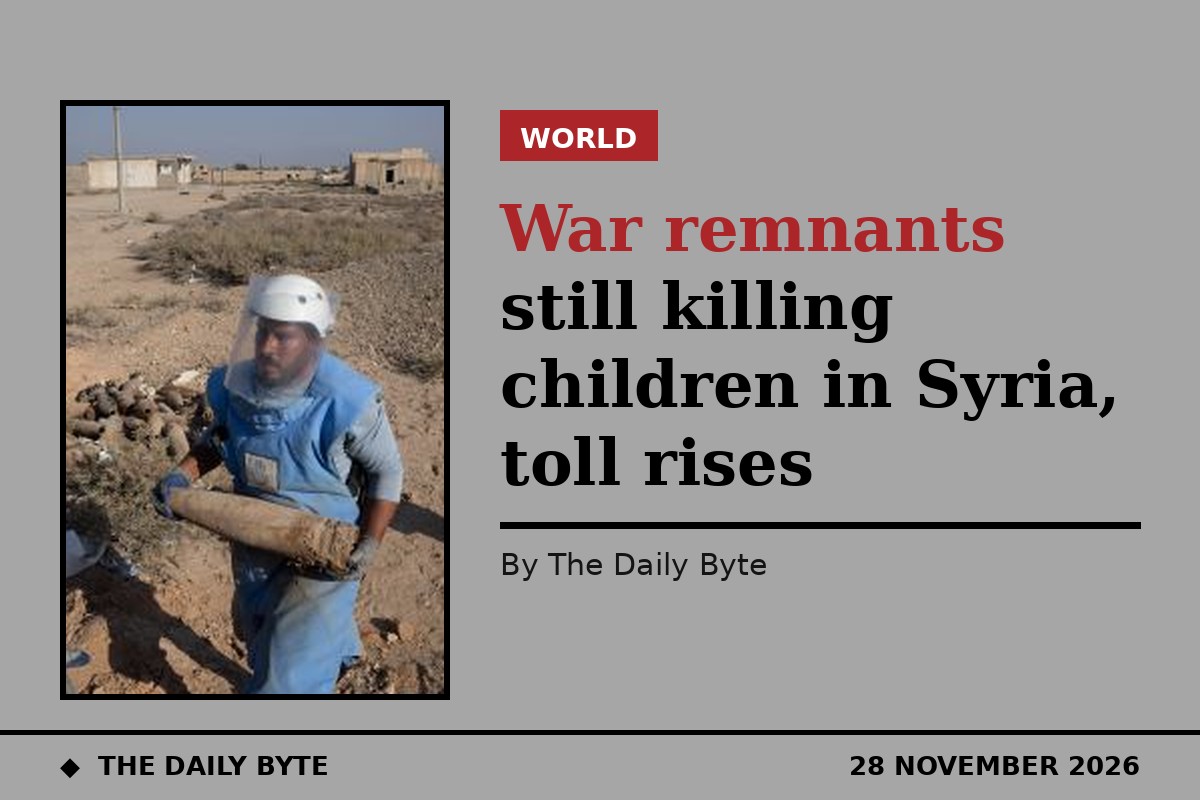
Five children from one family were killed when a landmine left over from Syria's war exploded in their village in southern Idlib province on 22 November, in the latest reminder that the country's buried weapons are still killing children almost two years after the fall of Bashar al-Assad's government.
The blast in Umm Khazim, in the countryside around Khan Sheikhoun, was first reported as killing four children aged between 8 and 15 and injuring two others. The governor of Idlib later said five children from the Qattar family had been killed and a seven-year-old child injured, revising the earlier toll. The Syrian Network for Human Rights documented the names of the five children killed: Yousef Hussein al-Qattar, aged 8; Muhanna Nouri Rashad al-Qattar, aged 15; Alaa Walid al-Qattar, aged 13; Mohammed Fayez al-Qattar, aged 12; and Mahmoud Walid al-Qattar, aged 10, who was injured in the explosion and later died of his wounds the same day.
Syria's state news agency SANA and the Turkish state agency Anadolu Agency both reported the same toll, and SANA's reporter in Idlib said the two injured children were taken to hospitals in Hama for treatment. The identity of those who laid the device at Umm Khazim was not established in either account. Both agencies attributed the remnants to the former government, which is reported here as their account. None of those killed or injured was named in the state media reports.
More deaths in Daraa, Deir ez-Zor and Aleppo
The Idlib deaths were not isolated. Earlier on the same day, a soldier was killed and two others were injured while dismantling mines and war remnants in the town of al-Tarif, in the western Deir ez-Zor countryside, the defence ministry said, according to both agencies. The following day, 23 November, a 13-year-old boy was killed by explosive war remnants in the village of Asem in the Daraa countryside, according to SANA and the government newspaper Al-Thawra.
On Saturday 28 November, one person was killed and another injured when a landmine left over from the war exploded in a vehicle they were travelling in, in the town of Hayyan in the northern Aleppo countryside, according to the Emergency and Disaster Management Directorate in Aleppo province. The Syrian channel al-Ikhbariya, in an account carried by Anadolu Agency, said the person killed was a child and the man injured was his father.
A toll that keeps rising
The scale of the danger is set out in figures published this month. According to an early November report by the United Nations Children's Fund, UNICEF, more than 550 explosive ordnance incidents caused 887 casualties across Syria during the first nine months of 2026, including 98 children killed and 211 injured. The Landmine and Cluster Munition Monitor 2026 report recorded 1,602 people killed or injured by landmines and explosive remnants of war in Syria during 2025, more than 50 percent above the previous year, the International Campaign to Ban Landmines said on 24 November.
Landmine Monitor recorded at least 13,953 people killed or injured by mines and explosive remnants of war in Syria between 1999 and 2024, Anadolu Agency reported, adding that the real figure may be higher because casualties are difficult to document. According to the UK-based Syrian Observatory for Human Rights, 14 children were killed and another 29 injured by explosive remnants across Syria during November, including the latest casualties in Idlib. Earlier in November, Save the Children reported that four children had been killed by landmines and unexploded ordnance in less than a week, including three who died while herding sheep near Palmyra.
Mines and unexploded ordnance left from the war remain in farmland, pasture and residential areas across several Syrian governorates, and clearance is slow and dangerous work, as the death of the soldier dismantling mines in Deir ez-Zor shows. Children are among the most exposed, because they play, herd animals and collect firewood in fields and open ground where devices lie buried. With the war over but its weapons still in the soil, monitors warn the toll will keep rising unless clearance reaches the villages and farmland where families are trying to rebuild their lives.


