Warsaw march urges Nawrocki to sign abortion bills
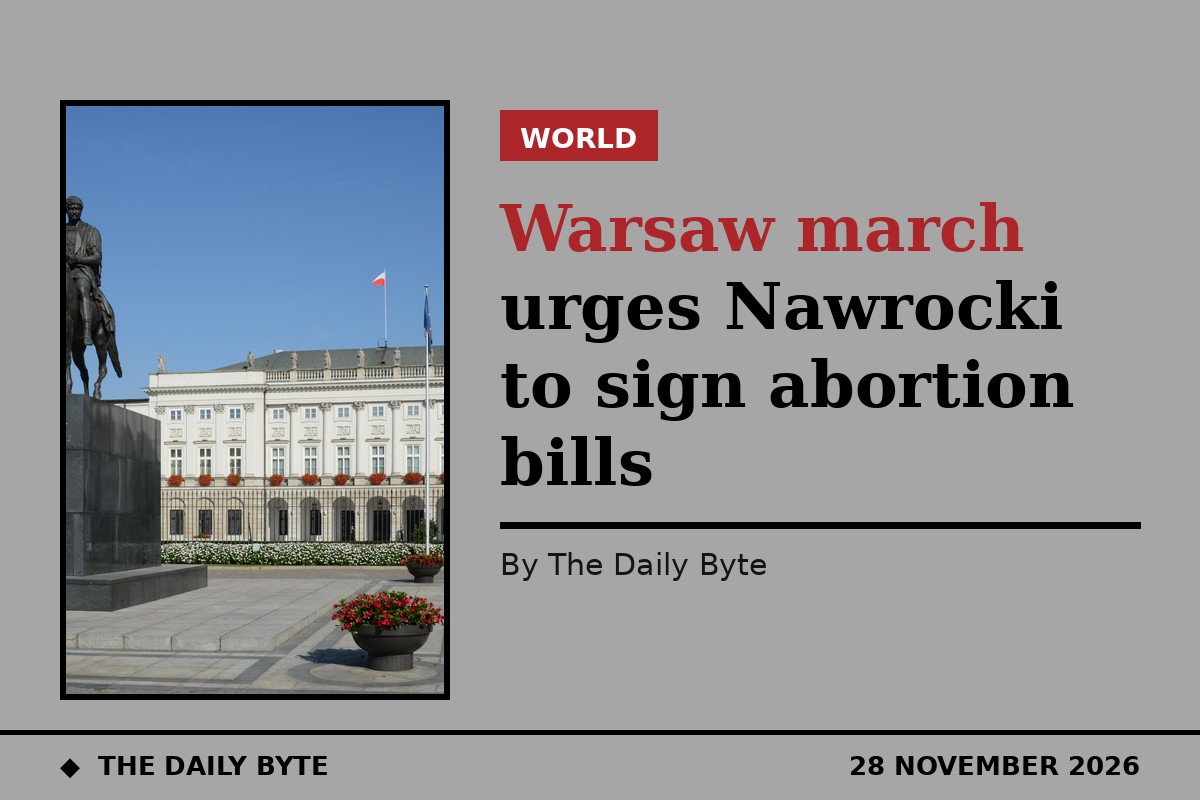
Women marched through the centre of Warsaw to the Presidential Palace on Saturday, calling on President Karol Nawrocki to sign two bills easing Poland's near-total abortion ban before his deadline to decide expires. The march was timed to the last day the president has to sign the bills, veto them or send them to the Constitutional Tribunal.
The march took place on Saturday 28 November, from the Sejm, Poland's lower house of parliament, to the Presidential Palace. It was organised by the All-Poland Women's Strike, known in Polish as Ogolnopolski Strajk Kobiet, and the Widzialne Foundation. It began at 2 p.m. in front of the Sejm and proceeded along Matejki Street, Aleje Ujazdowskie, Plac Trzech Krzyzy, Nowy Swiat and Krakowskie Przedmiescie, reaching the Presidential Palace shortly before 4 p.m., where the rally was scheduled to last until 6 p.m.
Two bills are on the president's desk. The first would decriminalise assisting in an abortion. The second would restore the right to terminate a pregnancy in cases of severe foetal defect. According to the organisers and Polsat News, the deadline by which the president can sign the bills, veto them or refer them to the Constitutional Tribunal expires on 28 November. No information about the president's decision had been released by the time reports of the march were published.
Abortion in Poland has been legal only in narrow circumstances since a 2020 Constitutional Tribunal ruling removed severe foetal defect as a permitted ground. The Sejm, parliament's lower house, passed the two bills in October, and campaigners described the vote as a small step towards restoring access. The bills then passed to the president, who had said as a candidate that he would not sign even a bill restoring the severe-defects rule.
The organisers noted that the date of the march coincides with the 108th anniversary of Polish women winning the right to vote. In a statement, they said they would ask the president: "Where is abortion?" They also argued that public opinion polls have shown for years that a majority of Poles support legal abortion.
Left party lawmaker Joanna Wicha took part in the march. She said the solutions presented to the president "are not sufficient," but pointed to the current political landscape, noting that the governing coalition includes the Polish People's Party, known as PSL, which does not support such legislation. She added that the president had already announced earlier that he would not sign the bills, and expressed hope that the sight of participants of all ages would prompt him to make a decision that takes all Poles into account. She also stressed that the march "has no political colors."
According to Polsat News, both women and men took part in the demonstration, and there were many flags and banners calling for liberalisation of abortion law. The march drew people of all ages, Wicha said, and the organisers had framed it as a demonstration for all Poles, not for one party.
The decision now rests with the president. He can sign both bills, veto them, or refer them to the Constitutional Tribunal, and the deadline for that choice falls on Saturday. Campaigners have warned that a veto would leave the near-total ban in place, while the government has said it will look for another way to change the law if the bills are blocked. Whatever Nawrocki decides, the march made clear that the demand for change is still being pressed on the streets of Warsaw.


