Wells Fargo puts AI agent risk on customers from Tuesday
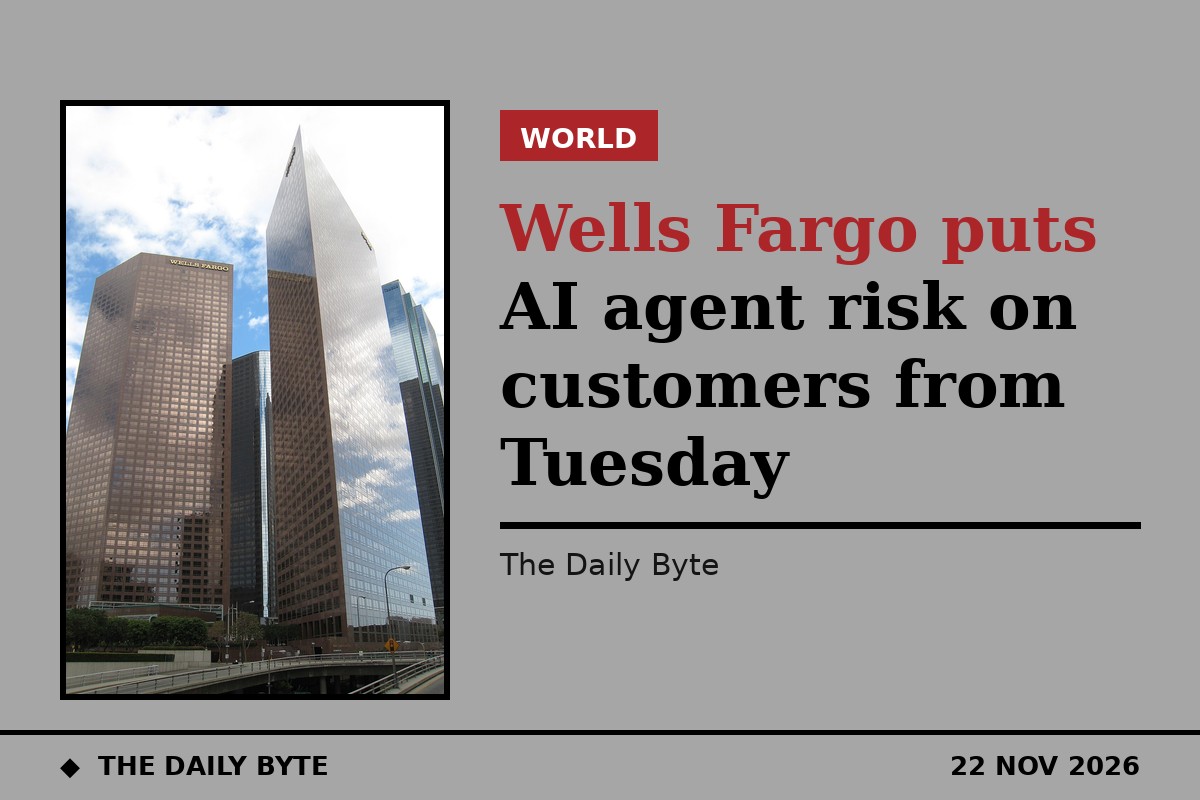
From Tuesday 24 November 2026, Wells Fargo customers who hand their bank login to an AI agent do so entirely at their own risk. The bank’s updated Online Access Agreement adds a new Section 15 covering third-party AI agents, and it states plainly: “Your use of any AI Agent is AT YOUR OWN RISK.”
Under the new terms, anything an agent does with a customer’s login counts as if the customer did it personally. The bank will not carry out additional verification on those actions, and any transaction an authorised agent starts is treated as initiated and authorised directly by the customer.
What the new terms require of customers
The agreement puts the burden of watching the agent on the account holder. Customers are expected to keep watch over what their agents are doing and to make sure the tools stay within the access they were granted. They are also responsible for cutting an agent off properly and promptly, and for keeping documentation proving they did so, according to Crypto Briefing.
That responsibility does not end when the customer decides to stop. Until Wells Fargo is informed, the customer carries responsibility for the agent’s actions, explicitly including unintentional actions and the consequences of manipulated inputs — language that covers prompt injection, where a malicious string hidden in a web page or an email tricks an agent into a harmful transaction.
The obligations are not entirely one-sided. Wells Fargo keeps the right to restrict or deny any AI agent’s access to customer accounts.
Why banks are drawing the line
The change tackles a problem that has no neat technical fix. When an agent logs in with a customer’s username and password, the session looks exactly like the customer at the keyboard, and the bank cannot tell the customer, an authorised agent and a rogue agent apart.
Wells Fargo is not alone. JPMorgan Chase does not let outside parties log in with customers’ credentials, and its chief executive Jamie Dimon warned on the bank’s third-quarter earnings call on 13 October 2026 about a “liability transfer” from AI agents. Citi has added its own AI agent section to its online banking agreement this month, and Bank of America’s deposit agreement already makes customers responsible for anyone they let use their login, even if that person exceeds their authorisation.
What the law does and does not cover
Customers may not be able to fall back on federal protections. Regulation E, the US rule behind the $50 limit on losses from a lost or stolen card reported promptly, caps consumers’ losses from unauthorised transfers, but it excludes transfers made by someone the consumer gave their access device to. For business accounts, those liability rules do not apply at all, and the agreement says so plainly.
The terms apply subject to applicable law, so the contract may not be the last word in a dispute. But it sets the bank’s starting position, and it was first reported by American Banker on 2 November 2026, before being picked up more widely, including by Wired on 22 November 2026.
Why this week matters
The new terms take effect days before Black Friday on 27 November 2026, the busiest shopping week of the year, when AI shopping agents are being offered to more customers than ever. Anyone using an AI tool to pay bills, move money or manage accounts at Wells Fargo should understand that the bank will treat that tool’s actions as their own. The practical advice from the reporting is simple: review what access your agents hold before 24 November, and keep written proof whenever you revoke access.
The full updated agreement is published on Wells Fargo’s own site.
Frequently asked questions
When do Wells Fargo’s new AI agent terms take effect? Tuesday 24 November 2026, when the updated Online Access Agreement comes into force.
Who is responsible if my AI agent makes a mistake? You are. The terms say anything an agent does under your login is deemed to have been initiated and authorised directly by you, and using an agent is at your own risk.
What if I revoke an agent’s access? You must do it properly and promptly, keep documentation proving you did so, and tell the bank. You remain responsible until the bank is informed.
Are other banks doing the same? Yes. Citi has added its own AI agent section, JPMorgan blocks outside parties from logging in with customer credentials, and Bank of America’s deposit agreement already covers the same ground.
Sources: Crypto Briefing; American Banker via DEV Community.


