Welsh First Minister 'Gobsmacked' By Burnham Devolution Snub
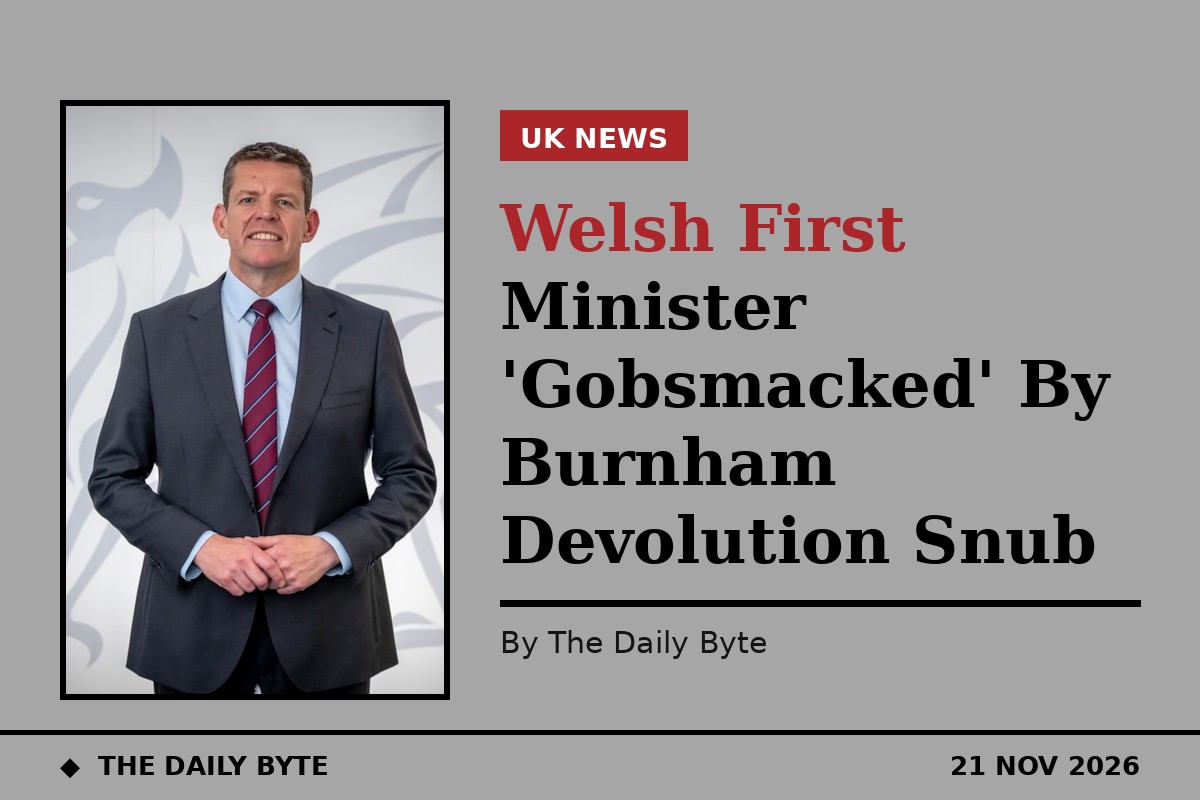
Wales' First Minister Rhun ap Iorwerth has said he is "pretty gobsmacked" after the prime minister rejected long-standing calls to hand powers from Westminster to Cardiff. Speaking to BBC Radio Wales breakfast on Saturday 21 November, he said the decision showed Westminster was disregarding the views of the people of Wales.
"This is about Westminster saying, we decide, it doesn't matter what the people of Wales think," the first minister said. "I'm pretty gobsmacked by that."
The row follows a letter sent by Prime Minister Andy Burnham to ap Iorwerth on Friday 20 November. In it, Burnham said he was "not persuaded" by the case for devolving responsibility for policing and justice, the Crown Estate and rail infrastructure to Wales.
Ap Iorwerth said the Welsh secretary, Stephen Kinnock, had told him there had been a lot of engagement across the departments of the UK government in Whitehall, but not with Wales. "They then decided that they didn't want Wales to be empowered on policing, justice, the Crown Estate and on rail," he said.
What Burnham said no to
On policing, Burnham argued that the integrated England and Wales system was essential to maintaining interoperability, enabling seamless cross-border working and ensuring forces in Wales could draw on national and specialist capabilities.
On justice, the prime minister said he "strongly believes" the current devolution settlement enables Wales to benefit from the resources, expertise and resilience of a shared justice system.
On the Crown Estate, which includes the seabed off the Welsh coast, Burnham said its current model provided the best means of maximising the economic and social benefits for Wales, and that the UK government was "not persuaded by the case for devolving the management of the Crown Estate in Wales, nor to prepare for a future transfer". The land belongs to the reigning monarch, and the revenue from its property portfolio goes directly to the UK Treasury.
On rail infrastructure, Burnham told the first minister he believed funding and delivery was best done by the new Great British Railways, in collaboration with Transport for Wales and the Welsh government. "I am therefore not persuaded by the case for full devolution of rail infrastructure, as it would fragment the current system and affect the service provided to the public by the highly integrated cross border network," he wrote.
Reaction in Cardiff
A spokesperson for the first minister accused the prime minister of "turning his back on devolution". "His warm words on devolution are now ringing hollow and there is no longer any doubt that when he talks of driving power out of Whitehall, he only means to the regions of England," they said. The spokesperson added that the refusal "proves that the prime minister does not view Wales as an equal nation."
Former first minister Mark Drakeford said he was "disappointed" by Burnham's decision. "I don't think he quite understands how different things are when you talk about a country, with the Senedd," he said.
Burnham's position is also at odds with Welsh Labour leader Ken Skates, who reiterated at a party conference last weekend that policing and the Crown Estate should be devolved.
How the row built up
The letter, seen by BBC Wales, followed what had been seen as positive talks between the prime minister and the first minister in Glasgow last month. Asked about the prime minister's position on devolving policing after that meeting, ap Iorwerth said: "I think instinctively the prime minister wants to go there." Burnham had also previously said he was "open" to the idea.
The refusal came six days after Burnham addressed Welsh Labour's conference in Llandudno on 14 November, where he promised to take power away from Westminster and give Wales a stronger voice, as reported by Talking Wales. His letter now sets out the limits of that ambition, while leaving the door open to further discussions on employment support, financial flexibility and closer cooperation.
Kinnock said there was "a bold and ambitious offer on the table there to work with the first minister on a whole range of issues around devolving fiscal powers, employment support, reindustrialisation, innovation and regional empowerment". He said the changes Wales had sought would have led to "destabilisation and fragmentation and disintegration".
For now, the four major demands remain with Westminster, and the disagreement is the sharpest public clash between Cardiff and Downing Street since Burnham became prime minister.