Welsh First Minister Seeks Alliance for More Powers
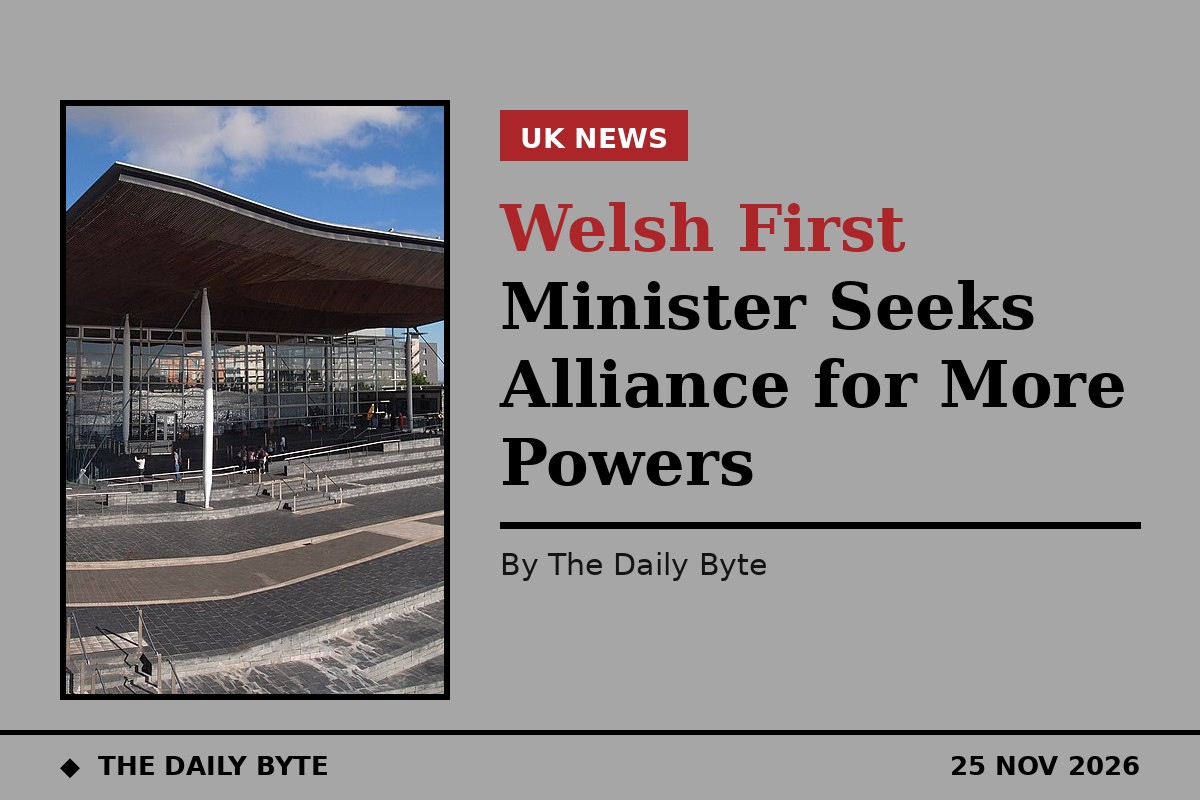
Wales's First Minister has announced plans for a broad alliance to press for more powers for Wales, days after the Prime Minister rejected proposals to transfer policing, justice, rail infrastructure and Crown Estate management to Cardiff.
Rhun ap Iorwerth told the Senedd on Tuesday 24 November that the campaign should reach beyond negotiations between the two governments, bringing together supporters of further devolution from across Welsh politics, the trade union movement and wider civil society.
He drew a direct parallel with the campaign that won a devolved Welsh legislature in the 1997 referendum, which passed by 50.3% of the vote. "It's time to say 'yes' for Wales once more," he told members.
What Westminster turned down
The row follows a letter from Prime Minister Andy Burnham, sent on Friday 20 November, in which he said he was "not persuaded" by the case for devolving four areas: policing, justice and prisons, rail infrastructure, and management of the Crown Estate.
The Welsh Government argues that holding those powers would let it join up public services, set infrastructure priorities and manage the revenues from Wales's natural resources, including offshore wind. The UK Government argues that shared systems bring advantages in cross-border cooperation, specialist resources and financial capacity.
Mr ap Iorwerth has asked the Prime Minister to reconsider the independent evidence behind the Welsh case, including the Silk Commission of 2014, the Commission on Justice in Wales of 2019 and the Independent Commission on the Constitutional Future of Wales, whose final report was published in January 2024.
Support beyond Plaid Cymru
The First Minister welcomed recent interventions from TUC Cymru, former first ministers and Senedd members, suggesting the campaign could extend beyond traditional party lines. Former first ministers Mark Drakeford and Carwyn Jones have both opposed Westminster's position, while Welsh Labour leader Ken Skates has reaffirmed his party's support for further devolution.
Mr Skates has, however, emphasised continuing negotiations and the opportunities offered by the UK Government, particularly on employment support, youth justice and probation. The Welsh Conservatives oppose further transfers of powers, arguing that the Welsh Government should concentrate on improving the services it already runs.
What is still on the table
Despite the disagreement, the two governments have not reached a complete impasse. The Prime Minister's correspondence identifies areas where talks can continue, including greater fiscal flexibility for Wales, a bigger Welsh role in employment support, probation and youth justice, more involvement in policing governance within the existing settlement, and economic cooperation through a proposed Partnership for Growth.
Mr ap Iorwerth welcomed the progress on fiscal flexibility and economic cooperation, but said those measures were not enough to meet his government's wider constitutional aims. He has requested an urgent meeting with the Prime Minister and is awaiting a reply to his latest correspondence.
What happens next
The proposed alliance has yet to take formal shape. Its membership, leadership, programme of work and timetable have not been announced, and it is not, at this stage, a campaign for any one long-term constitutional outcome, such as independence or a federal United Kingdom. Its stated purpose is to build broader agreement that Wales and its elected representatives should have a greater say in the country's constitutional future.
The Senedd's Constitution, Justice and External Affairs Committee has also invited Mr Burnham to give evidence about the UK Government's response to previous constitutional reviews. Whether politicians and organisations with different views on Wales's long-term future can agree on a common programme of immediate reforms remains the open question.