Record Settler Attacks Hit Olive Harvest
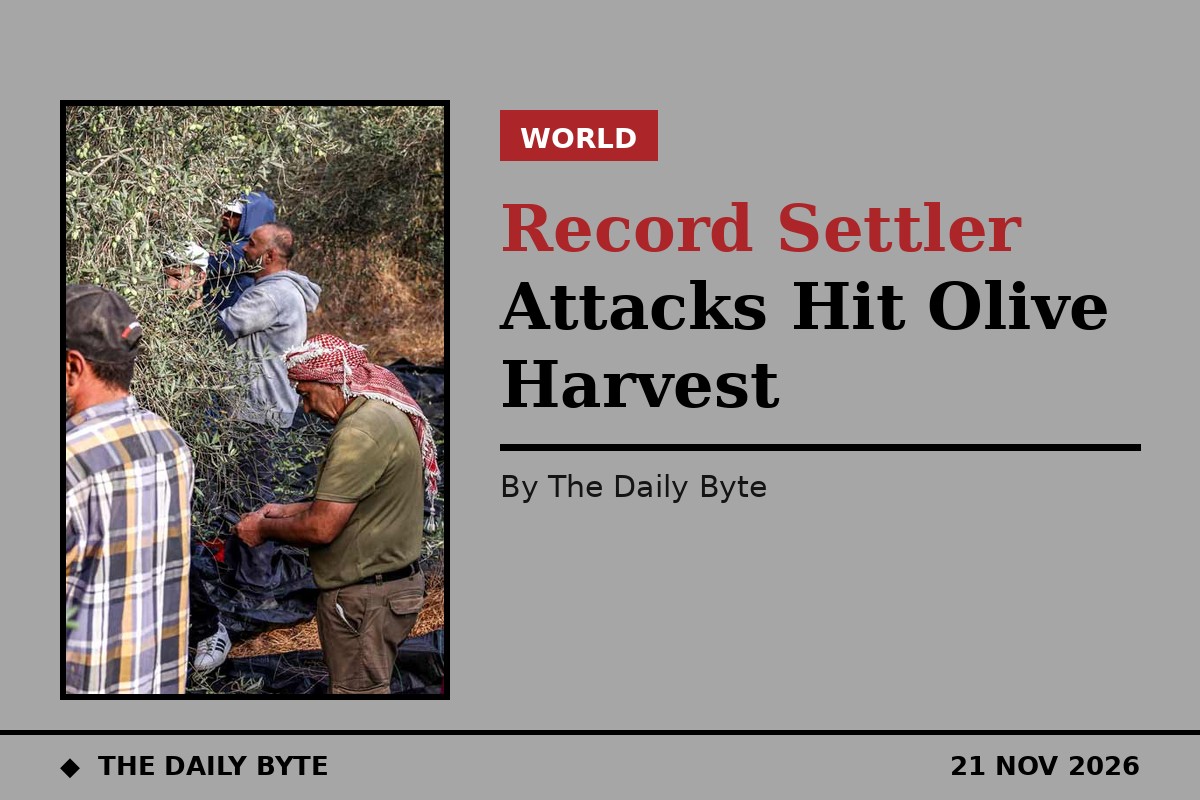
Israeli settlers have carried out more than 400 attacks causing casualties or property damage during this year's olive harvest in the occupied West Bank, more than in any previous season, UN agencies and humanitarian groups said on Friday. The violence has struck at a harvest that tens of thousands of Palestinian families depend on for their livelihoods.
Since September, more than 4,000 trees and saplings have been damaged and over 25,000 kilogrammes of produce vandalised or stolen, according to the Humanitarian Country Team for the Occupied Palestinian Territory, which brings together the heads of UN entities and international and Palestinian aid groups. The group said earlier calls on the Israeli authorities to protect Palestinians and ensure they can safely reach their groves had not been acted upon. "Instead, we've seen acquiescence, support and participation."
The violence has also spread into Areas A and B, which the 1995 Oslo II Accords placed under full or partial Palestinian Authority control and where Palestinians had faced fewer such attacks in past years. Solidarity activists, journalists and diplomats have also been targeted, the group said.
Trees uprooted by the authorities too
Settler attacks are not the only pressure on the harvest. In the first nine months of 2026, Israeli authorities uprooted or otherwise damaged more than 10,000 Palestinian-owned trees and saplings across the West Bank, most of them olive trees, the country team said.
Near Israeli settlements and behind the West Bank Barrier, Israeli forces are barring landowners from their groves unless they first obtain Israeli authorisation. Even where access has been scheduled, it has been for too few days, the group reported, and is often followed by cancellations, denial of entry, expulsion or attacks. Israeli settlements have spread so widely that few Palestinian communities remain unaffected by such restrictions, which in practice extend beyond the areas shown on the Israeli-issued coordination map. With thousands unable to reach their trees, crops are being lost.
A livelihood under pressure
An estimated 80,000 to 100,000 Palestinian families in the West Bank rely on olives and olive oil, a sector that contributes around 15 per cent of agricultural GDP, according to the UN. The harvest also holds deep social and cultural significance for farming communities.
Restrictions and disruption during the season and throughout the year prevent essential work such as pruning, fertilisation and pest control, steadily reducing tree productivity and future harvests. That undermines livelihoods, income and wider food security, the country team said, with broader implications for freedom of movement and other rights.
A deadly week in the West Bank
The harvest violence comes in a week of wider settler attacks across the territory. In Jericho, a 72-year-old Palestinian woman was shot and killed by an Israeli settler, the UN humanitarian office reported. Overall, 40 settler attacks resulting in casualties or property damage were recorded across 30 communities in a single week.
Settler attacks and related access restrictions displaced 68 Palestinians, including 31 children, in Hebron and Ramallah governorates during the same week. Since the beginning of 2026, more than 5,150 Palestinians have been displaced across the West Bank due to demolitions, settler violence, related access restrictions and evictions, averaging more than 16 people per day, according to the UN Office for the Coordination of Humanitarian Affairs.
What the UN is asking for
The humanitarian groups urged the Israeli authorities in the strongest possible terms to end all attacks on Palestinians and their livelihoods, as required by international law, and to ensure farmers have free, safe, sufficient and reliable access to their land. Farmers must be able to bring in essential agricultural supplies, equipment and vehicles, and safely transport their harvested olives, the statement said.
"Perpetrators must be stopped and held to account," the group said, calling on member states to use their influence to ensure the measures are implemented promptly and sustained throughout the year. This year's harvesting window is closing, the statement added, "but there is still some time to act."