WFP to Help 91 Million People in 2027
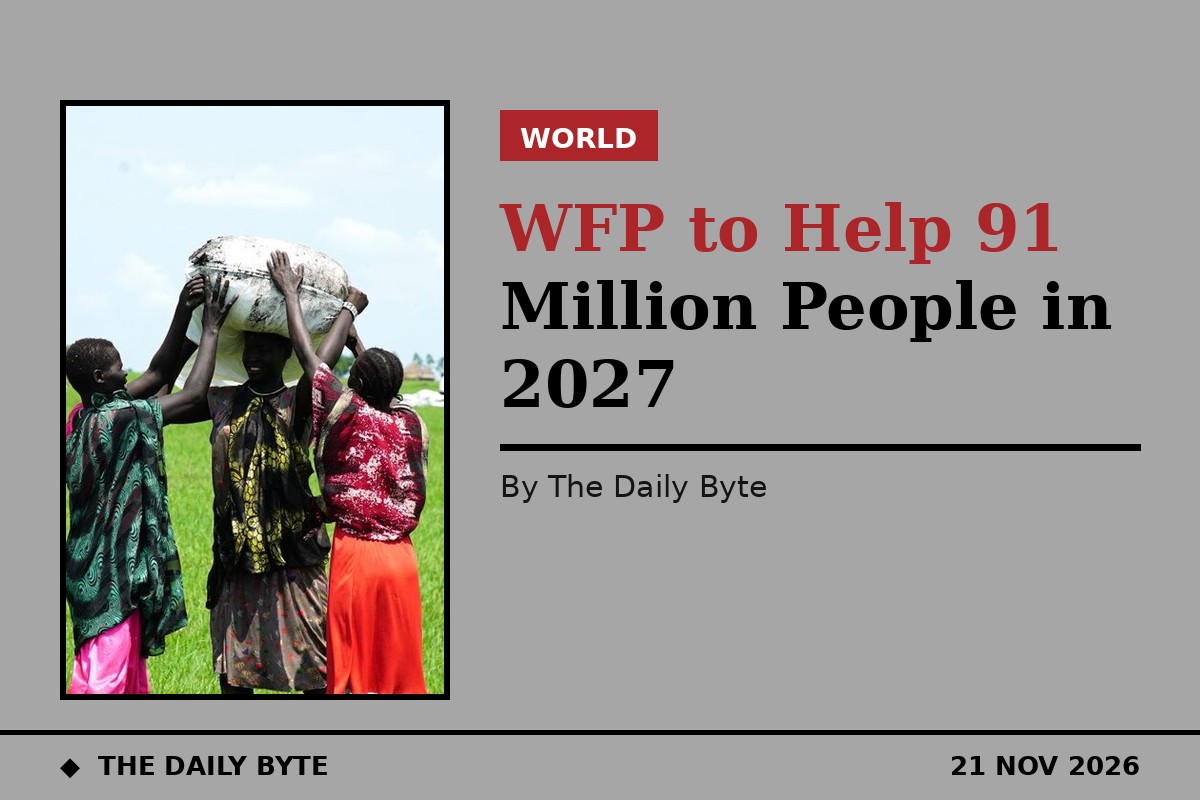
The World Food Programme (WFP) plans to assist 91 million people in 2027 at a cost of just over 12 billion dollars, but has warned that millions more will go hungry as funding shortfalls continue and another global food crisis looms.
The United Nations agency launched its Global Outlook for 2027 in Rome on Friday, 20 November, setting out a plan that reaches only about a third of the people facing acute hunger worldwide. As many as 266 million people faced acute hunger in 2025, according to the Global Report on Food Crises, with an estimated 39 million at emergency levels or worse.
A smaller target than the need
The 91 million target is fewer than the 110 million people the agency aimed to help in 2026, according to Reuters, and the reduction does not reflect falling need. It reflects the hard choices imposed by shrinking aid budgets. WFP director Laura Turner told a Geneva briefing that the agency's 2026 appeal for 13 billion dollars is only about half funded.
“Our teams are having to make very difficult decisions on the ground. Inevitably, that means we're leaving people behind,” Assistant Executive Director Matthew Hollingworth said, presenting the outlook to journalists in Geneva. “What's even more concerning is that in the current environment, the gap between those we can and cannot reach is probably going to grow larger.”
Hollingworth warned that the world could soon face a third major global food crisis in six years, after the shocks of the Covid pandemic and the war in Ukraine, as conflict, higher transport costs and a powerful El Nino disrupt harvests and push up food prices.
Africa carries the largest share
Eastern and Southern Africa account for the largest slice of the 2027 plan, with 102 million people acutely food insecure in the region, 33 million targeted for assistance and 4.6 billion dollars required. Conflict has created what Hollingworth called triple choke points on three crucial shipping lanes, the Strait of Hormuz, the Bab al-Mandab Strait and the Black Sea, while famine risks are rising in war-torn Sudan.
Nearly 72 per cent of WFP's requirements for 2027 are for crisis response, while 28 per cent supports resilience-building, the agency said. That balance reflects an operation still dominated by emergencies, even as the agency tries to invest in helping communities withstand the next shock rather than only surviving the current one.
Doing more with less
WFP said it is pivoting towards efficiencies that will extend its reach to the most vulnerable. That includes scaling up anticipatory action, including insurance and pre-arranged finance that help communities prepare before climatic shocks strike, working more through local partners, and expanding market-based assistance such as cash, which gives families greater choice and supports local markets.
“For the world's most vulnerable people, acute hunger is becoming harder to escape,” said WFP Executive Director Luke J. Lindberg. “We can protect the most vulnerable, but it will require sustained political commitment, investment and collective action. I urge others to join our call and take action to ensure no more famines, no more weaponization of food, and no more attacks on humanitarians.”
The agency called for flexible, predictable funding that lets it direct resources to where needs are greatest. Without it, officials warned, the gap between the 91 million it plans to reach and the 266 million in acute need will keep widening.


