WFP Warns Food Aid for 7.3 Million at Risk From Wars
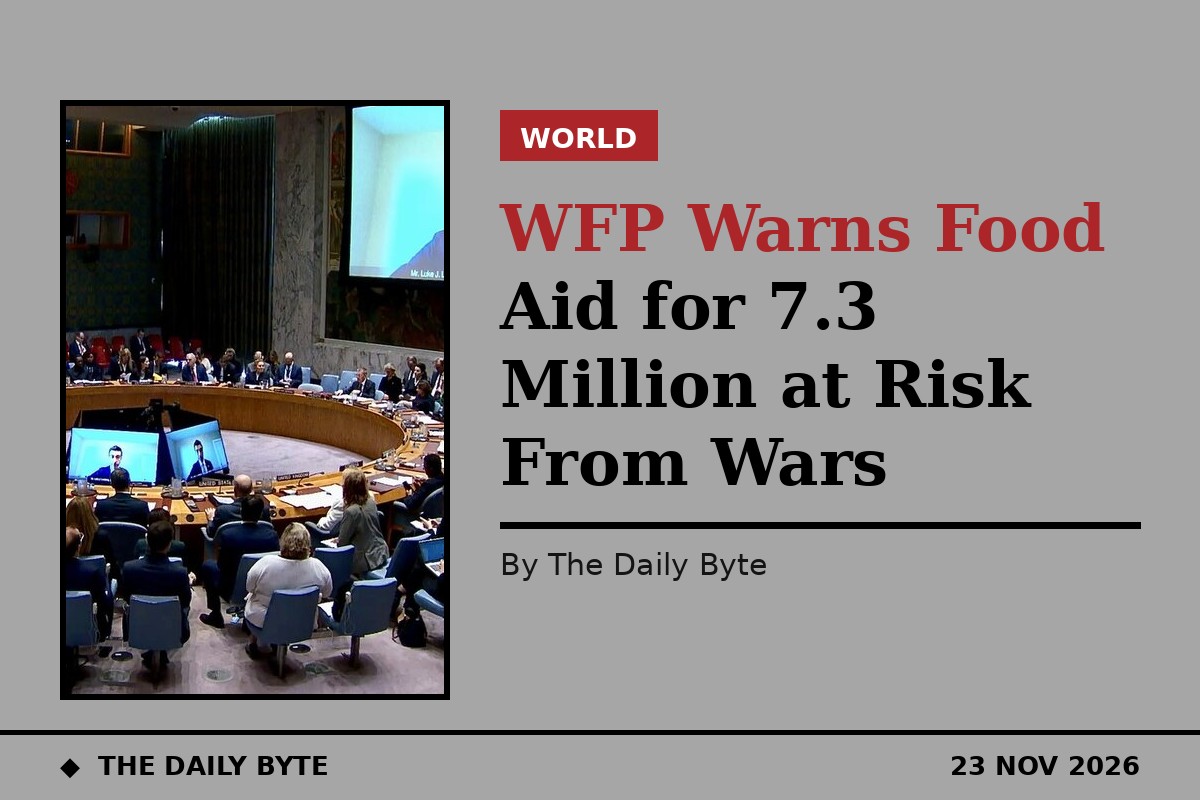
Wars in the Middle East and Ukraine are driving up the cost of feeding the world's hungriest people, the head of the United Nations World Food Programme warned the UN Security Council on Monday, 23 November. Executive Director Luke Lindberg said disruption to three vital shipping routes could add 727 million dollars to the agency's costs by mid-2027, putting food assistance for 7.3 million more people at risk. He described the squeeze as a triple chokepoint affecting the Strait of Hormuz, the Bab el-Mandeb strait and the Black Sea.
A triple chokepoint on the world's food routes
At the heart of the warning is the disruption of food exports and farming inputs through three of the world's most important trade routes. Around 30 percent of global fertiliser supplies pass through the Strait of Hormuz, while the Black Sea is a critical source of grain for many of the countries where the World Food Programme works. The UN Food and Agriculture Organization's food price index reached a near four-year high in September, and wheat prices are almost 10 percent higher than in January. By mid-October, 63 percent fewer wheat and maize vessels were moving through the Bosphorus, the key maritime gateway carrying Black Sea grain to global markets, than at the same point in 2025. Around 10 million tonnes of Russian and Ukrainian wheat could consequently fail to reach global markets, enough to feed an estimated 44 million people. The route has also become extraordinarily dangerous for the people transporting food, with more than 300 attacks recorded this year and at least 40 people killed. Lindberg told the Council that a triple chokepoint has dramatically tightened the supply of food exports and farming inputs, and that combined with a surge in conflicts and climate shocks such as El Nino, the effect on food production and prices has been very real.
Hunger is already at alarming levels
The warning comes as 266 million people worldwide already face acute hunger, with a risk of famine in parts of Sudan, South Sudan and Somalia. In Sudan, the cost of a basic diet has risen by 130 percent since February, as conflict and economic turmoil collide with the wider global price shock. During his first field mission to Sudan, Lindberg met Samia, a mother of five who fled conflict in Darfur and walked for days in search of food and safety before reaching a displacement camp in Kosti. She works in a local market whenever she can, but what she earns is scarcely enough to survive, and each week it buys a little less. The Black Sea's grain is vital to countries including Somalia, which is at risk of famine, and Yemen, which imports 90 percent of its food. Yet grain silos in Ukraine and Poland are full while families face catastrophic hunger. Lindberg told the Council that this is not a problem of production, but a political problem, and that grain is available but is not reaching the people who need it most.
Aid budgets are being squeezed too
The same pressures pushing up prices for families are also making it more expensive to deliver humanitarian assistance. The World Food Programme provides assistance to more than 100 million people in 83 countries each year, but it has already lowered its target to provide food assistance to 91 million people in 2027, down from 110 million people this year. Its total costs last year were nearly 12.2 billion dollars, so 727 million dollars in additional costs by mid-2027 would mark an increase of nearly 6 percent. Lindberg, who was named in September by US President Donald Trump to head the world's largest humanitarian agency and is a former US agriculture official, said the agency cannot avoid the volatility that comes with higher transport and commodity costs. This is taking money straight out of the World Food Programme's operations, he said, directly translating into less food for fewer families.
Three red lines for a world without hunger
Lindberg closed his address by calling on member states to commit themselves to three red lines: no more famines, no more weaponisation of food, and no more attacks on humanitarians. He said these are the essential foundations for a world without hunger, and urged Council members to work together to make them a reality. The agency said it stands ready to facilitate humanitarian grain shipments from both Russia and Ukraine, and called for rapid, practical action and clear coordination to get food moving again. For millions of people already living on the edge, the message from New York was stark: the food exists, but unless the routes reopen and the fighting eases, it will not reach them. Reuters reported the warning, and the World Food Programme published Lindberg's full address to the Security Council.


