WFP Cuts Gaza Food Aid as 1.4m Go Hungry
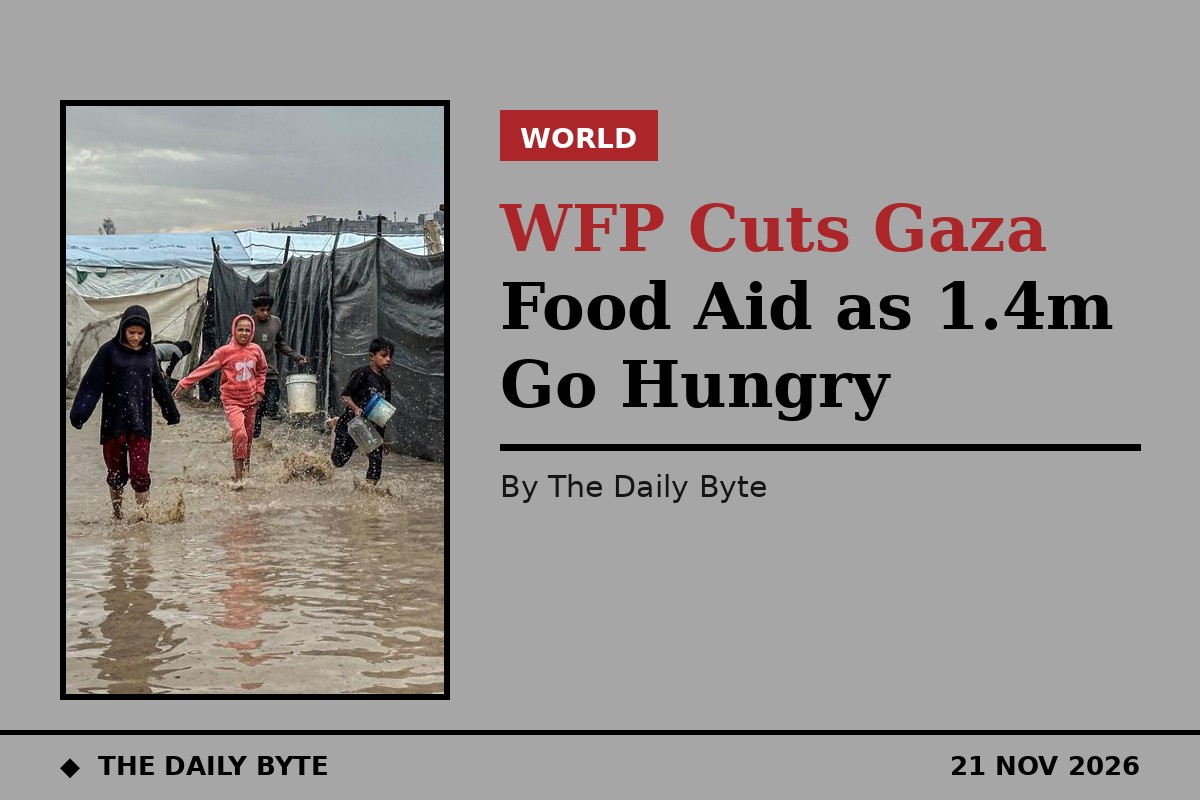
The World Food Programme says about 1.4 million people in Gaza — two-thirds of the population — are acutely food insecure, as funding shortfalls force it to cut monthly food assistance by a third and halve rations for the families it still reaches.
The figures come in the agency's Palestine external situation report published on Saturday, covering October 2026, which warns that displaced families are facing a fourth winter in tents and that deteriorating weather will further deplete their already limited capacity to store food safely and access cooking fuel.
Funding shortfalls have already forced the agency to cut monthly food assistance by one-third in Gaza and by half in the West Bank, the report says, heightening the risk of further deterioration in food security as winter compounds existing vulnerabilities.
Half a million lose support
The cuts were announced on 19 October. Since then, the number of people receiving food and cash assistance in Gaza has fallen from 1.6 million in September to 1.1 million, leaving about half a million people without critical support.
Food rations have been cut in half: families receiving assistance now get one food parcel instead of two, along with a smaller bag of wheat flour. The number of hot meals provided each day has fallen from 250,000 to 150,000, and the value of cash assistance given to 75,000 families has been reduced.
Families living in hard-to-reach areas, including near the Yellow Line of Israeli military control, now receive a hot meal every other day instead of daily.
For the past three years, the programme's food assistance has provided a lifeline for up to 90 per cent of families in Gaza. Since the ceasefire was announced in October 2025, teams had been reaching around 1.6 million people every month with food parcels, wheat flour, bread, hot meals, nutrition support, school snacks and cash assistance. The agency says it no longer has enough funding to sustain that level of support.
Crisis-level hunger
Roughly 67 per cent of Gazans — an estimated 1.4 million people — are experiencing acute food insecurity at crisis level or worse, classified as Phase 3 or above under the Integrated Food Security Phase Classification. Although that is down from 77 per cent at the end of 2025, the agency said the improvement remains modest and fragile.
Some 200,000 people remain in emergency conditions, where immediate food assistance is needed to prevent deaths from hunger. Only one in five children consumes a sufficiently diverse diet, and access to healthcare and other essential services remains limited.
The cuts come at a critical time in Gaza, where more than 80 per cent of the population is unemployed, leaving many families unable to afford fresh produce or protein-rich foods even when they are available.
For now, the agency says it can continue supporting bakeries that cover a third of Gaza's bread needs, provide nutrition assistance to 300,000 women and children, and deliver healthy school snacks to 200,000 students.
Funding gap
Funding for the agency's Palestine operation in 2026 amounted to less than half of what it received in previous years. It urgently requires 450 million dollars to maintain critical operations in Gaza and the West Bank over the six months from October 2026 to March 2027.
"Improved humanitarian access and delivery of assistance since October 2025 have helped reduce food insecurity, but these gains remain fragile and could quickly be reversed if humanitarian funding continues to decline," the agency warned.
Funding shortages have also affected operations in the West Bank, where the number of people receiving assistance was cut by half — from 400,000 to 200,000 — in September.
The agency stressed that as winter approaches, additional resources are urgently needed to sustain emergency food assistance, provide critical engineering support and prevent malnutrition among young children and pregnant and breastfeeding women.


