What Are Rare Earth Minerals?
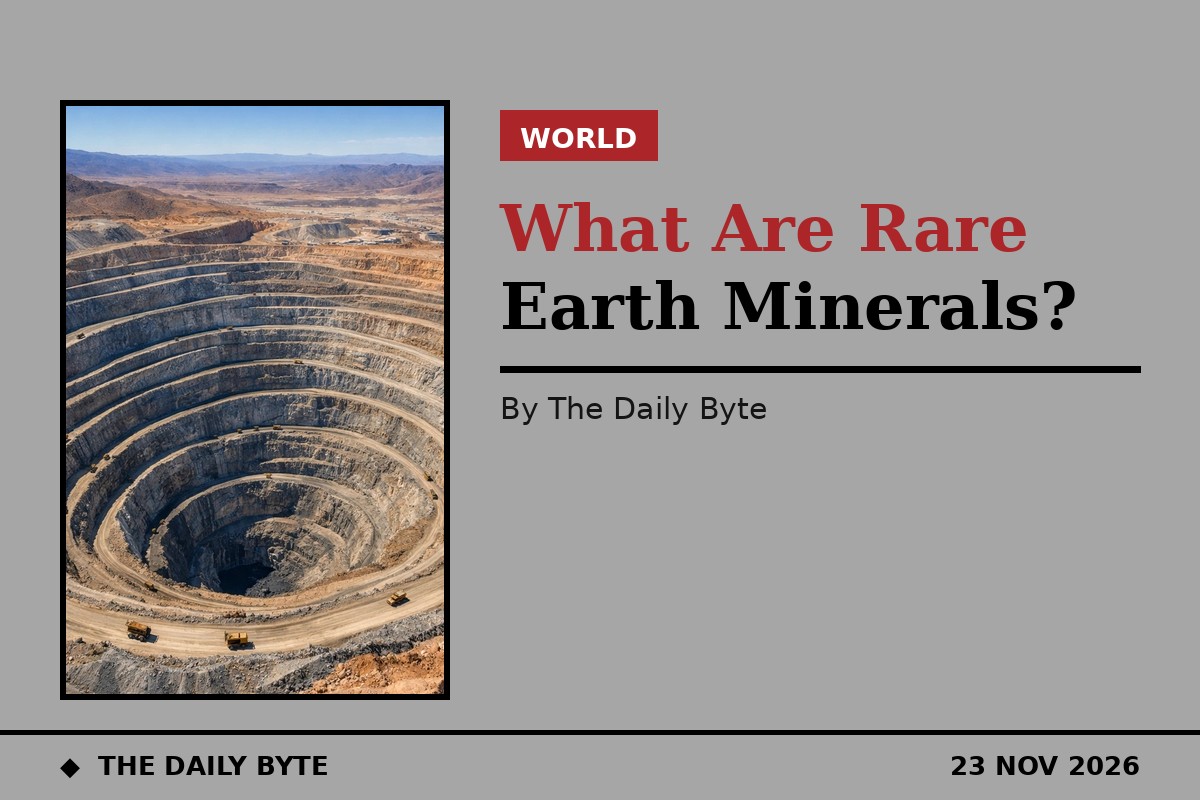
Rare earth minerals are a group of 17 metallic elements with a misleading name. They power the magnets in electric cars and wind turbines, the screens and speakers in mobile phones, the catalysts that clean car exhausts, and the guidance systems in missiles and satellites. They are not actually rare — as a group they are about as abundant in the Earth's crust as lead — but they are difficult to mine and process, and a handful of countries dominate their supply. That combination has made them one of the most strategically important groups of materials in the world.
They returned to the headlines in November 2026, when Thailand announced plans to block exports of chemicals used in rare earth mining to Myanmar, blaming unregulated mines across its border for poisoning rivers in the country's north with arsenic. If you have ever wondered what rare earth minerals actually are, where they come from and why governments argue over them, this explainer sets out the answers.
The short answer
Rare earth minerals are 17 elements on the periodic table: the 15 lanthanides, which run from lanthanum (atomic number 57) to lutetium (atomic number 71), plus scandium (atomic number 21) and yttrium (atomic number 39). Scandium and yttrium are not lanthanides, but they behave so similarly and turn up in the same ore deposits that chemists and geologists count them in the group.
The name is a historical accident. When these elements were first isolated in Scandinavia in the late 18th and 19th centuries, they were found in uncommon minerals and were hard to separate from one another, so they were called "rare earths" to distinguish them from the alkaline earth elements, such as calcium and magnesium, found in the same deposits. The label stuck even though scientists later discovered that most of them are fairly common in the Earth's crust. The real scarcity is not in the ground. It is in the number of places where they occur in concentrations worth mining, and in the number of facilities able to separate them into usable form.
All 17 elements
The full list is: lanthanum, cerium, praseodymium, neodymium, promethium, samarium, europium, gadolinium, terbium, dysprosium, holmium, erbium, thulium, ytterbium and lutetium — the 15 lanthanides — plus scandium and yttrium.
Each has its own uses, and only a few dominate trade. Neodymium is the most commercially important, because it is the key ingredient in neodymium-iron-boron magnets, the strongest permanent magnets known. Cerium is the most abundant of the 17 and is used in catalytic converters and glass polishing. Lanthanum goes into camera lenses and rechargeable battery electrodes. Europium and terbium produce the red and green phosphors in lamps and displays. Gadolinium is used in MRI contrast compounds and as a neutron absorber in nuclear reactors. Yttrium is used in ceramics, lasers and phosphors. Promethium is the odd one out: it is radioactive, has no stable isotopes, and occurs in nature only in trace amounts, so it is of little commercial importance.
Light and heavy rare earths
The group is usually split in two. The light rare earth elements run from lanthanum (57) to gadolinium (64). The heavy rare earth elements run from terbium (65) to lutetium (71), together with yttrium, which is counted as heavy by convention. Scandium is not classified as either light or heavy.
The split matters because the two groups behave differently in the ground and in the market. Light rare earths are more abundant and are found in most deposits. Heavy rare earths are scarcer, harder to extract, and often more valuable per kilogram — terbium oxide, for example, is priced far above cerium or lanthanum oxide. Many of the most sensitive uses, including high-performance magnets that must keep working at high temperatures, depend on heavy rare earths such as dysprosium and terbium added to neodymium magnets.
Where rare earths are found
Rare earth elements almost never occur on their own. Because their atoms are so similar in size, they substitute freely for one another inside mineral crystals, so all 17 typically occur together in different proportions in more than 100 minerals. The principal ores are bastnäsite, monazite and xenotime, along with lateritic ion-adsorption clays — weathered soils in which the elements are loosely bound and can be leached out with chemicals.
The best-known mine outside China is Mountain Pass in California, an open-pit mine on the south flank of the Clark Mountain Range, about 85 kilometres south-west of Las Vegas. Its ore is bastnäsite, and it was once the world's dominant source of rare earths before competition from China largely closed it down. It has since reopened under new ownership and is now the largest rare earth mine in the United States.
Other production comes from Australia, Myanmar, Thailand, India, Madagascar, Russia and Brazil, but none of these comes close to China's scale. World reserves are estimated at more than 75 million tonnes of rare earth oxide, with China holding the largest share, about 44 million tonnes.
What rare earths are used for
Rare earths have hundreds of commercial uses, and demand has grown as technology has become more dependent on them. The largest uses, in order of demand in the United States, are catalysts, magnets, metal alloys, glass and polishing, phosphors and ceramics, according to the US Congressional Research Service.
Magnets are the most strategically sensitive use. Neodymium-iron-boron magnets are used in the motors of electric vehicles, the generators of offshore wind turbines, headphones, computer hard drives and the motors in countless household appliances. A single large offshore wind turbine can contain hundreds of kilograms of rare earth magnets, and an electric car motor typically contains around a kilogram of neodymium.
Catalysts are the largest use by volume. Cerium and lanthanum are used in oil refinery catalysts and in the catalytic converters that cut exhaust pollution from petrol and diesel cars. Phosphors containing europium, terbium and yttrium produce the colours in fluorescent lamps, LED lights and display screens. Polishing powders based on cerium are used to finish glass for lenses, mirrors and smartphone screens. In medicine, gadolinium compounds sharpen MRI scans, while samarium and lutetium have specialist roles. In defence, rare earths go into satellite communications, guidance systems, aircraft structures, radar and smart missiles.
Who produces them
China dominates the rare earth industry to a degree matched by few other materials. According to the US Geological Survey's Mineral Commodity Summaries 2026, world mine production in 2025 was an estimated 390,000 tonnes of rare earth oxide. China mined about 270,000 tonnes of that total, or roughly 69%. The United States was a distant second at about 51,000 tonnes, or around 13%.
China's grip on processing is even tighter than its grip on mining. The International Energy Agency estimates that China accounted for about 91% of the refining of magnet rare earths and about 94% of sintered magnet production in 2024. That means ore mined in other countries is often shipped to China to be separated and refined before it can be used. It is this processing dominance, more than the mining figures alone, that gives China its leverage over global supply.
China has also shown a willingness to use that leverage. It tightened export controls on seven rare earth elements in 2025, and export restrictions and licensing have repeatedly become a point of friction in trade disputes. Governments in the United States, Europe, Japan and Australia have responded with efforts to build alternative mines, refineries and magnet plants, but new projects take years to open, and the chemical separation of rare earths is a technically demanding business that China has spent decades mastering.
Why they are in the news in November 2026
The latest flashpoint is on the border between Thailand and Myanmar. Unregulated rare earth mining has boomed in Myanmar's Shan State in recent years, much of it feeding Chinese demand, and the mines have been blamed for contaminating rivers that flow into northern Thailand. Arsenic levels in the Kok and Sai rivers have surged, with Thai officials reporting readings as much as 30 times the Thai standard in some stretches, threatening public health and farmland.
On Saturday 21 November, Thailand's deputy prime minister, Yodchanan Wongsawat, announced that Thailand plans to stop exporting chemicals used in rare earth mining to Myanmar, and to restrict transit shipments through Thai territory as well. The government said it would use the National Security Council mechanism, working with the industry and commerce ministries, to cut off the precursor chemicals that the mines depend on. Thailand also plans to declare the Thai side of the Kok River a pollution control zone from 2 December, and to hold ministerial-level talks with China and Myanmar from 24 to 26 November.
The move is aimed at one of the least visible but most important links in the rare earth chain: the chemicals used to leach the elements out of ore and clay. It is also a reminder that the politics of rare earths is not only about great-power rivalry. It is also about the rivers, farms and communities that live downstream of the mines.
The environmental cost
Mining and processing rare earths is chemically intensive and produces large volumes of waste. The elements occur in low concentrations and are hard to separate from each other, so extraction uses strong acids, solvents and leaching agents, and leaves behind tailings that can contain radioactive thorium and uranium, which occur naturally alongside the rare earths in minerals such as monazite.
Ion-adsorption clay mining, the method used widely in southern China and Myanmar, is particularly damaging when unregulated. It involves pumping chemical solutions into hillsides to dissolve the rare earths out of the soil, and the run-off can carry arsenic and other toxic substances into streams and groundwater. That is the process blamed for the contamination of the Kok, Sai and Ruak rivers in northern Thailand.
Regulated mines operate under much tighter controls, with lined tailings ponds, water treatment and land rehabilitation. But the cost of meeting those standards is one reason why so much production has concentrated in countries where enforcement has been weaker. Any effort to diversify supply must reckon with that cost, and with the willingness of importing countries to pay for cleaner production.
Rare earths and critical minerals
Rare earths are often described as critical minerals, but the two terms are not the same. "Rare earth elements" is a fixed chemical group of 17 elements. "Critical minerals" is a government list based on supply risk and economic importance, and it changes as risks change. The US Geological Survey's 2025 list of critical minerals contains 60 entries, including lithium, cobalt, copper and tungsten as well as most of the rare earths — promethium is the only rare earth left off the list.
That distinction matters for policy. A government that wants to secure its supply of rare earths is not only concerned with mines. It must also think about refineries, magnet factories, stockpiles, recycling and substitutes. Recycling is growing, with rare earths recovered from old phones, hard drives and electric motors, but it still supplies only a small share of demand. Substitutes exist for some uses — ferrite magnets can replace neodymium magnets in some motors, for example — but they are usually bulkier and less efficient.
Can the world diversify?
New mines are opening, including projects in Australia, the United States and Africa, and governments are funding refineries and magnet plants to reduce dependence on China. But building a full supply chain takes time. A mine needs years of permitting and construction, a refinery needs specialist chemical expertise, and magnet makers need customers willing to sign long-term contracts at prices that can compete with established Chinese producers.
The Thailand announcement shows that pressure can also come from unexpected directions. A dispute about river pollution has become a lever over the supply of chemicals to mines in a neighbouring country, and the talks due in Bangkok from 24 November will test whether that lever produces cleaner mining or simply shifts production elsewhere. Either way, the 17 elements that were once a footnote in chemistry textbooks are now at the centre of arguments about clean energy, national security and the environment — and that is why a question as simple as "what are rare earth minerals?" has become so widely asked.
Sources: EARTH Magazine, "Mineral Resource of the Month: Rare Earth Elements" (U.S. Geological Survey); U.S. Geological Survey, Mineral Commodity Summaries 2026; Reuters reporting on Thailand's announcement of 21–22 November 2026.


