What Are the Epstein Files? Full Explainer
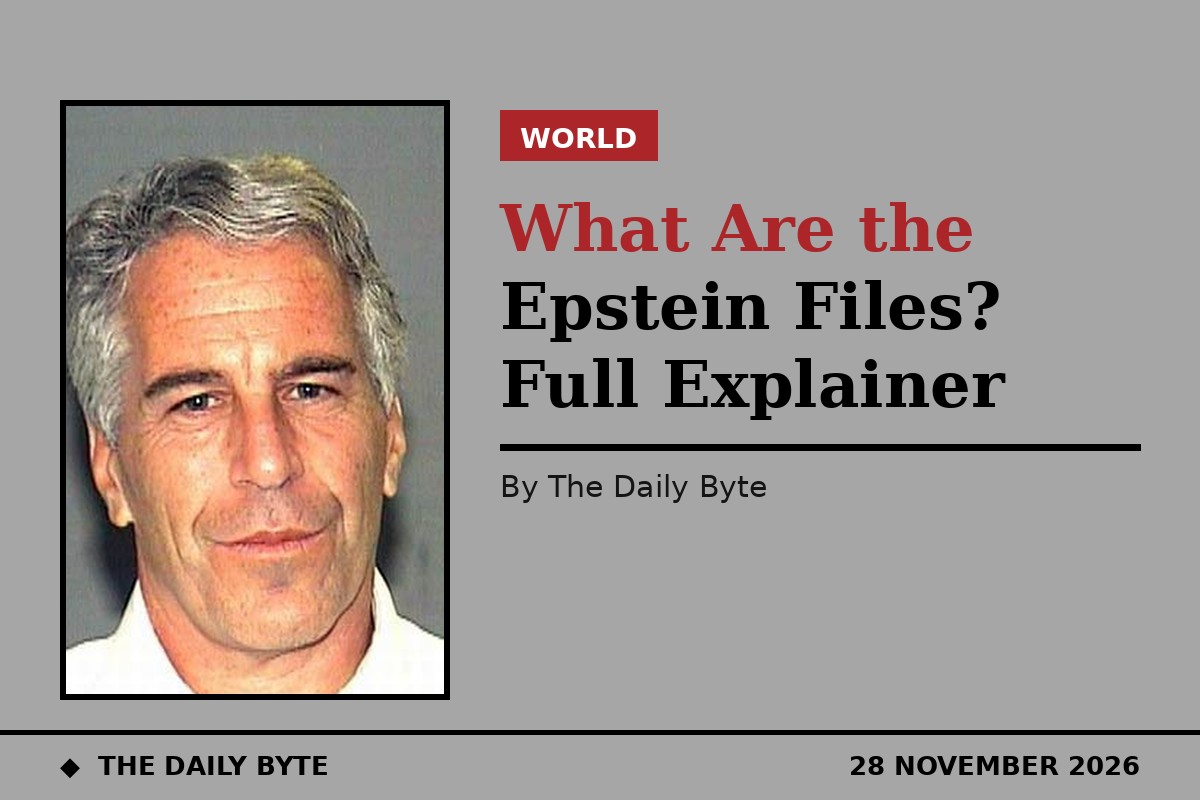
The Epstein files are the United States Justice Department's records of its investigations into Jeffrey Epstein, the financier and convicted sex offender who died in a New York jail cell in 2019 while awaiting trial on federal sex trafficking charges. They include FBI reports, witness interviews, flight logs, internal communications, immunity deals and material about Epstein's detention and death. Under a law signed by President Donald Trump on 19 November 2026, the Justice Department must make all of the unclassified records public in a searchable and downloadable format within 30 days, which sets a deadline of 19 December 2026.
The files have become one of the most searched subjects in American politics because Epstein moved in wealthy and powerful circles, and because the government has for years released only fragments of what it holds. The new law, the Epstein Files Transparency Act, was passed by Congress with near-unanimous support after months of political pressure. This explainer sets out what the files are, what the law requires, what is likely to be held back, and what the release will and will not prove.
What the "Epstein files" actually are
There is no single document called the Epstein files. The phrase covers the full archive of material gathered by the Justice Department and the FBI across more than one investigation into Epstein and his associate Ghislaine Maxwell. The law lists the categories the department must release, and they are broad. They include all unclassified records, documents, communications and investigative materials relating to Epstein, including material about the investigations, the prosecutions and his time in custody.
Beyond that general instruction, the law names eight additional categories. They include material relating to Maxwell, who was convicted of sex trafficking offences and is serving a 20-year prison sentence; flight logs and travel records for aircraft, vessels and vehicles owned, operated or used by Epstein; and records about decisions on whether to charge Epstein and his associates. The law also covers the department's internal communications about Epstein and its handling of his death in custody.
The archive is large. The Justice Department has said in court filings that it holds material obtained from FBI searches of Epstein's homes, interview records, and years of accumulated investigative files. How much of it is unclassified, and how much has already been released in earlier tranches, is part of what the new deadline is meant to settle. The department is required to publish the material in a searchable and downloadable format, rather than as a set of scanned images that cannot be searched.
Who was Jeffrey Epstein?
Jeffrey Epstein was an American financier who built a fortune in the 1980s and used it to cultivate relationships with politicians, royalty, business leaders and academics. He pleaded guilty in Florida in 2008 to state charges of soliciting prostitution, after a federal investigation into the sexual abuse of teenage girls was set aside under a controversial non-prosecution agreement. He served a short jail sentence under a work-release arrangement that allowed him to leave custody for much of the day.
He was arrested again in July 2019, this time on federal charges of sex trafficking of minors and conspiracy. Prosecutors alleged that he sexually abused dozens of teenage girls and ran a network that recruited them, with Maxwell as his principal associate. Epstein pleaded not guilty. On 10 August 2019, while held at the Metropolitan Correctional Center in Manhattan, he was found dead in his cell. His death was ruled a suicide. The charges against him were dropped after his death, but the investigation into Maxwell continued, and she was convicted in December 2021.
The unanswered questions about Epstein's death, his wealth and his connections have fuelled years of speculation. That speculation is one reason the files are so keenly anticipated, and also one reason the release needs to be read carefully: a name appearing in an investigative file is not, on its own, evidence that the person committed a crime.
Why the files were not released sooner
Epstein's case has been the subject of Freedom of Information requests, lawsuits and congressional demands for years. Earlier releases of material were partial. Files released earlier in 2026 contained little that was new, according to news reports at the time, and much of the material had already been made public through court proceedings. The department also said it had found no incriminating list of Epstein's clients, a statement that satisfied nobody and deepened the demands for full disclosure.
The political pressure changed in November 2026. A bipartisan group in the House of Representatives, led by Republican Thomas Massie and Democrat Ro Khanna, used a discharge petition to force a vote on releasing the files. President Trump had long opposed full disclosure, describing the interest in Epstein as a distraction, but reversed his position after Republican supporters of release signalled they would vote with Democrats. On 18 November 2026, the House passed the Epstein Files Transparency Act by 427 votes to 1. The Senate passed it the same day by unanimous consent, a procedure that allows a bill to pass without a formal vote if no senator objects. Trump signed it into law the next day, 19 November 2026.
What the Epstein Files Transparency Act requires
The Act is short and direct. It orders the Attorney General, Pam Bondi, to make publicly available, in a searchable and downloadable format, all unclassified records, documents, communications and investigative materials in the possession of the Justice Department that relate to Jeffrey Epstein, including all investigations, prosecutions and custodial matters. The deadline is 30 days after the Act became law, which falls on 19 December 2026.
The key facts are summarised below.
The Epstein Files Transparency Act at a glance. House vote: 427 to 1, on 18 November 2026. Senate passage: unanimous consent, 18 November 2026. Signed into law: 19 November 2026, by President Donald Trump. Public law number: 119-38. Release deadline: 19 December 2026, thirty days after enactment. Format required: searchable and downloadable. What must be released: all unclassified Justice Department records relating to Jeffrey Epstein, including investigations, prosecutions and custodial matters. Enforcement mechanism: none written into the law.
The breadth of the order is unusual. Congress rarely instructs the executive branch to publish an entire investigative archive, and the Act was written to limit the department's discretion. It states plainly that no records may be withheld or redacted because of embarrassment, reputational harm or political sensitivity. That wording was aimed at a specific fear: that the department would use redactions to protect powerful people named in the files.
What can be redacted, and what cannot
The Act does allow some material to be held back. Records may be redacted to protect the identities of victims, to avoid harming an ongoing investigation, or to protect information that could jeopardise national defence or foreign policy. Classified material is outside the scope of the order altogether. Victim protection is the least controversial of these exceptions, and it is also the most important: many of the people who gave evidence against Epstein were children at the time, and their names and identifying details are routinely withheld from published court material.
The difficulty is that the exceptions are wide enough to cover a great deal. The Justice Department can argue that a document relates to an ongoing investigation, and it has opened new inquiries connected to Epstein, including an investigation ordered by the President into Epstein's links to his political opponents. That investigation could, in principle, be used to justify withholding material. Whether Congress and the courts accept that reasoning is likely to be tested in the weeks after the deadline.
The Act contains no enforcement mechanism. There are no fines, no penalties and no automatic sanction if the deadline passes without a full release, and no independent body is given the power to check whether redactions were properly applied. That is why the release is being watched so closely: the law depends on political pressure and court action rather than on a punishment for non-compliance.
The court case over the FBI interview notes
Even before the deadline, the courts have been involved. In a case brought by journalist Katie Phang, a federal judge in Washington, Emmet Sullivan, ordered the Justice Department to publish handwritten FBI interview notes in its online Epstein Library by 23 November 2026. The notes sit beneath three typed FBI interview reports from 2019. The department argued that the notes were essentially duplicates of reports already released, and it appealed against the order on 17 November 2026. An appeal does not automatically pause the order, and the dispute illustrates how contested the release has become: the department is fighting in court over material it says adds nothing, while critics argue that every page should be public.
A federal judge in Florida has also ordered the release of Epstein grand jury transcripts under the new law, adding another front to the legal battle over disclosure.
What the files will not prove
The most important thing to understand about the release is what it cannot do. The files are an investigative archive, not a verdict. They contain allegations, interview notes, leads that were followed and leads that were not, and material gathered about people who were never charged with any offence. A person whose name appears in a flight log was a passenger on a flight. A person named in a witness interview may have been mentioned by somebody else, in a statement that was never tested in court. Neither fact proves wrongdoing.
The files may also contain material that is wrong, incomplete or contradictory. Witness accounts differ, and investigators recorded claims they could not verify. The department's own review, described in a letter from Deputy Attorney General Todd Blanche, concluded that the review had not revealed credible evidence that Epstein blackmailed prominent individuals, and had not uncovered evidence that could support an investigation against uncharged third parties. Critics have pointed out that the public cannot test that conclusion while the underlying evidence is redacted.
Readers should also be cautious about material circulating online as part of the files. Faked documents and misattributed photographs have already spread on social media, and the only reliable source is the Justice Department's own Epstein Library at justice.gov/epstein, where the department publishes what it releases.
What happens next
The first test comes on 19 December 2026, the statutory deadline. The department has said it expects to release several hundred thousand documents on the day, with more to follow over the following weeks. Lawmakers from both parties have said they will keep pressing for the material the department holds back, and some are already pushing for a second transparency bill to close the gaps they say remain in the law.
If the release is incomplete, the dispute is likely to move to the courts and to Congress, where the House Oversight Committee continues its own inquiry. Bill Clinton and Hillary Clinton are due to testify before the committee in February 2027. Whatever the files contain, the argument over whether the public has seen all of them is likely to run well beyond the December deadline.
Frequently asked questions
When will the Epstein files be released? The Epstein Files Transparency Act requires the Justice Department to publish the unclassified records by 19 December 2026, thirty days after President Trump signed the Act on 19 November 2026. The department has said it expects to release several hundred thousand documents by the deadline, with further releases to follow.
What exactly has to be released? All unclassified records, documents, communications and investigative materials held by the Justice Department that relate to Jeffrey Epstein, including material about the investigations, the prosecutions and his custody and death, plus eight named categories including material about Ghislaine Maxwell and Epstein's flight logs.
Can the Justice Department redact the files? Yes, but only for defined reasons: to protect victims, to avoid harming an ongoing investigation, or to protect national defence or foreign policy. The law expressly forbids withholding material because of embarrassment, reputational harm or political sensitivity.
Does a name in the files mean the person committed a crime? No. The files are investigative records containing allegations, witness statements and travel records about many people, including people never charged with any offence. A name in the files is not evidence of wrongdoing.
Where can I read the files? The Justice Department publishes released material in its online Epstein Library at justice.gov/epstein. The text of the Act itself is published by the Government Publishing Office as Public Law 119-38.


