What Are the Northern Lights? Aurora Explained
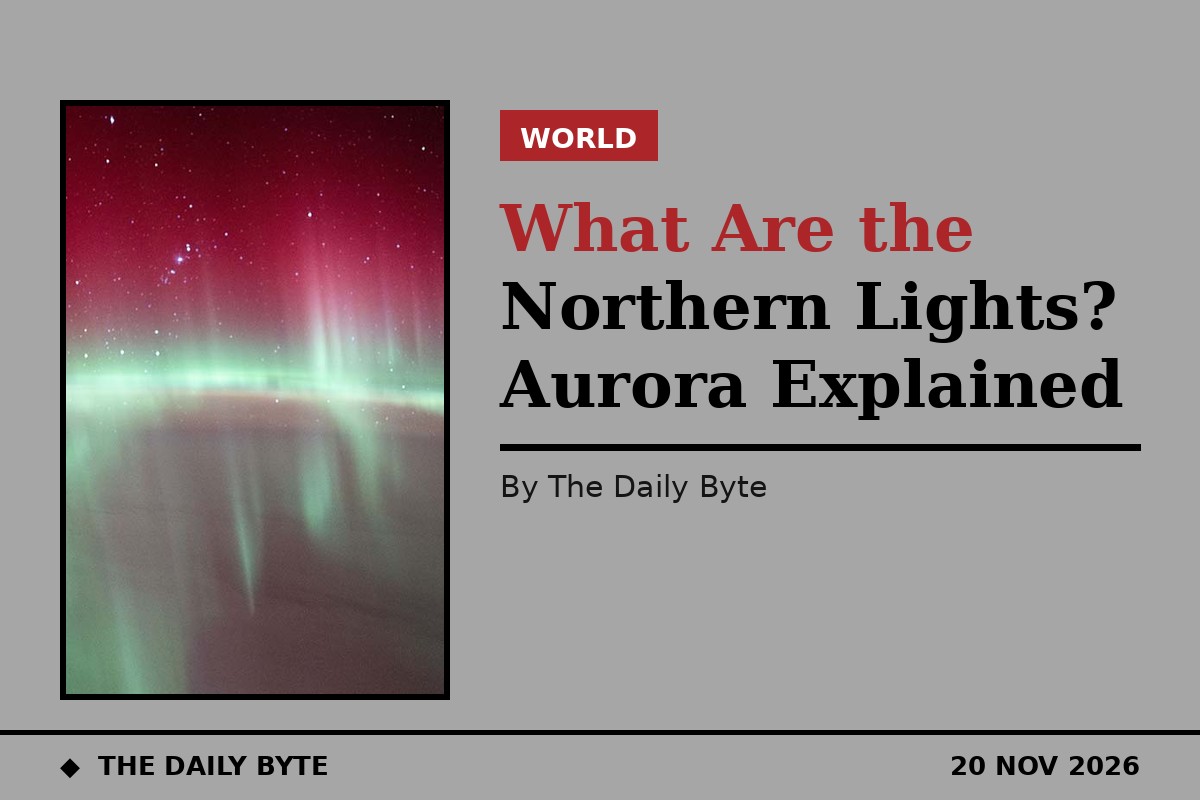
The northern lights, also known as the aurora borealis, are curtains and ribbons of coloured light that appear in the night sky: most often green, but sometimes pink, red, blue or violet. They are caused by charged particles streaming from the Sun colliding with gases high above the Earth. The lights are most often seen near the Arctic, but during strong solar storms they can appear much further south, including over the UK.
The display takes its formal name from Latin: borealis means north. The same phenomenon in the southern hemisphere is called the southern lights, or aurora australis. Auroras are not unique to Earth either. Scientists have seen them on other planets, including Mars, Jupiter and Saturn, as well as on comets and even distant dwarf stars, according to the Natural History Museum in London.
What causes the northern lights?
It starts with the Sun. "The Sun is a nuclear furnace, squeezing atoms together at its heart to release energy," Dr Geoff Vasil, who studies the Sun at the University of Edinburgh, told the Natural History Museum. "Ultimately, that's where the power behind the northern lights comes from." That energy drives the solar wind, a stream of charged particles, mostly protons and electrons, that flows away from the Sun in all directions. The Met Office says the solar wind travels at around one million miles per hour.
Earth's own magnetic field, generated by currents in its metallic outer core, deflects most of those particles. But some are funnelled along the magnetic field lines towards the poles and down into the upper atmosphere. When the Sun is more active, it throws out larger bursts of particles in solar flares and coronal mass ejections, huge eruptions of plasma from the Sun's surface. When these reach Earth they disturb the magnetic field, in events called geomagnetic storms, and push more particles into the atmosphere.
As the Natural History Museum explains, when the Sun's magnetic field reaches Earth it can push Earth's magnetic field out behind the planet like a stretched elastic band. When it snaps back, in a process called reconnection, it releases a large number of particles into the upper atmosphere, and the northern lights grow bigger and brighter. The charged particles collide with atoms and molecules of oxygen and nitrogen, handing them extra energy. The atoms cannot store that energy for long, so they release it as light, and the colour depends on which gas was hit and how high up the collision happened.
Why are the northern lights different colours?
Green is the colour most people picture, and it is the most common, but the full palette comes from the different gases in the upper atmosphere and the height at which they are struck. Auroras typically occur between about 80 and 250 kilometres above the Earth's surface.
| Colour | What makes it | When you see it |
|---|---|---|
| Green | Oxygen about 100 to 200 kilometres up. | The main colour of most displays. There is a lot of oxygen at this height, so collisions are likely. |
| Red | Oxygen more than 200 kilometres up. | Rare, and only during strong solar activity. The glow can linger for more than a minute, leaving a red smear sometimes called a blood aurora. |
| Pink, purple and blue | Nitrogen around 100 kilometres up. | Only when the Sun is very active, so that enough charged particles get past the oxygen higher up to reach the nitrogen below. |
| Yellow | Different colours mixing together. | Often seen when the Sun is very active and many colours are produced at once. |
Some of the light the aurora produces is outside what human eyes can see. Ultraviolet and infrared light can normally only be detected by specialist equipment, and have been seen in auroras around other planets as well as objects in outer space.
Where can you see the northern lights?
The lights appear most often in a ring-shaped region called the annulus, centred on the northern magnetic pole and around 3,000 kilometres across. Countries inside or near that ring, including Iceland, Finland, Canada, Norway and Sweden, are generally the best places to see them, along with Alaska and northern Russia. The further north you are, the better your chances on an ordinary night.
When solar activity is strong, the ring expands and the lights can reach more southerly countries, including the UK and the United States. In the UK the best chances are in Scotland, northern England, North Wales and Northern Ireland, according to the Met Office, but during intense solar storms the lights have been seen much further south. The Natural History Museum's guide includes a photograph of a green and red aurora hanging over Brighton's seafront, taken during just such a storm.
When is the best time to see them?
Darkness matters most, so the aurora season in the far north runs roughly from September to April. Within that, the best months are generally March and April and September and October, around the spring and autumn equinoxes, when day and night are roughly the same length. This pattern is known as the Russell-McPherron effect, named after the two scientists who noticed it: around the equinoxes, the magnetic fields of the Sun and Earth line up in opposite directions, letting more particles from the solar wind into Earth's atmosphere, and the magnetic poles sit at a right angle to the flow of the solar wind, which strengthens the effect further.
On any given night, the lights are generally at their strongest between 11pm and 2am, although this varies with conditions. The Sun also goes through an 11-year cycle in which the strength of its magnetic field changes. When the cycle peaks, at solar maximum, the Sun's magnetic field is at its strongest, producing stronger and more frequent solar storms, more coronal mass ejections, and a better chance of bright auroras reaching lower latitudes.
How are the northern lights forecast?
Forecasting the lights means combining information about conditions on the Sun and conditions on Earth, and it is a tricky process. The Natural History Museum quotes Dr Vasil: "We know what happens in almost every stage of the process of the northern lights forming, but the whys are mysterious. The stages on Earth are much better understood than those in the Sun."
Because scientists do not fully understand how the Sun works, forecasting tries to model what it might do based on previous observations. The size and position of sunspots, for example, can suggest when they might erupt. Short-term forecasts are more accurate than longer-term predictions. For the UK, the Natural History Museum recommends checking the US Space Weather Prediction Center or AuroraWatch UK, run by Lancaster University, to see when the lights are likely to be visible in your area. The Met Office also publishes space weather forecasts.
Can you see the northern lights in the UK?
Yes, and it happens more often than many people expect, though it is never guaranteed on a given night. Your best chance is to get away from town lights, find high ground with a clear view to the north, and check the forecast first. The Met Office's advice is to find dark, clear skies, since light pollution and cloud cover can hide the display, and to look from north-facing coasts and rural spots.
To the naked eye the lights can look fainter than in photographs, sometimes appearing as a pale grey-green glow rather than vivid curtains, because cameras collect light over a long exposure while eyes do not. If you want to photograph them, the Natural History Museum advises finding clear, dark skies away from artificial light, setting your camera to a long exposure, keeping it as still as possible, ideally on a tripod, and, on a smartphone, turning the flash off and using night mode with a longer exposure.
Are the northern lights dangerous?
The lights themselves are harmless to watch. They happen far above the Earth, in the thermosphere, and the particles that cause them never reach the ground. The solar storms behind the brightest displays can have practical effects, however: as the University Corporation for Atmospheric Research notes, the only significant impact on Earth associated with auroras is a possible disruption of radio communications, as charged particles from the Sun disturb Earth's magnetic field. That is also why the same space weather is watched closely by satellite operators and power grid managers.
For most people, though, the northern lights are simply one of the most striking things the night sky can do, and the reason they draw travellers to the Arctic every winter. The science is still incomplete, the forecasts are still uncertain, and that uncertainty is part of the point: when the sky above the Arctic turns green, it means a storm on the Sun, 150 million kilometres away, has just reached the air above your head.
Frequently asked questions
What is the difference between the northern lights and the southern lights? They are the same phenomenon. The northern lights, or aurora borealis, appear in the northern hemisphere, and the southern lights, or aurora australis, appear in the southern hemisphere. The northern lights are generally easier to see because there are more land-based viewing places near the Arctic than near the Antarctic.
Why is green the most common northern lights colour? Green light comes from oxygen about 100 to 200 kilometres up, where there is a lot of oxygen for charged particles to hit. Red comes from oxygen much higher up, where there is less of it, so it only appears during strong solar activity.
What is the best month to see the northern lights? March and April, and September and October, around the equinoxes, when the lights tend to be stronger. In the far north the season runs from September to April, when nights are dark enough to see them.
Can the northern lights be predicted? Partly. Forecasters watch sunspots and solar activity and combine that with conditions on Earth, but short-term forecasts are more accurate than long-term ones, and a clear sky and dark location matter as much as the forecast.
Sources: Natural History Museum, What are the northern lights? | Met Office, Northern lights


