What Are the Yellow Vests? France Protests Explained
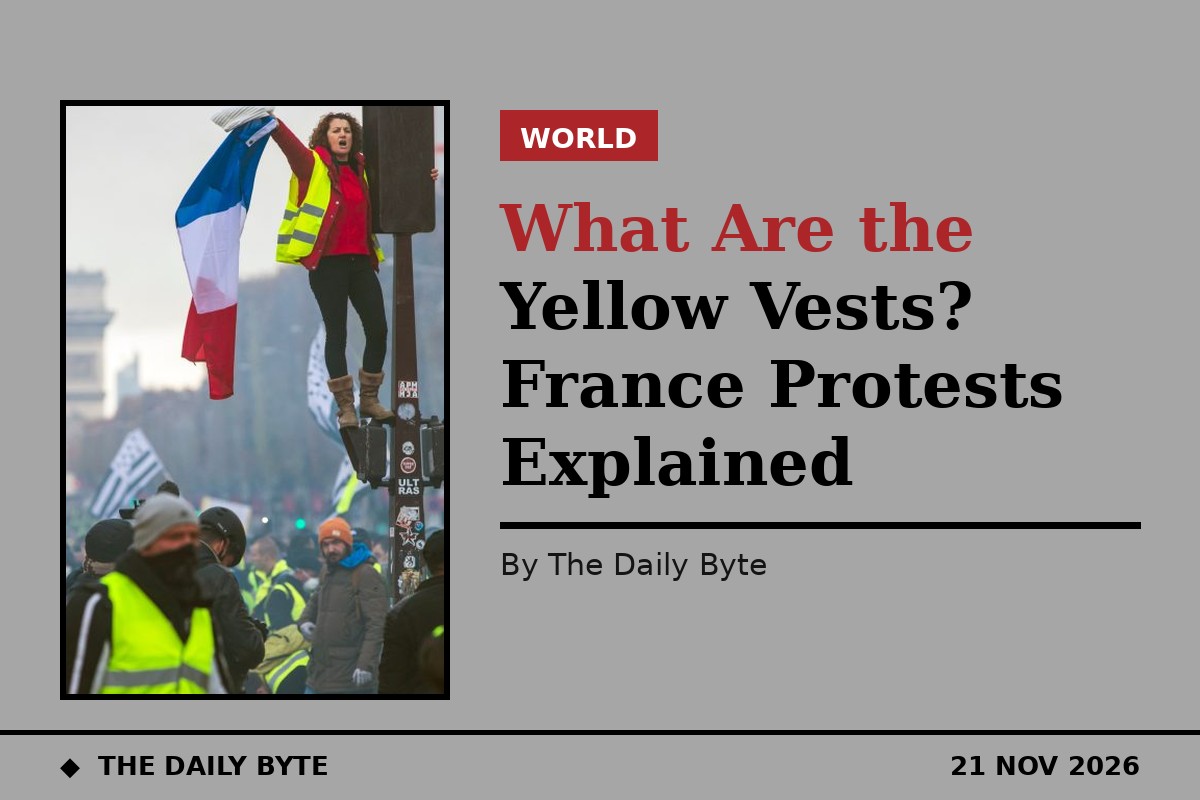
The yellow vests are back on the streets of France. On Saturday 21 November 2026, protesters wearing the bright yellow high-visibility jackets that gave the movement its name are marching in Paris and in towns across the country, marking eight years since the movement first appeared. The Paris march runs from Place de la République to Place de la Nation, and around 70,000 police officers and gendarmes have been deployed across France for the day.
To many people outside France, the yellow vests are a familiar image: crowds in fluorescent jackets filling the Champs-Élysées, roundabouts blocked by protesters, and weekly Saturday demonstrations that once dominated the news. But the movement itself is often misunderstood. It has no leader, no political party and no single programme. It began as a protest about fuel prices and grew into a much wider revolt about the cost of living, wages and who pays tax in France.
This explainer sets out what the yellow vests are, how the movement began in 2018, what it achieved, why it faded, and why it is marching again in November 2026.
What are the yellow vests?
The yellow vests, known in French as the gilets jaunes, are a protest movement that began in France in November 2018. The name comes from the high-visibility yellow safety vests that French law has required all drivers to keep in their vehicles since 2008, to be worn if a driver has to leave the car in an emergency. Protesters adopted the vest because almost everyone in France already owned one, it cost almost nothing, and it was instantly visible on television and in photographs.
The movement is deliberately leaderless. It grew through Facebook groups and online petitions rather than through trade unions or political parties, and it has never had a single spokesperson or a fixed list of demands that everyone agrees on. That informality was part of its strength in 2018, when it mobilised hundreds of thousands of people in a matter of weeks, and part of its weakness later, when it struggled to turn street protests into lasting political change.
The yellow vests are best understood as a movement of people who felt left behind: workers in rural areas and small towns who depend on their cars, people on low and middle incomes who felt that taxes kept rising while public services declined, and pensioners who saw their spending power fall. The vest became a symbol of that shared frustration, worn by people who did not see themselves in any existing party or union.
How did the movement start?
The immediate trigger was a planned increase in fuel taxes. In the autumn of 2018, the French government announced that taxes on diesel and petrol would rise in January 2019 as part of a long-running policy of taxing fossil fuels to fight climate change. Diesel was particularly sensitive. For decades, French governments had encouraged diesel cars with favourable tax treatment, so many households outside the big cities drove diesel vehicles and had no realistic alternative to driving.
The announcement landed on top of years of frustration. An online petition against fuel price rises posted in May 2018 attracted nearly one million signatures. In early December 2018, a survey found that 46 percent of French people said they supported the yellow vests and a further 26 percent said they sympathised with them. A cut in the speed limit on two-lane roads from 90 to 80 kilometres per hour in July 2018 had added to the anger of rural drivers, and the abolition of the solidarity tax on wealth in late 2017 had left many convinced that the government was cutting taxes for the rich while raising them for everyone else.
The first day of action came on Saturday 17 November 2018. Protesters blocked roundabouts, toll plazas and fuel depots across France, and large crowds gathered in Paris. The protests were organised for Saturdays, which became known as acts, and they continued week after week through the winter of 2018 and into 2019. Some demonstrations turned violent, with barricades, smashed shopfronts and clashes with police, and the unrest was described as the most serious in France since the protests of May 1968.
What did the yellow vests want?
At first the demand was simple: cancel the fuel tax rise. But as the movement grew, its demands widened into a broad critique of taxation, wages and democracy. Representatives of the movement sent a list of claims to the government in late November 2018, drawn from a survey of about 30,000 supporters. The list included lower taxes across the board, a return of the solidarity tax on wealth, an increase in the minimum wage, lower fuel and motor taxes, and the creation of a citizens' initiative referendum, which would allow voters to propose and repeal laws directly.
Behind the list was a single complaint: that the burden of taxation in France fell too heavily on working and middle-class households, especially those living outside the big cities, while the wealthy and large companies paid proportionately less. Protesters also demanded better public services, higher pensions, and an end to what they saw as a political system in which ordinary people had no real say between elections.
The demands were never fully unified. Some yellow vests focused on fuel prices and purchasing power. Others wanted deep democratic reform. Some leaned left, some leaned right, and many rejected all parties. That breadth made the movement hard to negotiate with, but it also explains why it drew support from such a wide range of French society.
How did the government respond?
The government first tried to hold its line, then gave ground. On 4 December 2018, Prime Minister Édouard Philippe announced in a nationally televised address that the fuel tax rise due on 1 January would be suspended for six months. The yellow vests rejected the concession as too little and too late, and the protests continued.
On 10 December 2018, President Emmanuel Macron addressed the nation and announced a package of measures. The fuel tax rise was cancelled outright, along with a six-month moratorium on diesel and petrol price changes. The government said the price of the regulated Électricité de France blue tariff would not rise before March 2019, and it removed the tax on overtime pay and end-of-year bonuses while cutting fuel and motor taxes. Macron also launched a national debate, inviting citizens across France to discuss taxes, public spending, democracy and the ecological transition.
The concessions took some of the pressure off, but they did not end the movement. Saturday protests continued through 2019, although in smaller numbers, and the movement's energy gradually shifted from the streets to local groups and online networks. The original wave of weekly Saturday protests ran until the middle of 2020.
Why did the movement matter?
The yellow vests mattered because they changed French politics. They showed that a protest movement could organise itself without unions or parties, using social media alone, and mobilise hundreds of thousands of people. They forced a president who had built his reputation on reform to abandon a flagship tax policy within weeks. And they put the cost of living, and the divide between metropolitan France and the rest of the country, at the centre of political debate for years afterwards.
The movement also left a lasting mark on how France polices protests. The weekly demonstrations produced some of the worst street violence in decades, with injuries among both protesters and police, and the policing of the movement became a political controversy in its own right. The image of the yellow vest, meanwhile, spread beyond France, adopted by protesters in other countries as a symbol of revolt against the cost of living.
For all its impact, the movement never turned itself into a political force. It had no candidates, no party and no agreed programme, and its support faded as the Saturday crowds shrank. By 2020 the yellow vests were a memory for most French people, even though small groups continued to meet and to protest.
Why are the yellow vests back in 2026?
The yellow vests returned in the autumn of 2026 because the grievances that created them never went away. Prices for food and energy have risen, wages have not kept pace, and housing has become harder to afford. In early November 2026, trade unions, housing rights groups and social movements in seven countries, France, Spain, Italy, Greece, Portugal, Belgium and the United Kingdom, launched a coordinated call for action under the slogan People over Profit, with days of action from 17 to 22 November.
The French revival began on Saturday 17 October 2026, and the 21 November march is the sixth Saturday of protests since then, known within the movement as Act VI. The demands echo those of 2018, updated for 2026: lower food and energy prices, higher wages and pensions, better access to housing, and greater protection for public services. The national coordination of the movement called on supporters to mark the eighth anniversary by returning to the roundabouts and toll plazas, wearing their vests, from Friday 20 November to Sunday 22 November.
The scale is smaller than in 2018, but it is still significant. According to Interior Ministry figures, about 106,000 people demonstrated across France on Saturday 14 November, including 24,000 in Paris, compared with 146,000 across the country the previous weekend. The movement has also joined forces with the trade unions this time, marching with them rather than apart from them, which is a change from earlier in the autumn.
What is happening on 21 November 2026?
In Paris, the march on Saturday 21 November 2026 follows a route approved by the police prefecture on Friday 20 November. It sets off at 2pm from Place de la République and proceeds along Boulevard Voltaire to Place de la Nation, through the 3rd, 10th, 11th and 12th arrondissements. The yellow vests gather at 1pm in Place de la République and march at the rear of a united front that also includes the inter-union coalition, youth organisations and the Right to Housing movement.
The yellow vests had proposed their own route, from Place de la Bastille to Place de la Concorde, opposite the National Assembly, but the police prefecture rejected it, as it had rejected a gathering on the Champs-Élysées. The approved route is the only one authorised for the day, and it has been used several times this autumn. Interior Minister Laurent Nuñez told BFMTV that around 70,000 police officers and gendarmes would be deployed across France on Saturday, the same number as the previous weekend.
Eight years after the first Saturday of blockades, the yellow vest is back on the streets because the question it raised has not been answered: who pays for the cost of living, and who decides? The movement that began over a fuel tax has become, in 2026, a test of whether a leaderless protest born on Facebook can still mobilise France, and whether the government that once cancelled a tax rise to calm the streets will listen again.